Flag General Physics> (a) A roller coaster goes up a hill then ...
question mark

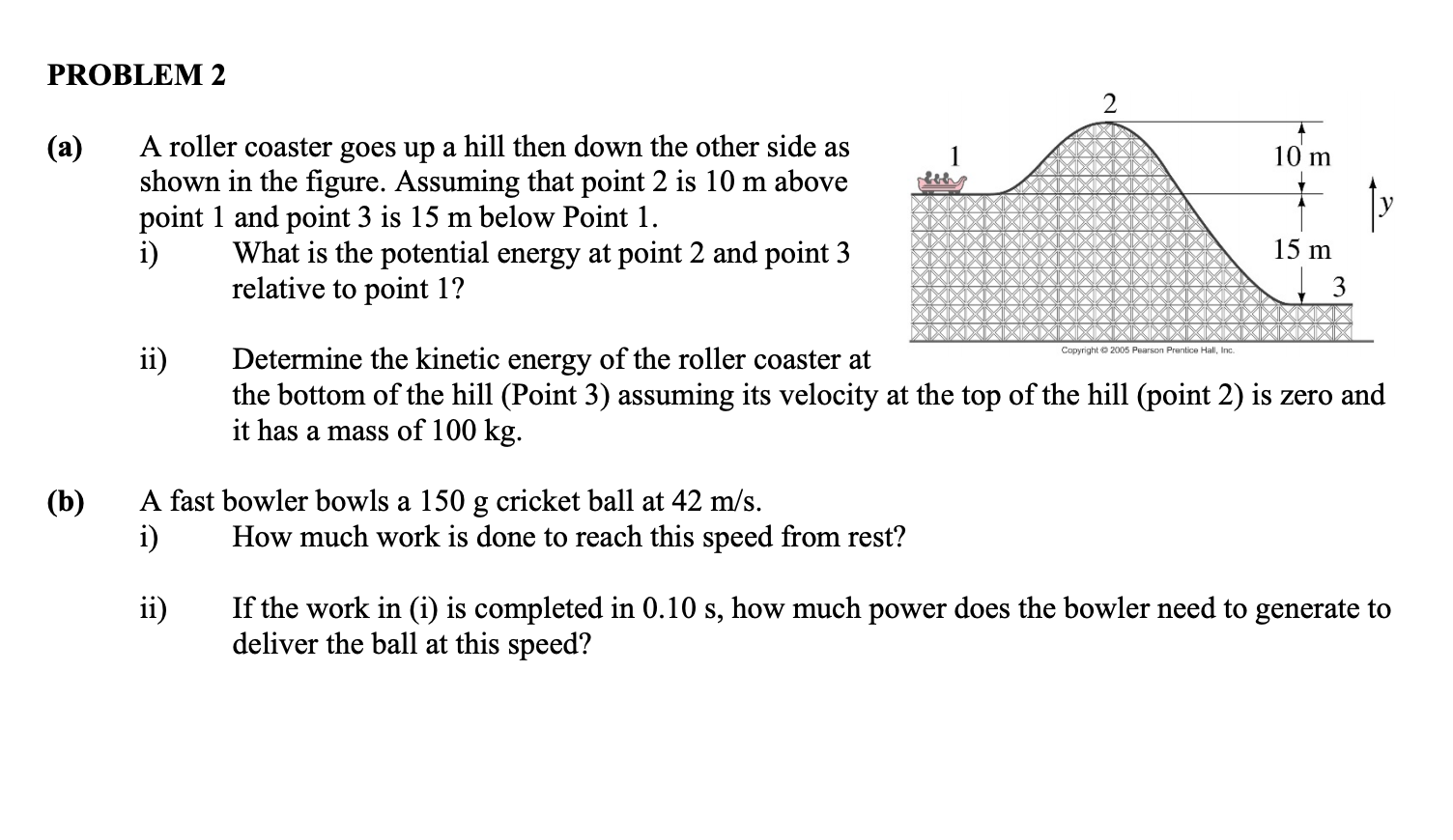
(a) A roller coaster goes up a hill then down the other side as shown in the figure. Assuming that point 2 is 10 m above point 1 and point 3 is 15 m below Point 1. i) What is the potential energy at point 2 and point 3 relative to point 1? ii) Determine the kinetic energy of the roller coaster at the bottom of the hill (Point 3) assuming its velocity at the top of the hill (point 2) is zero and it has a mass of 100 kg. (b) A fast bowler bowls a 150 g cricket ball at 42 m/s. i) How much work is done to reach this speed from rest? ii) If the work in (i) is completed in 0.10 s, how much power does the bowler need to generate to deliver the ball at this speed?
Mayank , 5 Years ago
Grade 12th pass
anser 1 Answers
Askiitians Tutor Team

Let's break down your questions step by step, starting with the roller coaster scenario. We’ll calculate the potential energy at points 2 and 3 relative to point 1, and then determine the kinetic energy at the bottom of the hill. After that, we’ll tackle the cricket ball problem involving work and power.

Potential Energy Calculations

Potential energy (PE) is calculated using the formula:

PE = mgh

Where:

  • m = mass (in kg)
  • g = acceleration due to gravity (approximately 9.81 m/s²)
  • h = height above a reference point (in meters)

i) Potential Energy at Points 2 and 3

Assuming the mass of the roller coaster is 100 kg:

1. **At Point 2** (10 m above Point 1):

Using the formula:

PE2 = mgh = 100 kg * 9.81 m/s² * 10 m = 9810 J

2. **At Point 3** (15 m below Point 1):

Since Point 3 is below Point 1, the height (h) is negative:

PE3 = mgh = 100 kg * 9.81 m/s² * (-15 m) = -14715 J

Kinetic Energy at the Bottom of the Hill

ii) Kinetic Energy at Point 3

At the bottom of the hill (Point 3), we can use the principle of conservation of energy. The total mechanical energy at Point 2 (potential energy) will convert into kinetic energy (KE) at Point 3, assuming no energy losses:

KE = PE2 - PE3

KE = 9810 J - (-14715 J) = 9810 J + 14715 J = 24525 J

Cricket Ball Work and Power Calculations

Now, let’s move on to the cricket ball scenario. We’ll calculate the work done to accelerate the ball and then find the power generated.

i) Work Done to Reach Speed

Work (W) is calculated using the formula:

W = ΔKE

Where ΔKE is the change in kinetic energy, given by:

KE = 0.5 * m * v²

1. **Initial Kinetic Energy (at rest)**:

KEinitial = 0 (since the ball starts from rest)

2. **Final Kinetic Energy (at 42 m/s)**:

KEfinal = 0.5 * 0.150 kg * (42 m/s)² = 0.5 * 0.150 * 1764 = 132.3 J

Thus, the work done to reach this speed is:

W = KEfinal - KEinitial = 132.3 J - 0 = 132.3 J

ii) Power Required to Deliver the Ball

Power (P) is calculated using the formula:

P = W / t

Where:

  • W = work done (in joules)
  • t = time taken (in seconds)

Given that the work done is 132.3 J and the time taken is 0.10 s:

P = 132.3 J / 0.10 s = 1323 W

In summary, we found:

  • Potential Energy at Point 2: 9810 J
  • Potential Energy at Point 3: -14715 J
  • Kinetic Energy at Point 3: 24525 J
  • Work done on the cricket ball: 132.3 J
  • Power generated by the bowler: 1323 W

This breakdown illustrates how energy transformations occur in both scenarios, showcasing the principles of physics in action. If you have any further questions or need clarification on any part, feel free to ask!

ApprovedApproved
Last Activity: 8 Months ago
star
LIVE ONLINE CLASSES

Prepraring for the competition made easy just by live online class.

tv

Full Live Access

material

Study Material

removal

Live Doubts Solving

assignment

Daily Class Assignments