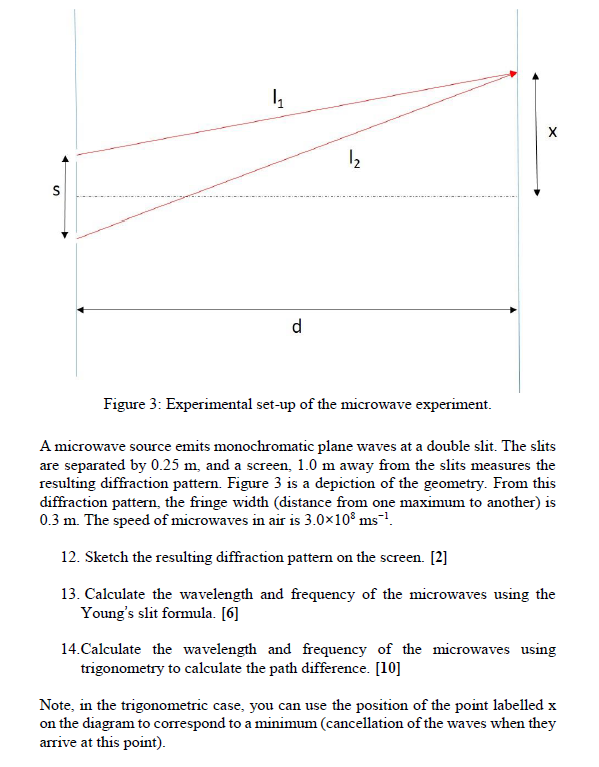
To analyze the diffraction pattern produced by the double slit, we can use the principles of wave interference. The key parameters you've provided will help us calculate the wavelength of the microwaves and understand the relationship between the slit separation, the distance to the screen, and the fringe width.
Understanding the Setup
In this scenario, we have a double slit experiment where monochromatic plane waves from a microwave source pass through two closely spaced slits. The slits are separated by a distance \(d = 0.25 \, \text{m}\), and the screen where the diffraction pattern is observed is located \(L = 1.0 \, \text{m}\) away from the slits. The fringe width, which is the distance between adjacent bright fringes, is given as \(w = 0.3 \, \text{m}\).
Key Formula for Fringe Width
The fringe width in a double slit experiment can be calculated using the formula:
w = \frac{\lambda L}{d}
Where:
- w = fringe width
- \(\lambda\) = wavelength of the microwaves
- L = distance from the slits to the screen
- d = distance between the slits
Calculating the Wavelength
We can rearrange the formula to solve for the wavelength \(\lambda\):
\(\lambda = \frac{w \cdot d}{L}\)
Now, substituting the values:
- w = 0.3 m
- d = 0.25 m
- L = 1.0 m
Plugging in these values:
\(\lambda = \frac{0.3 \, \text{m} \cdot 0.25 \, \text{m}}{1.0 \, \text{m}} = 0.075 \, \text{m}\)
Interpreting the Wavelength
The calculated wavelength of the microwaves is \(0.075 \, \text{m}\) or \(75 \, \text{mm}\). This wavelength is typical for microwaves, which fall within the electromagnetic spectrum between radio waves and infrared radiation.
Understanding the Diffraction Pattern
The diffraction pattern observed on the screen consists of alternating bright and dark fringes. The bright fringes occur where the waves from the two slits arrive in phase, reinforcing each other, while the dark fringes occur where the waves arrive out of phase, canceling each other out.
Practical Implications
This experiment not only demonstrates the wave nature of microwaves but also illustrates fundamental concepts in physics such as interference and diffraction. The ability to calculate the wavelength using simple measurements of fringe width and slit separation is a powerful tool in experimental physics.
In summary, by applying the principles of wave interference and using the provided measurements, we determined that the wavelength of the microwaves is \(0.075 \, \text{m}\). This understanding is crucial for further studies in wave optics and related fields.