The equation cos(9x)=0 has roots x=(2n+1)π/18 for n=0,1,2….17 … (i)
But cos(9x) = cos⁹x*{ 9C0 – 9C2*t² + 9C4*t⁴ − 9C6*t⁶ + 9C8*t⁸ } (t=tanx, see end)
So either cosx=0 or 9C0 – 9C2*t² + 9C4*t⁴ − 9C6*t⁶ + 9C8*t⁸ = 0
From (i) n=4,13 solve cos(x)=0 and using tan(180−x)=−tan(x) gives
±tan(10), ±tan(30), ±tan(50), ±tan(70) as solutions of the octic.
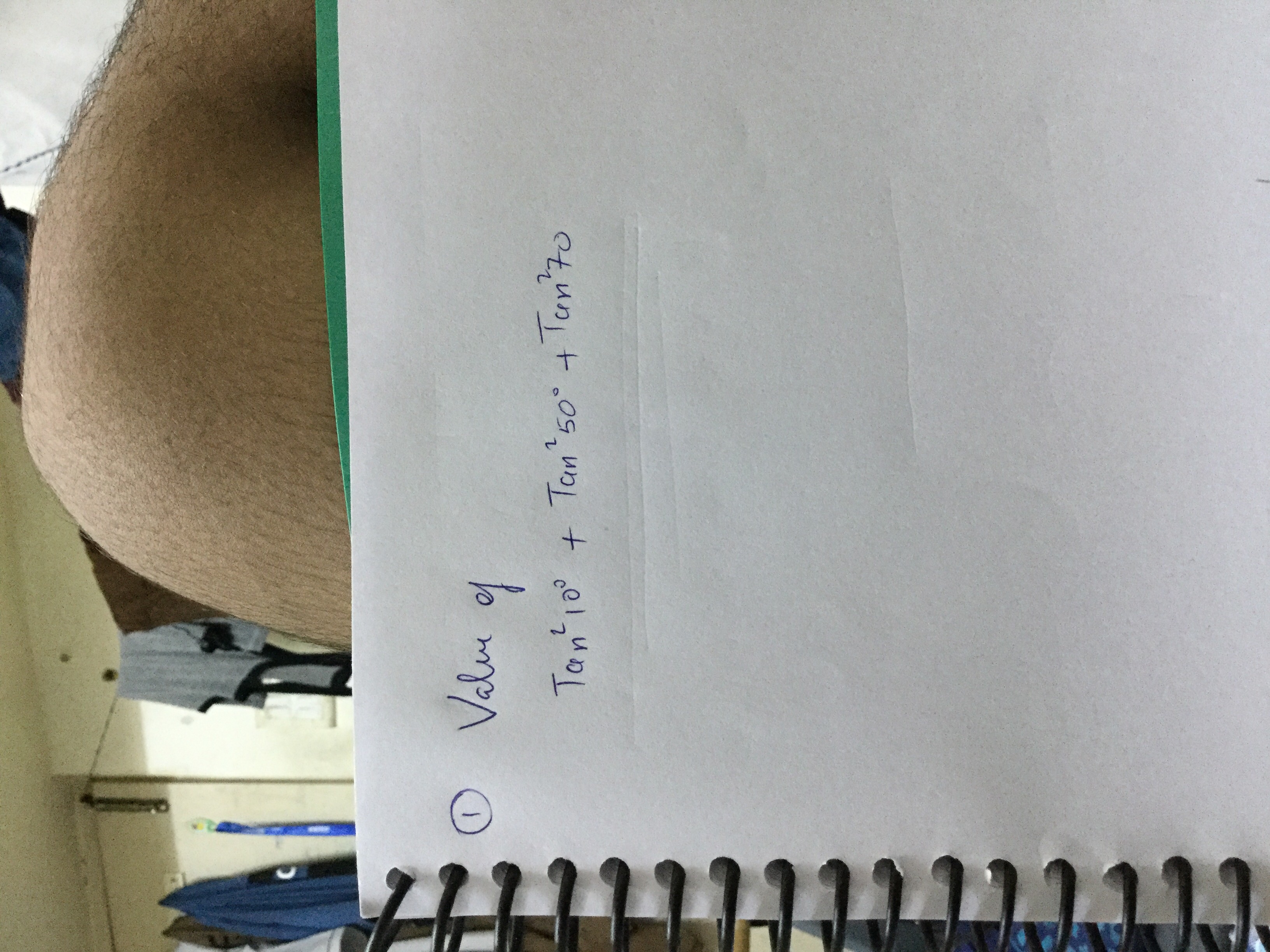
Further setting z=t² gives tan²(10), tan²(30), tan²(50), tan²(70) as the solutions of
9C0 – 9C2*z + 9C4*z² − 9C6*z³ + 9C8*z⁴ = 0
By root properties tan²(10)+tan²(30)+tan²(50)+tan²(70) = 9C6/9C8 = 84/9
But tan²(30) = (1/√3)² = ⅓ and so tan²(10)+tan²(50)+tan²(70) = 9
You can also get from the same equation …
tan(10)*tan(50)*tan(70) = sqrt( (9C0/9C8) ) / tan(30) = 1/√3
cot²(10)+cot²(50)+cot²(70) = 9C2/9C0 – cot²(30) = 33
……………………………….
cos(9x)+isin(9x) = (cosx+isinx)⁹ = ∑ (r=0,9) 9Cr*cos^(9-r)x*(isinx)^r
= cos⁹x * ∑ (r=0,9) 9Cr*(itanx)^r
Equating real parts : cos(9x) = cos⁹x * { 9C0 – 9C2*t² + 9C4*t⁴ − 9C6*t⁶ + 9C8*t⁸ }
Where t=tanx