HELLO THERE!
First of all, let me tell you that a carbocation is stabilized by +I effect, or if Lone pair is donated. Also, a carbocation is destabilized by -I effect.
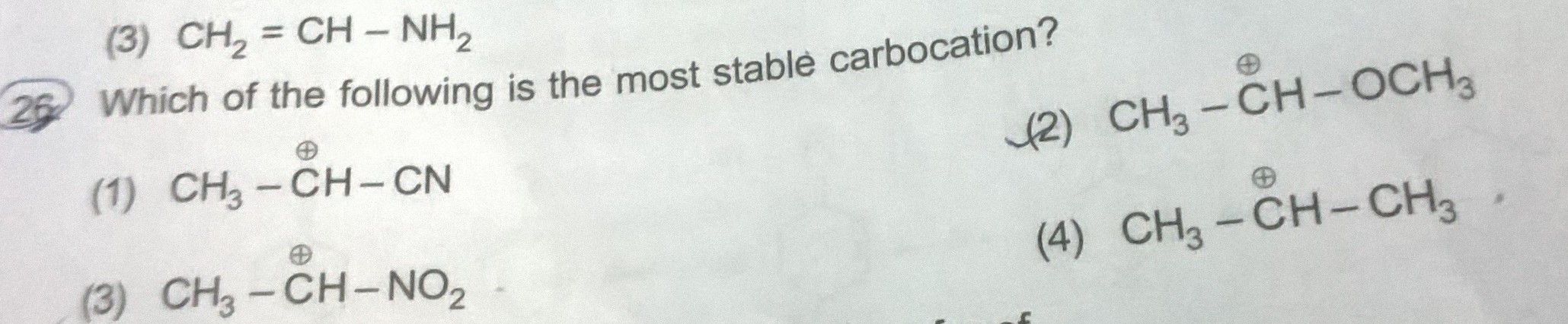
Hence, carbocations in Options (1) and (3) are highly unstable because NO2 and CN show -I effect, thus destabilizing the carbocation.
Thus, we got two options eliminated.
The competition is now between Options (2) and (4).
In Option (4), we see two alkyl groups are attached, which have +I effect. Hence, the secondary carbocation in Option (4) is stable.
However, in Option (3), we have a methoxy group attached to the positively charged carbon. The O atom of the methoxy group has two lone pair electrons. This lone pair electron is in resonance and hence the positive charge is distributed over the system, and resonance-stabilized carbocations are more stable.
So, your answer is Option (2).
Thanks!