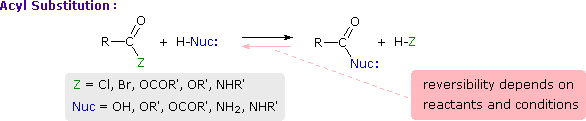
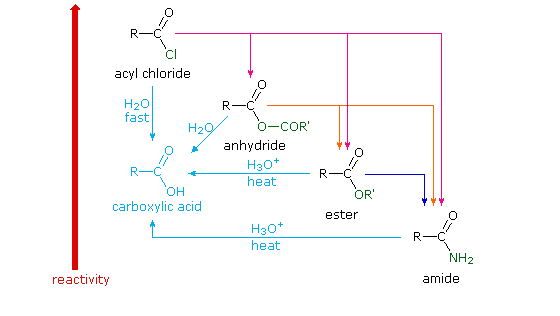
> Carboxylic acids and their derivatives
1) Decarboxylation reaction (WITH SODA-LIME OF b-keto carboxylic acid)
2) Arndt-Eistert rxn (mechanism, reference O.P Tendon-organic chemistry, rxn is for higher homologues of the acids)
3) Hunsdiecker rxn (bromo-becarboxylation, mechanisms)
4) rxn of acyl chloride with ammonia and amines(refer eg.benzoyl chloride + piperidine à N-Benzoylpiperidine)
5)Base hydrolysis of the ester (BAC2; when ethyl propanoate labeled with 18O in the ether type of oxygen of the ester is subjected to hydrolysis with aq.NaOH all of the 18O shows up in ethanol that is produced,none of the 18O appears in propanoate ions.why?; why here the attack at alkyl carbon not observed?)
6) In acid anhydrides,under heating effects of hydroxy acids,why b-hydroxy acid only forms a,b-unsaturated acid while other form(a,g,d) cyclic structures?
7) Why Clemmensen reduction is not used for compounds which have acid sensitive group, how to identify them?
Similiarly, with Wolff-kishner reduction, we neglect base sensitive groups?
8) When to see for chair form or boat form of 6 membered ring & why is chair form less stable than boat form?
9) Please explain with mechanism of E1 reaction of alcohols, ethers; E2 reaction of alkyl halide. Some problem on ring expansion when to see for that? What are the necessary conditions for ring expansions? And why only E1 shows this effect while E2 doesn’t?
Ø amines
10) Curtius rearrangements (mechanism with explanation)
11) Schmidt rxn (mechanism involved)
12) Lossen rearrangement {reference Morrison boyld} (base catalyzed mechanism; its mechanism)
13) Hinsberg rxn (explain with example in the chapter from module)
14) Dieckmanns’ condensation (mechanism with a suitable example)
> Carboxylic acids and their derivatives
1) Decarboxylation reaction (WITH SODA-LIME OF b-keto carboxylic acid)
2) Arndt-Eistert rxn (mechanism, reference O.P Tendon-organic chemistry, rxn is for higher homologues of the acids)
3) Hunsdiecker rxn (bromo-becarboxylation, mechanisms)
4) rxn of acyl chloride with ammonia and amines(refer eg.benzoyl chloride + piperidine à N-Benzoylpiperidine)
5)Base hydrolysis of the ester (BAC2; when ethyl propanoate labeled with 18O in the ether type of oxygen of the ester is subjected to hydrolysis with aq.NaOH all of the 18O shows up in ethanol that is produced,none of the 18O appears in propanoate ions.why?; why here the attack at alkyl carbon not observed?)
6) In acid anhydrides,under heating effects of hydroxy acids,why b-hydroxy acid only forms a,b-unsaturated acid while other form(a,g,d) cyclic structures?
7) Why Clemmensen reduction is not used for compounds which have acid sensitive group, how to identify them?
Similiarly, with Wolff-kishner reduction, we neglect base sensitive groups?
8) When to see for chair form or boat form of 6 membered ring & why is chair form less stable than boat form?
9) Please explain with mechanism of E1 reaction of alcohols, ethers; E2 reaction of alkyl halide. Some problem on ring expansion when to see for that? What are the necessary conditions for ring expansions? And why only E1 shows this effect while E2 doesn’t?
Ø amines
10) Curtius rearrangements (mechanism with explanation)
11) Schmidt rxn (mechanism involved)
12) Lossen rearrangement {reference Morrison boyld} (base catalyzed mechanism; its mechanism)
13) Hinsberg rxn (explain with example in the chapter from module)
14) Dieckmanns’ condensation (mechanism with a suitable example)