(a)
The block moves down the inclined plane with constant speed, therefore kinetic force of friction is equal to the component of its weight along the length of inclined plane, that is
fk = mg sin θ
Here m is the mass of the block, and g is the acceleration due to gravity.
The frictional force is also given as
The acceleration experienced by the block when it is projected upwards is:

It has been calculated above that the coefficient of kinetic friction is μ
k = tan θ . Substitute the same in the equation above,

Therefore the block decelerates at a = - 2g sin θ (negative sign accounts for the fact that the block slows down).
The time taken by the block to come at rest is:

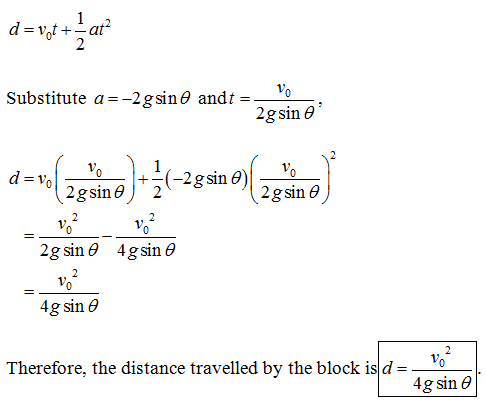
Also, the distance travelled by the block is:
(b)
The coefficient of static friction is always greater than the coefficient of kinetic friction, therefore if the block stopped once in its journey it will not going to move again unless the force accelerating the block has a magnitude greater than static force of friction.


