
Bragg`s law

sakshi jain , 11 Years ago
Grade
 Inorganic Chemistry> Bragg`s law...
 4 Answers
Last Activity: 11 Years ago
Last Activity: 11 Years ago
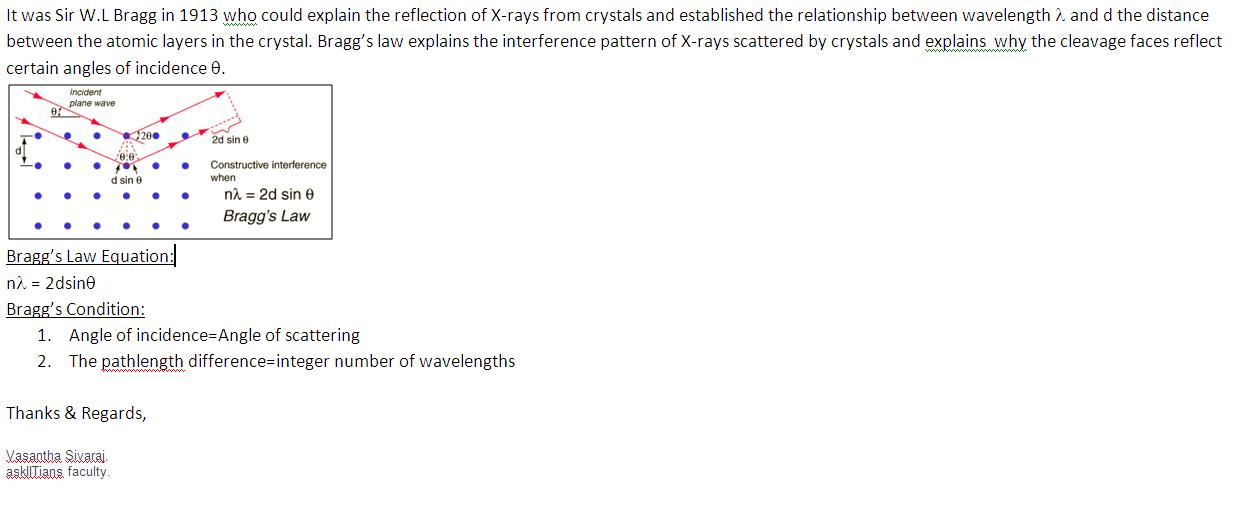
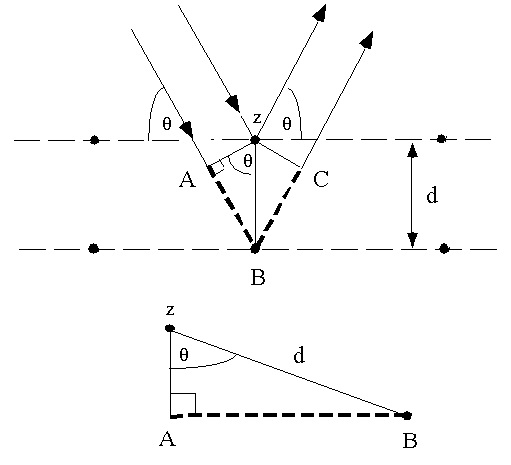
Bragg's Law refers to the simple equation:
derived by the English physicists Sir W.H. Bragg and his son Sir W.L. Bragg in 1913 to explain why the cleavage faces of crystals appear to reflect X-ray beams at certain angles of incidence (T, ?). The variable d is the distance between atomic layers in a crystal, and the variable lambda is the wavelength of the incident X-ray beam (see applet); n is an integer.n? = 2d sinT

Last Activity: 11 Years ago
Last Activity: 11 Years ago

Prepraring for the competition made easy just by live online class.

Full Live Access

Study Material

Live Doubts Solving

Daily Class Assignments

Last Activity: 3 Years ago
Last Activity: 3 Years ago
Last Activity: 3 Years ago
Last Activity: 3 Years ago