Question icon
Grade 12Analytical Geometry

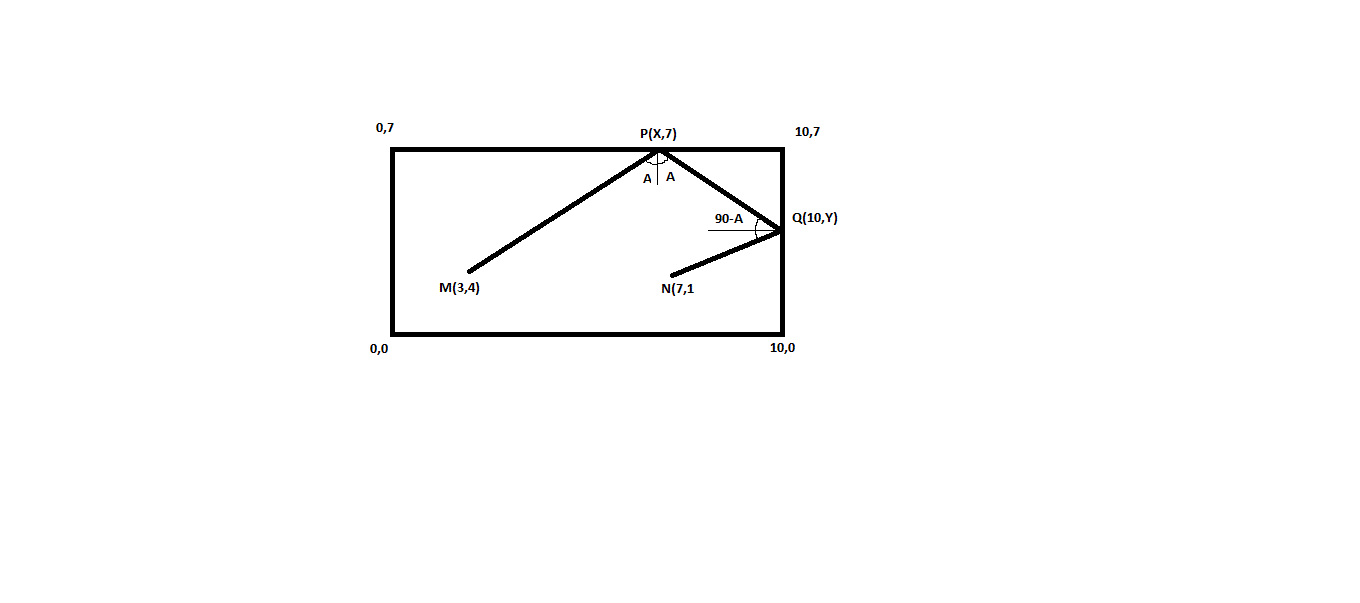
a rectangular billiard table has vertices at p(0,0), q(0,7) ,r(10,7)&s(10,0) . a small billiard ball starts at m(3,4) & moves in astraight line to the top of the table, bounces to the right of the table, then comes to rest at n(7,1) .what is the y-cordinate of the point where ball hits the right side of table?

Profile image of ffggfg hkjj
15 Years agoGrade 12
Answers icon

2 Answers

Profile image of AJIT AskiitiansExpert-IITD
15 Years ago

Dear ffggfg hkjj,


1953_21440_RRR.gif

I guess the above figure is what is meant by the question, We will apply the laws of reflection at the strike points of the ball. So the angle at which the ball is reflected after the first strike is equal to angle at which it had striked i.e A .

slopes:

PM : tan(90-A) = 3/x-3   or cot A =  3/x-3  -----------------------1

PQ: tan(-(90-A)) = y-7/10-x  or -Cot A = y-7/10-x-------------------2

QN: tan(90-A) = y-1/3 or cot A = y-1/3----------------------------3

divide 1 by 2 and 1 by 3

we get

10x-30 = xy-3y +21

x+ 9  = xy-3y +3

solving we get

x= 19/3 and y = 37/10


Please feel free to ask your queries here. We are all IITians and here to help you in your IIT JEE preparation.

All the best.

Win exciting gifts by answering the questions on Discussion Forum. So help discuss any query on askiitians forum and become an Elite Expert League askiitian.

Now you score 5+15 POINTS by uploading your Pic and Downloading the Askiitians Toolbar  respectively : Click here to download the toolbar..

Askiitians Expert

Ajit Singh Verma IITD

Profile image of Karanveer
7 Years ago
Answer is π/6
 
Step by Step Explanation :
Equation of given hyperbola can be written as 
\frac{x^{2}}{1/4} + \frac{y^{2}}{1/9} = 1
So
a^{2} = 1/4
a= 1/2
Similarly b= 1/3
General point on ellipse (1/2 \sec \theta,1/3 \tan \theta)
Using T=0 on ellipse
 
We get
4px-9qy = 1
Where (p,q) is point of contact
Since it's equation of tangent, so by comparing this with given equation of tangent
4x-3y = \sqrt{3}
We get p= 1/\sqrt{3}
 
And q = 1/3\sqrt{3}
Since p = 1/2\sec \theta
1/2\sec \theta = 1/\sqrt{3}
sec\theta = 2/\sqrt{3}
So \Theta = π/6 π/6
Hope it helps.