The First Law of Thermodynamics:-
The first law of thermodynamics states that, ” If the quantity of heat supplied to a system is capable of doing work, then the quantity of heat absorbed by the system is equal to the sum of the increase in the internal energy of the system, and the external work done by it.”
Mathematical Expression of First Law:-
Consider some gas enclosed in a barrel having insulating walls and conducting bottom. Let an amount of heat ‘Q’ be added to the system through the bottom. If ‘U1’ is the initial energy of the system, then,
Total energy of the system in the beginning = U1+Q
After gaining heat the gas tends to expand, pushing the piston from A to B as shown in below figure. As a result of this, some work ‘W’ is done by the gas. The work is external work, since the system undergoes a displacement. If ‘U2’ is final internal energy of the system, then,
.jpg "Heating a gas at constant pressure")
Total energy of the system at end = U2+W
In accordance to the law of conservation of energy, total energy of the system in the beginning will be equal to total energy of the system at end.
So, U1+Q = U2+W
It may be noted that ‘U1’, ‘U2’,‘Q’ and ‘W’ all are being taken in same units.
So, Q = (U2 – U1) + W
When infinitesimal amount of heat ‘dQ’ is added to the system, corresponding changes in internal energy ‘dQ’ and external work done ‘dW’ are so small.
Then, dQ = dU + dW
Or, dQ = dU+ pdV
This is mathematical statement of the first law of thermodynamics.
Therefore, first law of thermodynamics signifies that, “energy can neither be created nor destroyed, but it can only be transformed from one form to another”.
Thus, dQ= dU+dW
If work is done by the surroundings on the system (as during the compression of a gas), W is taken as positive so that dQ = dU+W. if however work is done by the system on the surroundings (as during the expansion of a gas), W is taken as negative so that dQ = dU – dW.
Refer This Video:-
Problem 1:-
Consider that 214 J of work done on a system, and 293 J of heat are extracted from the system. In the sense of the first law of thermodynamics, what are the values (including algebraic signs) of (a) W, (b) Q, and (c) ?En?
Concept:-
For a thermodynamic system, in which internal energy is the only type of energy the system may have, the law of conservation of energy may be expressed as
Q + W = ΔEint
Here Q is the energy transferred (as heat) between the system and environment, W is the work done on (or by) the system and ΔEint is the change in the internal energy of the system.
By convention we have chosen Q to be positive when heat is transferred into the system and W to be positive when work is done on the system.
Solution:-
(a) Since work is done on the system, therefore algebraic sign of the work done will be positive and the magnitude of work done is 214 J.
Thus, W = +214 J.
Thus, Q = -293 J.
ΔEint = Q + W
= (-293 J) + (+214 J)
= -79.0 J
From the above observation we conclude that, the internal energy of the system would be -79.0 J.
Problem 2: 1 mole of ideal monoatomic gas at 27°C expands adiabatically against a constant external pressure of 1.5 atm from a volume of 4dm3 to 16 dm3.
Calculate (i) q (ii) w and (iii) ΔU
Solution:- (i) Since process is adiabatic q = 0
(ii) As the gas expands against the constant external pressure.
W = –PΔV = –1.6(V2–V1)
= –1.5 (16–4) = –18 atm dm3
(iii) ΔU = q + w = 0 + (–18) = –18 atm dm3
Problem 3:
A thermometer of mass 0.055 kg and heat capacity 46.1 J/K reads 15.0° C. It is then completely immersed in 0.300 kg of water and it comes to the same final temperature as the water. If the thermometer reads 44.4° C,what was the temperature of the water before insertion of the thermometer, neglecting other heat losses?
Concept:-
In accordance to the law of conservation of energy, for a thermodynamic system, in which internal is the only type of energy the system may have, the law of conservation of energy may be expressed as,
Q + W = ΔEint
Here Q is the energy transferred between the system and its environment, W is the work done on or by the system and ΔEint is the change in the internal energy of the system.
The heat capacity C of a body as the ratio of amount of heat energy Q transferred to a body in any process to its corresponding temperature change ΔT.
C = Q/ΔT
So, Q = C ΔT
The heat capacity per unit mass of a body, called specific heat capacity or usually just specific heat, is characteristic of the material of which the body is composed.
c = C/m
= Q/mΔT
So, Q = c mΔT
Solution:-
The heat transfers for the water Qw is,
Qw = mwcw (Tf –Ti)
Here, mass of water is mw, specific heat capacity of water is cw, final temperature is Tf and initial temperature is Ti.
The heat transfers for the thermometer Qt is
Qt = CtΔTt
Here, heat capacity of thermometer is Ct and ΔTt is the temperature difference.
As the internal energy of the system is zero and there is no work is done, therefore substitute ΔEint = 0 and W = 0 in the equation Q + W = ΔEint,
Q + W = ΔEint
Q + 0= 0
So, Q = 0
Or, Qw + Qt = 0
mwcw (Tf –Ti)+ CtΔTt = 0
So, Ti = (mwcw Tf + CtΔTt )/ mwcw
Here ΔTt = 44.4 ° C - 15.0 ° C
= 29.4 ° C
To obtain the temperature of the water before insertion Ti of the thermometer, substitute 0.3 kg for mw, 4190 J/kg.m for cw, 44.4 ° C for Tf, 46.1 J/K for Ct and 29.4 ° C for ΔTt in the equation Ti = (mwcw Tf + CtΔTt )/ mwcw,
Ti = (mwcw Tf + CtΔTt )/ mwcw
= [(0.3 kg) (4190 J/kg.m) (44.4 ° C) + (46.1 J/K) (29.4 ° C)] /[(0.3 kg) (4190 J/kg.m)]
=45.5 ° C
From the above observation we conclude that, the temperature of the water before insertion of the thermometer was 45.5 ° C.
Problem 4:-
Air that occupies 0.142 m3 at 103 kPa gauge pressure is expanded isothermally to zero gauge pressure and then cooled at constant pressure until it reaches its initial volume. Compute the work done on the gas.
Concept:-
In an isothermal process the work done W1 is defined as,
W1 = -nRT ln V2/V1
As from ideal gas equation, p1V1 = p2V2 = nRT, thus
W1 = -nRT ln V2/V1
= - p1V1 ln p1/p2
Here n is the number of moles, R is the gas constant, T is the temperature, V1 is the initial volume, V2 is the final volume, p1 is the initial pressure and p2 is the final pressure.
The work done W2 at constant pressure,
W2 = -p2ΔV
= -p2(V1-V2) (Since, ΔV = V1-V2)
= -p2 V1 (1-p1/p2)
= V1 (p1-p2)
Solution:-
The total work done W on the gas will be equal to the sum of work done W1 by isothermal process and work done W2 at constant pressure during cooling.
So, W = W1 + W2
= (- p1V1 ln p1/p2) + (V1 (p1-p2))
To find out the work done W on the gas, substitute 204×103 Pa for p1, 0.142 m3 for V1, 101×103 Pa for p2 in the equation W = (- p1V1 ln p1/p2) + (V1 (p1-p2)),
W = (- p1V1 ln p1/p2) + (V1 (p1-p2))
= [-(204×103 Pa) (0.142 m3) ln (204×103 Pa)/( 101×103 Pa) ] + [(0.142 m3) ((204×103 Pa) - (101×103 Pa))]
= -5.74×10³ Pa. m3
= (-5.74×10³ Pa. m3) (1 J/1 Pa.m3)
= -5.74×10³ J
From the above observation we conclude that, work done W on the gas would be -5.74×10³ J.
Problem 5:-
Calculate the work done by an external agent in compressing 1.12 mol of oxygen from a volume of 22.4 L and 1.32 atm pressure to 15.3 L at the same temperature.
Concept:-
In an isothermal process the work done by an external agent in compressing gas from its initial volume (Vi = V1 ) to its final volume (Vf = V2) is,
W = -nRT ln Vf / Vi
= -nRT ln V2/ V1 …… (1)
In accordance to ideal gas equation,
PV = nRT …… (2)
Here P is the pressure of the gas, V is the volume of the gas, n is the number of moles, r is the gas constant and T is the temperature of the gas.
At constant temperature if the gas compress from its initial pressure P1, intial volume V1 to its final pressure P2, final volume V2, then
P1 V1 = P2 V2 = nRT …… (3)
To find work W in terms of P1 and V1, substitute P1 V1 for nRT in the equation W = -nRT ln V2 / V1 ,
W = -nRT ln V2/ V1
= -P1 V1 ln V2/ V1
Solution:-
To obtain work done, substitute 1.32 atm for pressure P1, 22.4 L for initial volume V1 and 15.3 L for initial volume V2 in the equation W = -P1 V1 ln V2/ V1,
W = -P1 V1 ln V2/ V1
= -(1.32 atm) (1.01×10⁵ Pa / 1 atm) (22.4 L) (10-3 m3 / 1 L) ln ((15.3 L) (10-3 m3/1 L) /(22.4 L) (10-3 m3 / 1 L))
= 1.14×10³ Pa. m3
= (1.14×10³ Pa. m3) ( 1 J/1 Pa. m3)
= 1.14×10³ J
From the above observation we conclude that, the work done by an external agent in compressing the oxygen molecule would be 1.14×10³ J.
Problem 6:-
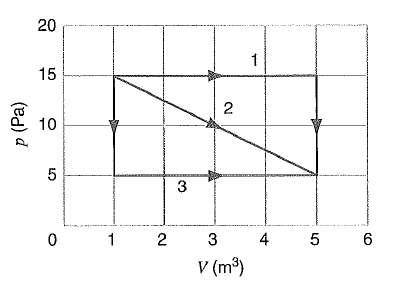
A sample of gas expands from 1.0 to 5.0 m3 while its pressure decreases from 15 to 5.0 Pa. How much work is done on the gas if its pressure changes with volume according to each of the three processes shown in the pV diagram in below figure.
Concept:-
Work is a path function. So work done on the gas depends upon the path. The area under pv diagram gives the work done on the gas between initial state i and final state f.
Work done W is defined as,
W = -pdV
Here p is the pressure and dV is the change in volume.
Solution:-
(a) In the process 1, the work done W1 will be zero for vertical path.
So W1 = 0 J
The work done is present only in horizontal path.
Thus the work done W2 for horizontal path will be,
W2= -pdV (negative sign is due to work is done on the gas
= - (15 Pa) (4m3)
= -60 Pa.m3
= (-60 Pa.m3) (1 J/1 Pa.m3)
= -60 J
Therefore the net work done W on the gas will be,
W = W1 + W2
= 0 J+(-60 J)
= -60 J
From the above observation we conclude that, the net work done on the gas would be -60 J.
(b) For the process 2, work done is negative of the area under the curve.
So the area A under the curve for process 2 will be,
A = ½ (15 Pa+5 Pa) (4m3)
= 40 Pa.m3
= (40 Pa.m3) (1 J/1 Pa.m3)
= 40 J
As for the process 2, work done is negative of the area under the curve; therefore the net work done on the gas will be -40 J.
(c) In the process 3, the work done W3 will be zero for vertical path.
So W3 = 0 J
The work done is present only in horizontal path.
Thus the work done W4 for horizontal path will be,
W4= -pdV (negative sign is due to work is done on the gas)
= - (5 Pa) (4m3)
= -20 Pa.m3
= (-20 Pa.m3) (1 J/1 Pa.m3)
= -20 J
Therefore the net work done W on the gas will be,
W = W3 + W4
= 0 J+(-20 J)
= -20 J
From the above observation we conclude that, the net work done on the gas would be -20 J.
Related Resources: You might like to refer some of the related resources listed below:
- Click here for the Detailed Syllabus of IIT JEE Physics.
- Look into the Sample Papers of Previous Years to get a hint of the kinds of questions asked in the exam.
- You can get the knowledge of Useful Books of Physics.
View courses by askIITians


Design classes One-on-One in your own way with Top IITians/Medical Professionals
Click Here Know More

Complete Self Study Package designed by Industry Leading Experts
Click Here Know More

Live 1-1 coding classes to unleash the Creator in your Child
Click Here Know More