Solved Examples on Thermodynamics:-
Problem 1:-
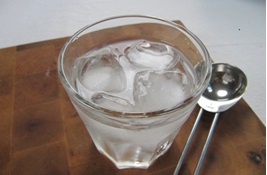
 A mixture of 1.78 kg of water and 262 g of ice at 0ºC is, in a reversible process, brought to a final equilibrium state where the water/ice ratio, by mass is 1:1 at 0ºC, (a) Calculate the entropy change of the system during this process. (b) The system is then returned to the first equilibrium state, but in an irreversible way (by using a Bunsen burner, for instance). Calculate the entropy change of the system during this process. (c) Show that your answer is consistent with the second law of thermodynamics.
Concept:-
The entropy change ΔS for a reversible isothermal process is defined as,
ΔS = Q/T
= -mL/T
Here m is the mass, L is the latent heat and T is the temperature.
Solution:-
(a) Mass of water = 1.78 kg
Mass of ice = 262 g
So the total mass of ice and water mixture will be,
Mass of ice-water mixture = (Mass of water) + (Mass of ice)
= (1.78 kg) + (262 g) = (1.78 kg) + (262 g×10-3 kg/1 g)
= 1.78 kg + 0.262 kg = 2.04 kg
If eventually the ice and water have the same mass, then the final state will have 1.02 kg (2.04 kg/2) of each.
Thus the mass of the water that changed into ice m will be the difference of mass of water mw and mass of final state ms.
So, m = mw - ms
To obtain mass of water that changed into ice m, substitute 1.78 kg for mass of water mw and 1.02 kg for mass of final state ms in the equation m = mw - ms,
m = mw - ms
= 1.78 kg – 1.02 kg
= 0.76 kg
The change of water at 0° C to ice at 0° C is isothermal.
To obtain the change in entropy ΔS of the system during this process, substitute 0.76 kg for mass m, 333×103 J/kg for heat of fusion of water L and 273 K for T in the equation ΔS = -mL/T,
ΔS = -mL/T
= -(0.76 kg) (333×103 J/kg )/(273 K)
= -927 J/K
From the above observation we conclude that, the change in entropy ΔS of the system during this process will be -927 J/K.
So, ΔS = -(- 927 J/K)
= 927 J/K
From the above observation we conclude that, the change in entropy ΔS of the system would be 927 J/K.
The total change in entropy will be,
ΔS = (-927 J/K) + (927 J/K) = 0
From the above observation we conclude that, our answer is consistent with the second law of thermodynamics.
__________________________________________________________________________
Problem 2:-
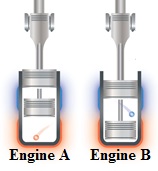
Engine A, compared to engine B, produces, per cycle, five times the work but receives three times the heat input and exhausts out twice the heat. Determine the efficiency of each engine.
Concept:-
Work done in an engine is equal to the difference of input heat and output heat.
Efficiency εA of engine A is equal to,
εA = WA/ Qi,A
Here, WA is the work done by engine A and Qi,A is the input heat of engine A.
Efficiency εB of engine B is equal to,
εB = WB/ Qi,B
Here, WB is the work done by engine B and Qi,B is the input heat of engine B.
Solution:-
Let work done by the engine B is WB. Since the engine A produces, per cycle, five times the work of B, so the work done WA by the engine A will be,
WA = 5 WB
Let heat input of engine B is Qi,B. Since engine A receives three times heat input of B, so the heat input Qi,A of engine A will be,
Qi,A = 3 Qi,B
Let heat output of engine B is Qo,B. Since engine A exhausts two times heat output of B, so the heat input Qo,A of engine A will be,
Qo,A = 2 Qo,B
Work done in an engine is equal to the difference of input heat and output heat.
So, WA = Qi,A - Qo,A
and
WB = Qi,B - Qo,B
Qo,B = Qi,B -WB
Substitute 5 WB for WA, 3 Qi,B for Qi,A and 2 Qo,B for Qo,A in the equation WA = Qi,A - Qo,A, we get,
WA = Qi,A - Qo,A
5 WB = 3 Qi,B - 2 Qo,B
= 3 Qi,B – 2(Qi,B -WB) (Since, Qo,B = Qi,B -WB)
3 WB = Qi,B
So, efficiency of engine B, εB will be,
εB = WB/ Qi,B
= 1/3
And
efficiency of engine A, εA will be,
εA = WA/ Qi,A
= 5 WB/3 Qi,B (Since, WA = 5 WB and Qi,A = 3 Qi,B)
= (5/3) (1/3) (Since,WB/Qi,B = 1/3)
= 5/9
From the above observation we conclude that, the efficiency of engine A will be 5/9 and engine B will be 1/3.
__________________________________________________________________________
Problem 3:-
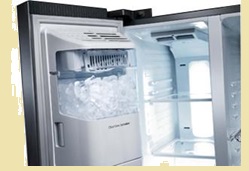
To make some ice, a freezer extracts 185 kJ of heat at -12.0ºC. The freezer has a coefficient of performance of 5.70. The room temperature is 26.0ºC, (a) How much heat is delivered to the room? (b) How much work is required to run the freezer?
Concept:-
A freezer would like to extract as much heat QL as possible from the low-temperature reservoir (“what you want”) for the least amount of work W (“what you pay for”). So the efficiency of a freezer is defined as,
K = (what you want)/(what you pay for)
= QL/W
and this is called coefficient of performance. The larger the value of K, the more efficient is the refrigerator.
Thus, W = QL/K
The first law of thermodynamics, applied to the working substance of the freezer, gives
W = QH – QL
Here QH is the exhausted heat.
Thus exhausted heat will be,
QH = W + QL
Solution:-
(a) To obtain the heat that is delivered to the room, first we have to find out the required work W to run the freezer.
To obtain the required work W to run the freezer, substitute 185 kJ for extracted heat QL and 5.70 for the coefficient of performance K in the equation W = QL/K,
W = QL/K
= 185 kJ/5.70
= 32.5 kJ
To obtain the heat that is delivered to the room, substitute 32.5 kJ for work W which is required to run the freezer and 185 kJ for extracted heat QL and in the equation QH = W + QL,
QH = W + QL
=32.5 kJ + 185 kJ
= 217.5 kJ
Rounding off to three significant figures, the heat delivered to the room would be 218 kJ.
W = QL/K
= 185 kJ/5.70
= 32.5 kJ
Therefore the required work W to run the freezer would be 32.5 kJ.
_______________________________________________________________________________
Problem 4:-
How much work must be done to extract 10.0 J of heat (a) from a reservior at 7ºC and transfer it to one at 27ºC by means of a refrigerator using a Carnot cycle; (b) from one at -73ºC to one at 27ºC; (c) from one at -173ºC to one at 27ºC; and (d) from one at -223ºC to one at 27ºC?
Concept:-
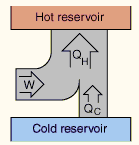
Coefficient of performance K of a Carnot refrigerator is defined as,
K = TL / TH - TL …… (1)
Here TL is the lower temperature of sink and TH is the higher temperature of source.
A refrigerator would like to extract as much heat QL as possible from the low-temperature reservoir (“what you want”) for the least amount of work W (“what you pay for”). So the efficiency of a refrigerator is defined as,
K = (what you want)/(what you pay for)
= QL/W
and this is called coefficient of performance. The larger the value of K, the more efficient is the refrigerator.
Thus, W = QL/K …… (2)
Substitute the value of K from equation (1) in the equation W = QL/K,
W = QL/K
= QL/( TL / TH - TL)
= QL (TH/ TL – 1)
Solution:-
(a) To obtain work W, substitute 10.0 J for QL, 27° C for TH and 7° C for TL in the equation W = QL (TH/ TL – 1),
W = QL (TH/ TL – 1)
= 10.0 J (27° C/ 7° C -1)
= 10.0 J ((27+273) K /(7+273) K -1)
= 10.0 J (300 K/280 K – 1)
= 0.714 J
Therefore the work done would be 0.714 J.
W = QL (TH/ TL – 1)
= 10.0 J (27° C/ (-73° C) -1)
= 10.0 J ((27+273) K /(-73+273) K -1)
= 10.0 J (300 K/200 K – 1)
= 5.00 J
Therefore the work done would be 5.00 J.
W = QL (TH/ TL – 1)
= 10.0 J (27° C/ (-173° C) -1)
= 10.0 J ((27+273) K /(-173+273) K -1)
= 10.0 J (300 K/100 K – 1)
= 20.0 J
Therefore the work done would be 20.0 J.
W = QL (TH/ TL – 1)
= 10.0 J (27° C/ (-223° C) -1)
= 10.0 J ((27+273) K /(-223+273) K -1)
= 10.0 J (300 K/50 K – 1)
= 50.0 J
Therefore the work done would be 50.0 J.
_____________________________________________________________________________
Problem 5:-
The motor in a refrigerator has a power output of 210 W. The freezing compartment is at -3.0ºC and the outside air is at 26ºC. Assuming that the efficiency is 85%of the ideal, calculate the amount of heat that can be extracted from the freezing compartment in 15 min.
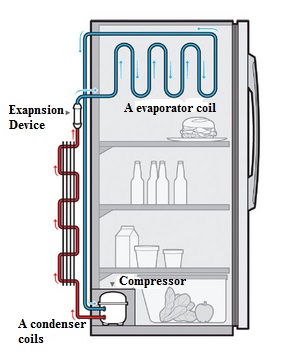
Concept:-
Coefficient of performance K of a Carnot refrigerator is defined as,
K = TL / TH - TL
Here TL is the lower temperature of sink and TH is the higher temperature of source.
Since here the efficiency is 85% of the ideal, therefore the coefficient of performance K of the refrigerator will be,
K = 0.85 (TL / TH - TL)
A refrigerator would like to extract as much heat QL as possible from the low-temperature reservoir (“what you want”) for the least amount of work W (“what you pay for”). So the efficiency of a refrigerator is defined as,
K = (what you want)/(what you pay for)
= QL/W
and this is called coefficient of performance. The larger the value of K, the more efficient is the refrigerator.
From the above equation K = QL/W, QL will be,
QL = (K) (W)
Work done (W) is equal to the product of power (P) and time (t).
W = (P) (t)
Solution:-
First we have to find out the coefficient of performance K and work done W.
To obtain coefficient of performance K, substitute 270 K for TL and 299 K for TH in the equation K = 0.85 (TL / TH - TL),
K = 0.85 (TL / TH - TL)
= 0.85 (270 K / 299 K - 270 K)
= 7.91
To obtain work done W, substitute 210 W for power P and 15 min for time t in the equation W = (P) (t),
W = (P) (t)
= (210 W) (15 min)
= (210 W) (15 min) (60 s/1 min)
= (210 W) (900 s)
= (1.89×10⁵ Ws) (1 J/1 Ws)
= 1.89×10⁵ J
To obtain the amount of heat QL that can be extracted from the freezing, substitute 7.91 for coefficient performance K and 1.89×10⁵ J for work done W in the equation
QL = (K) (W),
QL = (K) (W)
= (7.91) (1.89×10⁵ J)
= 1.50×10⁶ J
From the above observation we conclude that, the amount of heat QL that can be extracted from the freezing compartment in 15 min would be 1.50×10⁶ J.
__________________________________________________________________________________
Problem 6:-
Apparatus that liquefies helium is in a laboratory at 296 K. The helium in the apparatus is at 4.0 K. If 150 mJ of heat is transferred from the helium, find the minimum amount of heat delivered to the laboratory.
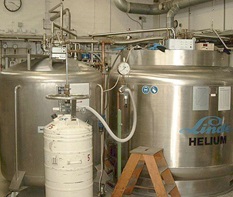
Concept:-
Coefficient of performance K of a Carnot refrigerator is defined as,
K = TL / TH - TL …… (1)
Here TL is the lower temperature of sink and TH is the higher temperature of source.
A refrigerator would like to extract as much heat QL as possible from the low-temperature reservoir (“what you want”) for the least amount of work W (“what you pay for”). So the efficiency of a refrigerator is defined as,
K = (what you want)/(what you pay for)
= QL/W
and this is called coefficient of performance. The larger the value of K, the more efficient is the refrigerator.
Thus, W = QL/K …… (2)
Substitute the value of K from equation (1) in the equation W = QL/K,
W = QL/K
= QL/( TL / TH - TL)
= QL (TH/ TL – 1) …… (3)
The first law of thermodynamics, applied to the working substance of the refrigerator, gives,
W = QH – QL
Here QH is the exhausted heat.
Thus exhausted heat will be,
QH = W + QL …… (4)
Substitute the value of W from equation (3) in the equation QH = W + QL,
QH = W + QL
= QL (TH/ TL – 1) + QL
= QL (TH/ TL)
Solution:-
To obtain the minimum amount of heat delivered to the laboratory, substitute 150 mJ for QL, 296 K for TH and 4.0 K for TL in the equation QH = QL (TH/ TL),
QH = QL (TH/ TL)
= ((150 mJ) (10-3 J/1 mJ)) (296 K/4.0 K)
= 11 J
From the above observation we conclude that, the minimum amount of heat delivered to the laboratory would be 11 J.
_____________________________________________________________________________________
Problem 7:-
A refigerator does 153 J of work to transfer 568 J of heat from its cold compartment. (a) Calculate the refrigerator’s coefficient of performance, (b) How much heat is exhausted to the kitchen?
Concept:-
A refrigerator would like to extract as much heat QL as possible from the low-temperature reservoir (“what you want”) for the least amount of work W (“what you pay for”). So the efficiency of a refrigerator is defined as,
K = (what you want)/(what you pay for)
= QL/W
and this is called coefficient of performance. The larger the value of K, the more efficient is the refrigerator.
The first law of thermodynamics, applied to the working substance of the refrigerator, gives
W = QH – QL
Here QH is the exhausted heat.
Thus exhausted heat will be,
QH = W + QL
Solution:-
(a) To obtain the coefficient of performance K of refrigerator, substitute 568 J for extracted heat QL and 153 J for the work W in the equation K = QL/W,
K = QL/W
= 568 J/153 J
= 3.71
Therefore, the coefficient of performance K of refrigerator would be 3.71.
QH = W + QL
= 153 J + 568 J
= 721 J
Therefore, exhausted heat to the kitchen by refrigerator would be 721 J.
____________________________________________________________________________
Problem 8:-
An invertor claims to have created a heat pump that draws heat from a lake at 3.0ºC and delivers heat at a rate of 20 kW to a building at 35ºC, while using only 1.9 kWof electrical power. How would you judge the claim?
Concept:-
Coefficient of performance (K) of a heat pump is defined as,
K = TL / (TH - TL)
Where, TL is the lower temperature and TH is the higher temperature of the reservoir.
Again, coefficient of performance (K) of a heat engine is defined as,
K = QL/W
= (QH – W) /W
Here QH heat at higher temperature and W is the work done.
We can write above equation K =(QH – W) /W,
K =(QH – W) /W
=(QH/t – W/t) /(W/t)
= (PH – P) /P (Since Power (P) = W/t)
Solution:-
To obtain the Coefficient of performance (K) of a heat pump, substitute 3.0 ° C for TL and 35 ° C for TH in the equation K = TL / (TH - TL),
K = TL / (TH - TL)
= 3.0 ° C/(35 ° C-3.0 ° C)
= (3+273) K/((35+273) K- (3+273) K)
= 276 K/(308 K-276 K)
= 8.62
To find out the coefficient of performance K of the machine which the inventor claims, substitute 20 kW for PH and 1.9 kW for P in the equation K = (PH – P) /P,
K = (PH – P) /P
= (20 kW-1.9 kW)/1.9 kW
= 9.53
Since the coefficient of performance K of the machine which the inventor claims is greater than the coefficient of performance (K) of a heat pump, therefore it cannot be done.
_________________________________________________________________________
Problem 9:-
The motor in a refrigerator has a power output of 210 W. The freezing compartment is at -3.0ºC and the outside air is at 26ºC. Assuming that the efficiency is 85% of the ideal, calculate the amount of heat that can be extracted from freezing compartment in 15 min.
Concept:-
Coefficient of performance K of a Carnot refrigerator is defined as,
K = TL / TH - TL
Here TL is the lower temperature of sink and TH is the higher temperature of source.
Since here the efficiency is 85% of the ideal, therefore the coefficient of performance K of the refrigerator will be,
K = 0.85 (TL / TH - TL)
A refrigerator would like to extract as much heat QL as possible from the low-temperature reservoir (“what you want”) for the least amount of work W (“what you pay for”). So the efficiency of a refrigerator is defined as,
K = (what you want)/(what you pay for)
= QL/W
and this is called coefficient of performance. The larger the value of K, the more efficient is the refrigerator.
From the above equation K = QL/W, QL will be,
QL = (K) (W)
Work done (W) is equal to the product of power (P) and time (t).
W = (P) (t)
Solution:-
First we have to find out the coefficient of performance K and work done W.
To obtain coefficient of performance K, substitute 270 K for TL and 299 K for TH in the equation K = 0.85 (TL / TH - TL),
K = 0.85 (TL / TH - TL)
= 0.85 (270 K / 299 K - 270 K)
= 7.91
To obtain work done W, substitute 210 W for power P and 15 min for time t in the equation W = (P) (t),
W = (P) (t)
= (210 W) (15 min)
= (210 W) (15 min) (60 s/1 min)
= (210 W) (900 s)
= (1.89×10⁵ Ws) (1 J/1 Ws)
= 1.89×10⁵ J
To obtain the amount of heat QL that can be extracted from the freezing, substitute 7.91 for coefficient performance K and 1.89×10⁵ J for work done W in the equation
QL = (K) (W),
QL = (K) (W)
= (7.91) (1.89×10⁵ J)
= 1.50×10⁶ J
From the above observation we conclude that, the amount of heat QL that can be extracted from the freezing compartment in 15 min would be 1.50×10⁶ J.
___________________________________________________________________________________
Problem 10:-
An ideal gas undergoes an isothermal expansion at 77ºC increasing its volume from 1.3 to 3.4 L. The entropy change of the gas is 24 J/K. How many moles of gas are present?
Concept:-
The entropy ΔS of an ideal gas undergoes an isothermal expansion is defined as,
ΔS = Q/T
= n R ln Vf/Vi
Here Q is the added heat, T is the temperature, n is the number of moles, R is the gas constant, Vf is the final volume and Vi is the initial volume.
From the equation ΔS = nR ln Vf/Vi, the number of moles n will be,
n = ΔS/ (R ln Vf/Vi)
Solution:-
To obtain the number of moles n are present in the gas, substitute 24 J/K for ΔS, 8.31 J/mol. K for R, 3.4 L for Vf and 1.3 L for Vi in the equation,
n = ΔS/ (R ln Vf/Vi)
= (24 J/K) / (8.31 J/mol. K) (ln 3.4 L/1.3 L)
= (24 J/K) / (8.31 J/mol. K) (ln (3.4/1.3))
= 3.00 mol
From the above observation we conclude that, the number of moles n are present in the gas would be 3.00 mol.
_______________________________________________________________________________
Problem 11:-
Water standing in the open at 32ºC evaporates because of the escape of some of the surface molecules. The heat of vaporization is approximately eqaul to εn, where ε is the average energy of the escaping molecules and n is the number of molecules per kilogram. (a) Find ε. (b) What is the ratio of ε to the average kinetric energy of H2O molecules, assuming that the kinetic energy is related to temperature in the same way as it is for gases?
Concept:-
Number of molecules n is equal to the Avogadro’s number NA divided by molecular weight M.
So, n = NA/M
The average kinetic energy Eav of a diatomic molecule like H2O is defined as,
Eav = 3/2 kT
Here k is the Boltzmann constant and T is the temperature.
Solution:-
(a) As heat of vaporization Lv is approximately equal to εn, where ε is the average energy of the escaping molecules and n is the number of molecules per kilogram, so,
Lv = εn
Or,
ε = Lv/n
= Lv/( NA/M)
= LvM / NA
To obtain the average energy ε, substitute 2256×103 J/kg for latent heat of vaporization of water molecule (H2O) Lv, 0.018 kg/mol for M and 6.03×10²³/mol for NA in the equation ε = LvM / NA, we get,
ε = LvM / NA
= (2256×103 J/kg)( 0.018 kg/mol)/( 6.03×10²³)
= 6.75×10⁻²⁰ J
From the above observation we conclude that, the value of average energy ε would be 6.75×10⁻²⁰ J.
(b) As, Eav = 3/2 kT, therefore the ratio of ε to the average kinetic energy Eav of H2O molecule will be,
ε / Eav = ε / (3/2 kT)
= 2 ε / 3 kT
To obtain the ratio of ε to the average kinetic energy Eav of H2O molecule, substitute 6.75×10⁻²⁰ J for ε , 1.38×10⁻²³ J/K for k and 32° C for T in the equation ε / Eav= 2 ε / 3 kT, we get,
ε / Eav= 2 ε / 3 kT
= 2(6.75×10⁻²⁰ J)/3(1.38×10-23 J/K)( 32° C)
= 2(6.75×10⁻²⁰ J)/3(1.38×10-23 J/K)( 32+273) K)
=2(6.75×10⁻²⁰ J)/3(1.38×10-23 J/K)( 305K)
= 10.7
From the above observation we conclude that, the ratio of ε to the average kinetic energy Eav of H2O molecule would be 10.7.
______________________________________________________________
Problem 12:-
(a) Calculate the rate at which body heat flows out through the clothing of a skier, given the following data: the body surfave area is 1.8 m2 and the clothing is 1.2 cm thick; skin surface temperature is 33ºC, whereas the outer surface of the clothing is at 1.0ºC; the thermal conductivity of the clothing is 0.040 W/m.K. (b) How would the answer change if, after a fall, the skier’s clothes become soaked with water? Asssume that the thermal conductivity of water is 0.60 W/m.K.
Concept:-
The rate H at which heat flows out through the clothing of a skier,
(a)directly proportional to the surface area (A) of the body.
(b) inversely proportional to the thickness of the clothing Δx.
(c) directly proportional to the temperature difference ΔT.
So, H = kA ΔT/ Δx
Where k is the proportionality constant and is called thermal conductivity of the material.
Solution:-
(a) Surface area of the body,
A = 1.8 m2
Temperature difference,
ΔT = (skin surface temperature) – (outer surface temperature of clothing)
= 33° C – 1° C = (32+273) K = 305 K
Thickness,
Δx = 1.2 cm
= (1.2 cm) (1 m/100 cm) = 0.012 m
To find out the rate H at which heat flows out through the clothing of a skier, substitute 1.8 m2 for the area A, 305 K for temperature difference ΔT and 0.012 m for thickness Δx and 0.040 W/m. K for the thermal conductivity k in the equation H = kA ΔT/ Δx,
H = kA ΔT/ Δx
= (0.040 W/m. K) (1.8 m2 ) (305 K) / (0.012 m)
= 1830 W
From the above observation we conclude that, the rate H at which heat flows out through the clothing of a skier would be 1830 W.
(b) From the equation H = kA ΔT/ Δx, we observed that rate H at which heat flows out through the clothing of a skier is directly proportional to the thermal conductivity k of clothing.
Now the thermal conductivity of water is changed to 0.60 W/m. K.
Thus thermal conductivity k is increased by a factor of,
= (0.60 W/m. K) / (0.04 W/m. K)
= 15
Since that rate H at which heat flows out through the clothing of a skier is directly proportional to the thermal conductivity k of clothing, therefore the rate H would increase by a factor of 15.
Related Resources:-
-
You might like to refer Thermodynamic state of a system and macroscopic intensive, extensive properties.
-
For getting an idea of the type of questions asked, refer the Previous Year Question Papers.
-
Click here to refer the most Useful Books of Physics.
To read more, Buy study materials of Thermodynamics comprising study notes, revision notes, video lectures, previous year solved questions etc. Also browse for more study materials on Chemistry here.
View courses by askIITians


Design classes One-on-One in your own way with Top IITians/Medical Professionals
Click Here Know More

Complete Self Study Package designed by Industry Leading Experts
Click Here Know More

Live 1-1 coding classes to unleash the Creator in your Child
Click Here Know More