Applications of Dimensions
Table of Content |
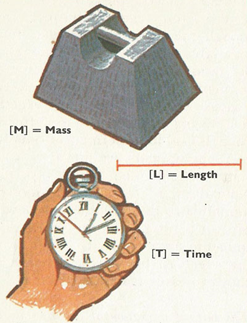
The physical quantities those can be expressed in terms of fundamental physical quantities are called derived physical quantities. All the physical quantities of interest can be derived from the base quantities. The power (exponent) of base quantity that enters into the expression of a physical quantity, is called the dimension of the quantity in that base. Broadly speaking, dimension is the nature of a Physical quantity. Understanding of this nature helps us in many ways.
Following are some of the applications of the theory of dimensional analysis in Physics:

(a) To find the unit of a given physical quantity in a given system of units:-
By expressing a physical quantity in terms of basic quantity we find its dimensions. In the dimensional formula replacing M, L, T by the fundamental units of the required system, we get the unit of physical quantity. However, sometimes we assign a specific name to this unit.
Problem 1:-
Find the dimension of Force.
Force is numerically equal to the product of mass and acceleration
Force = mass x acceleration
or [F] = mass x velocity/time= mass x (displacement/(time)2) = mass x (length/(time)2)
= [M] x [LT-2] = [MLT-2]
Its unit in SI system will be Kgms-2 which is given a specific name “newton (N)”.
Similarly, its unit in CGS system will be gmcms-2 which is called “dyne”.
(b) To find dimensions of physical constants or coefficients:-
The dimension of a physical quantity is unique because it is the nature of the physical quantity and the nature does not change. If we write any formula or equation incorporating the given physical constant, we can find the dimensions of the required constant or co-efficient.
Problem 2:-
Find the dimension of gravitational constant ’G’.
Solution:-
From Newton’s law of Gravitation, the exerted by one mass upon another is
F=G (m1 m2)/r2 or G=(Fr2)/(m1 m1 )
or [G] = [MLT-2][L2] / ([M][M]) = [M-1 L3 T-2 ]
We can find its SI unit which is m3/Kgs2.
(c) To convert a physical quantity from one system of units to another:-
This is based on the fact that for a given physical quantity, magnitude x unit = constant
So, when unit changes, magnitude will also change.
Convert one Newton into dyne.
Solution:-
Dimensional formula for Newton = [MLT-2]
Or 1 N = 1 Kg m/s2 ; But 1 kg = 103 g and 1 m = 102 cm
Therefore 1 N = ((103 g)(102 cm))/s2 = 105 g cm/s2 = 105 dyne
(d) To check the dimensional correctness of a given physical relation:-
This is based on the principle that the dimensions of the terms on both sides on an equation must be same. This is known as the ‘principle of homogeneity’. If the dimensions of the terms on both sides are same, the equation is dimensionally correct, otherwise not.
Caution: It is not necessary that a dimensionally correct equation is also physically correct but a physically correct equation has to be dimensionally correct.
Problem 4:-
Consider the formula, T=2π√(l/g)
Where T is the time period of oscillation of a simple pendulum in a simple harmonic motion, l and g are the length of the pendulum and gravitational constants respectively. Check this formula, whether it is correct or not, using the concept of dimension.
Solution:-
As we know [g] = [LT-2]
Therefore [T] = √(([L])/([LT-2])) = [T] s
Thus the above equation is dimensionally correct (homogenous) and later you will come to know that it is physically also correct.
____________________________________________________________________________________________________
Problem 5:-
Consider the formula s=ut -1/3 at2. Check this formula whether it is correct or not, using the concept of dimension.
Solution:-
[L] = [LT-1] [T] – [LT-2] [T2]
=> [L] = [L] – [L]
In this case also the formula is dimensionally correct but, you know that it is physically incorrect as the correct formula is given by
S = ut + ½ at2
(e) As a research tool to derive new relations:-
One of the aims of scientific research is to discover new laws relating different physical quantities. The theory of dimensions (in the light of principal of homogeneity) provides us with a powerful tool of research in the preliminary stages of investigation [It must be again emphasized that mere dimensional correctness of an equation does not ensure its physical correctnes
|
|


Limitations of the theory of dimensions:-
The limitations are as follows:-
(i) If dimensions are given, physical quantity may not be unique as many physical quantities have the same dimension. For example, if the dimensional formula of a physical quantity is [ML2T-2] it may be work or energy or even moment of force.
(ii) Numerical constants, having no dimensions, cannot be deduced by using the concepts of dimensions.
(iii) The method of dimensions cannot be used to derive relations other than product of power functions. Again, expressions containing trigonometric or logarithmic functions also cannot be derived using dimensional analysis, e.g.
s = ut + 1/3 at2 or y = a sinθ cotθ or P= P0exp[(–Mgh)/RT]
cannot be derived. However, their dimensional correctness can be verified.
(iv) If a physical quantity depends on more than three physical quantities, method of dimensions cannot be used to derive its formula. For such equations, only the dimensional correctness can be checked. For example, the time period of a physical pendulum of moment of inertia I, mass m and length l is given by the following equation.
T = 2π√(I/mgl) (I is known as the moment of Inertia with dimensions of [ML2] through dimensional analysis), though we can still check the dimensional correctness of the equation (Try to check it as an exercise).
(v) Even if a physical quantity depends on three Physical quantities, out of which two have the same dimensions, the formula cannot be derived by theory of dimensions, and only its correctness can be checked e.g. we cannot derive the equation.


Question 1:-
If force, time and velocity are treated as fundamental quantities then dimensional formula of energy will be,
(a) [FTV] (b) [FT2V] (c) [FTV2] (d) [FT2V2]
Question 2:-
Which one of the following physical quantities do not have the same dimensions.
(a) Pressure, Young’s Modulus, Stress (b) Electromotive Force, Voltage, Potential
(c) Heat, Work, Energy (d) Electric Dipole, Electric Field, Flux
Question 3:-
The pairs having same dimensional formula-
(a) Angular Momentum, Torque
(b) Torque, Work
(c) Plank’s Constant, Boltzmann’s Constant
(d) Gas Constant, Pressure
Question 4:-
If F = ax + bt2 + c where F is force, x is distance and t is time. Then what is dimension of axc/bt2?
(a) [ML2T-2] (b) [MLT-2] (c) [M0L0T0] (d) [MLT-1]
Question 5:-
The dimensional formula for angular momentum is,
(a) [ML2T-2] (b) [ML2T-1] (c) [MLT-1] (d) [M0L2T-2]


| Q.1 | Q.2 | Q.3 | Q.4 | Q.5 |
|
a |
d |
b |
b |
b |
Related Resources:-
-
You might like to refer Dimension.
-
For getting an idea of the type of questions asked, refer the Previous Year Question Papers.
-
Click here to refer the most Useful Books of Physics.
To read more, Buy study materials of Units & Dimensions comprising study notes, revision notes, video lectures, previous year solved questions etc. Also browse for more study materials on Physics here.
View courses by askIITians


Design classes One-on-One in your own way with Top IITians/Medical Professionals
Click Here Know More

Complete Self Study Package designed by Industry Leading Experts
Click Here Know More

Live 1-1 coding classes to unleash the Creator in your Child
Click Here Know More