Question icon
Electrostatics

This is electric charges and fields chapter.
Answer is 3rd option
Explain with diagram sir.
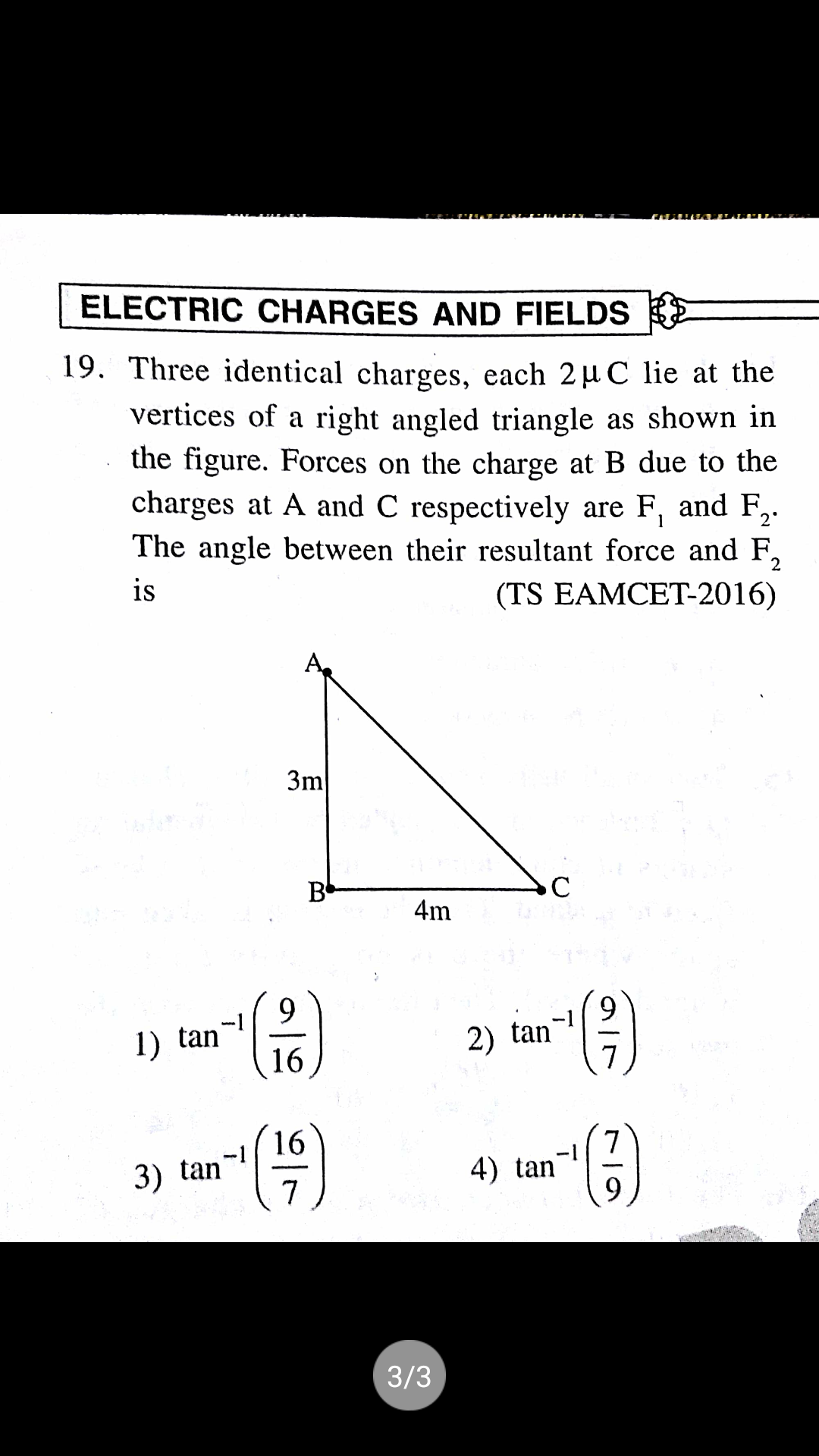
Question image for This is electric charges and fields chapter. Answ
Profile image of raju nagula
8 Years agoGrade
Answers icon

1 Answer

Profile image of Venkat
8 Years ago
Charge at B due charge at A
F_{1}=\frac{1}{4\pi \varepsilon _{0}}\frac{(2\mu*C)(2\mu*C) }{AB^{2}} \\F_{1}=\frac{1}{4\pi \varepsilon _{0}}\frac{(4*10^{-12}) }{0.03^{2}}
Note that the force F1 is a vector
 
Charge at B due to C.
F_{2}=\frac{1}{4\pi \varepsilon _{0}}\frac{(2\mu*C)(2\mu*C) }{BC^{2}} \\F_{2}=\frac{1}{4\pi \varepsilon _{0}}\frac{(4*10^{-12}) }{0.04^{2}}
Note that the force F2 is a vector.
 
Let us take the resultant of the above two forces make an angle \theta with horizontal line BC. So,
tan\theta =\frac{F_{1}}{F_{2}} \\ \\tan\theta =\frac{0.04^{2}}{0.03^{2}} \\ \\\theta =tan^{-1}\frac{16}{9}
Hence, correct answer is option C.