

Grade 12th passElectrostatics
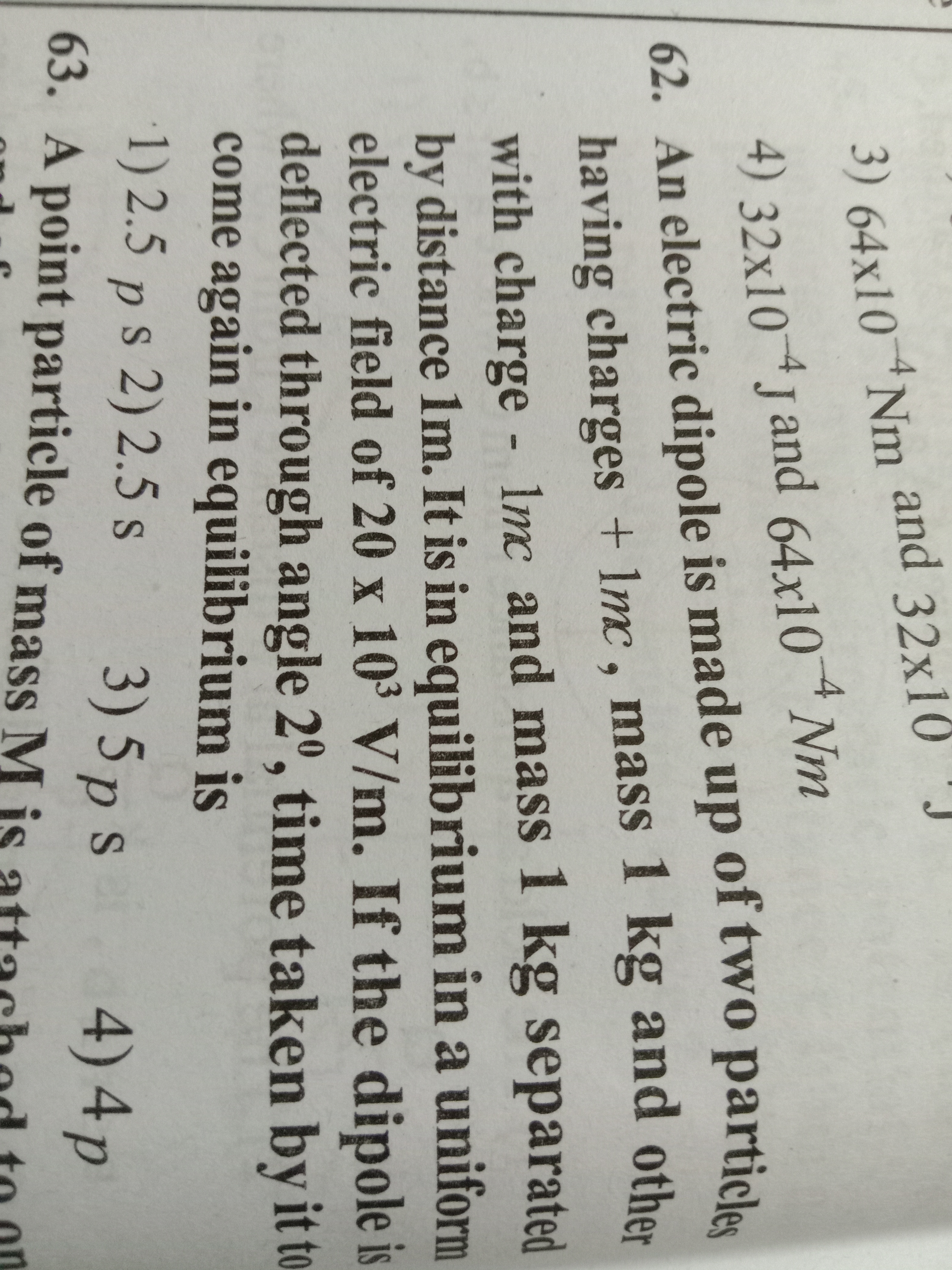
Need to find the time taken for the dipole to com
Need to find the time taken for the dipole to come back to eqm


 Approved Tutor Answer1 Year ago
To determine the time taken for a dipole to return to equilibrium, we need to consider the dynamics of the dipole in a uniform electric field. This involves understanding the forces acting on the dipole and how they influence its motion. Let's break this down step by step.
A dipole consists of two equal and opposite charges separated by a distance. When placed in an electric field, the dipole experiences a torque that tends to align it with the field. The torque (\( \tau \)) can be expressed as:
Here, \( p \) is the dipole moment (the product of charge and distance between the charges), and \( E \) is the electric field strength. The torque causes the dipole to rotate until it aligns with the field direction.
The angular motion of the dipole can be described using Newton's second law for rotation. The equation governing the angular displacement (\( \theta \)) of the dipole is:
Where \( I \) is the moment of inertia of the dipole. Substituting the torque into this equation gives:
To find the time taken for the dipole to return to equilibrium, we can simplify the motion by assuming small angles, where \( \sin(\theta) \approx \theta \). This approximation leads us to a simple harmonic motion (SHM) scenario:
This is a standard form of the SHM equation, where the angular frequency (\( \omega \)) is given by:
The time period (\( T \)) of the oscillation, which is the time taken for the dipole to return to its equilibrium position, can be calculated using the formula:
Let’s say we have a dipole with a dipole moment \( p = 1 \times 10^{-6} \, C \cdot m \), a moment of inertia \( I = 2 \times 10^{-5} \, kg \cdot m^2 \), and it is placed in an electric field \( E = 1000 \, N/C \). Plugging these values into the time period formula:
This means it takes approximately 0.28 seconds for the dipole to return to its equilibrium position after being displaced.
In summary, the time taken for a dipole to return to equilibrium in an electric field can be derived from its angular motion equations, leading us to a formula that resembles the characteristics of simple harmonic motion. By applying the relevant parameters, we can calculate the specific time period for any given dipole in an electric field.

Last Activity: 4 Years ago
Last Activity: 4 Years ago
Last Activity: 4 Years ago