

Grade 12Electrostatics
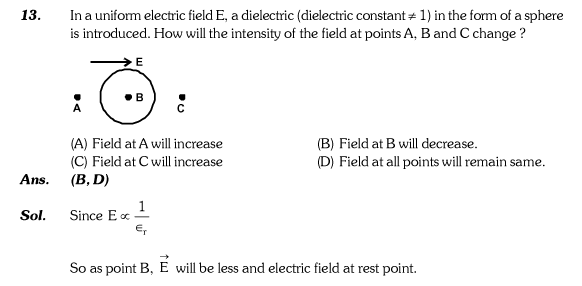
sir plaease dont see answer as ithink it is wrong in my view ans should be a,b,c. please help.
sir plaease dont see answer as ithink it is wrong in my view ans should be a,b,c. please help.


 Approved Tutor Answer1 Year ago
It sounds like you're grappling with a question where you're unsure about the correct answer. Let's break it down together. When faced with multiple-choice questions, it's important to analyze each option carefully. You mentioned that you think the answer should be a, b, or c. Let's explore how to evaluate these choices effectively.
When you encounter a question with several possible answers, a systematic approach can help clarify your thoughts. Here’s a step-by-step method to tackle it:
Make sure you understand what the question is asking. Look for keywords that indicate what is required. For example, if the question asks for the "best" answer, it implies that one option is more suitable than the others.
Take a moment to consider each answer choice individually. Here’s how you can do this:
As you analyze each option, start eliminating those that are clearly incorrect. This narrows down your choices and increases your chances of selecting the right answer.
Use your background knowledge related to the subject matter. Sometimes, recalling relevant concepts or facts can guide you toward the correct answer. For instance, if the question pertains to a scientific principle, think about what you know regarding that principle and how it applies to the options given.
If you’re still unsure after evaluating the options, make an educated guess based on your analysis. Trust your instincts, especially if you have a reason to favor one option over the others.
Let’s say the question is: "Which of the following is a primary color?" with options a) Red, b) Green, c) Yellow, and d) Purple. Here’s how you might approach it:
By following this structured approach, you can enhance your decision-making process when answering multiple-choice questions. If you have a specific question or topic in mind, feel free to share, and we can dive deeper into that together!

Last Activity: 3 Years ago
Last Activity: 4 Years ago
Last Activity: 4 Years ago
Last Activity: 4 Years ago