Answer 15.
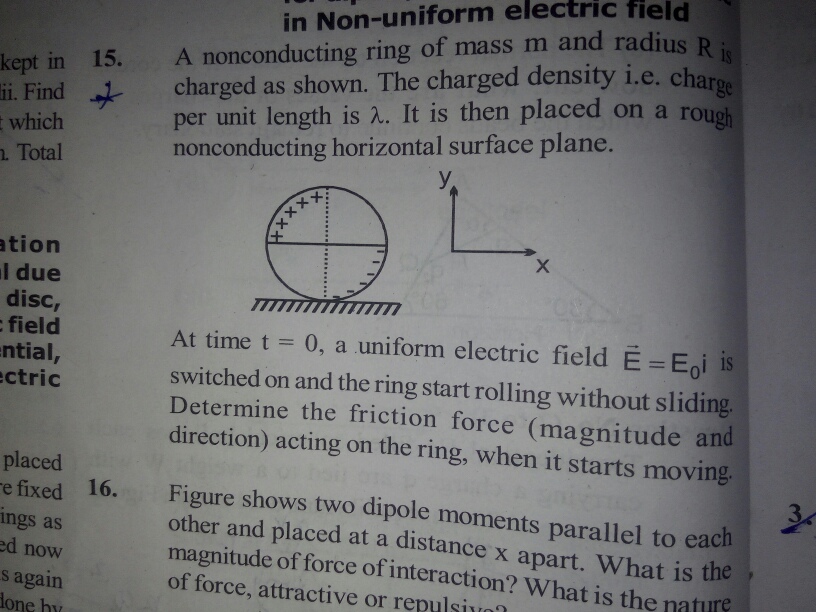
WHEN THE ELECTRIC FIELD IS APPLIED,
- IT WILL PRODUCE TORQUE (there will be friction also due to rough horizontal surface )
- THE NET ELECTRIC FORCE WILL BE ZERO.
torque = R . F. sinx where F is qE but q is not given
so q = (lambda)(R.dx) where x is the angle where the charge is distributed
TARGET: TO find TORQUE independent of x (angle)
torque = ∫ (lambda . R .dx ) E sinx
limit of integration will be 0 to pi/ 2 and this torque will be multiply by 2 becouse the torque is produced by both + and – charge
torque = 2 X ∫ (lambda . R .dx ) E sinx limit of integration will be 0 to pi/ 2
ON SOLVING, WE GET
torque = (2)( lambda)( E )( R2)
AS THE MOTION IS PURE ROLLING,
torque – (torque produced by frictional force ) = (moment of inertia ) (alpha )
where alpha = angular acceleration = f/(mR)
(2)( lambda)( E )( R2) – f(R) = I (ALPHA )
(2)( lambda)( E )( R2) – f(R) = I X f/(mR)
PUT I = mR2
and sove for f (frictional force)
f = (lambda )(E)(R)__________________________ANSWER




 Approved Tutor Answer8 Years ago