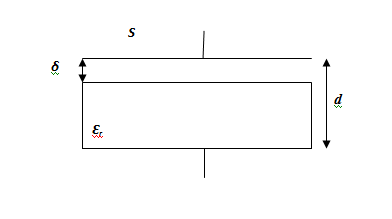
To tackle the problem of calculating the capacitance of a plate capacitor and the maximum voltage without experiencing corona discharge, we can break it down into manageable steps. Let's start by understanding the parameters given and how they relate to the formulas we will use.
Understanding the Given Parameters
We have the following information:
- Area of electrodes, S = 1 dm² = 0.01 m²
- Distance between electrodes, d = 2 mm = 0.002 m
- Relative permittivity of the dielectric, Ɛr = 4
- Electric strength of the dielectric, Es = 500 kV/cm = 50000 V/m
- Thickness of the vacuum area, δ = 0.2 mm = 0.0002 m
- Electric strength of vacuum, Esv = 30 kV/cm = 3000000 V/m
1. Calculating the Capacitance of the Capacitor
The capacitance \( C \) of a parallel plate capacitor can be calculated using the formula:
C = (Ɛ₀ * Ɛr * S) / d
Where:
- Ɛ₀ is the permittivity of free space, approximately \( 8.854 \times 10^{-12} \, \text{F/m} \)
- Ɛr is the relative permittivity of the dielectric material
- S is the area of the plates
- d is the separation between the plates
Now, substituting the values:
C = (8.854 \times 10^{-12} \, \text{F/m} * 4 * 0.01 \, \text{m}²) / 0.002 \, \text{m}
Calculating this gives:
C = (8.854 \times 10^{-12} * 4 * 0.01) / 0.002 = 1.77 \times 10^{-10} \, \text{F} = 177 \, \text{pF}
However, since we have a vacuum area, we need to consider the effective capacitance. The effective capacitance can be calculated by treating the capacitor as two capacitors in series: one with the dielectric and one with the vacuum.
Effective Capacitance Calculation
Let’s denote:
- Capacitance with dielectric: \( C_d = \frac{Ɛ₀ * Ɛr * S}{d - δ} \)
- Capacitance with vacuum: \( C_v = \frac{Ɛ₀ * S}{δ} \)
Calculating \( C_d \):
C_d = (8.854 \times 10^{-12} \, \text{F/m} * 4 * 0.01) / (0.002 - 0.0002) = 1.77 \times 10^{-10} \, \text{F} = 177 \, \text{pF}
Calculating \( C_v \):
C_v = (8.854 \times 10^{-12} \, \text{F/m} * 0.01) / 0.0002 = 4.427 \times 10^{-10} \, \text{F} = 442.7 \, \text{pF}
Now, since these two capacitances are in series, the total capacitance \( C_{total} \) is given by:
\(\frac{1}{C_{total}} = \frac{1}{C_d} + \frac{1}{C_v}\)
Calculating this gives:
\(\frac{1}{C_{total}} = \frac{1}{177 \times 10^{-12}} + \frac{1}{442.7 \times 10^{-12}}\)
Solving this results in:
C_{total} \approx 136.2 \, \text{pF}
2. Maximum Voltage Without Corona Effect
The maximum voltage \( U_{max} \) that the capacitor can withstand without experiencing corona discharge can be calculated using the electric strength of the dielectric material:
U_{max} = E_s * d
Substituting the values:
U_{max} = 50000 \, \text{V/m} * 0.002 \, \text{m} = 100 \, \text{V}
However, we also need to consider the vacuum area. The maximum voltage for the vacuum area is:
U_{max,vacuum} = E_{sv} * δ
Calculating this gives:
U_{max,vacuum} = 3000000 \, \text{V/m} * 0.0002 \, \text{m} = 600 \, \text{V}
Since the maximum voltage is limited by the weaker dielectric strength, we take the lower value:
U_{max} = 600 \, \text{V}
In summary, the calculations yield:
- Capacitance \( C \approx 136.2 \, \text{pF} \)
- Maximum voltage \( U_{max} \approx 600 \, \text{V} \)
These results illustrate the importance of considering both the dielectric material and the vacuum in capacitor design, as they significantly influence performance and safety limits.