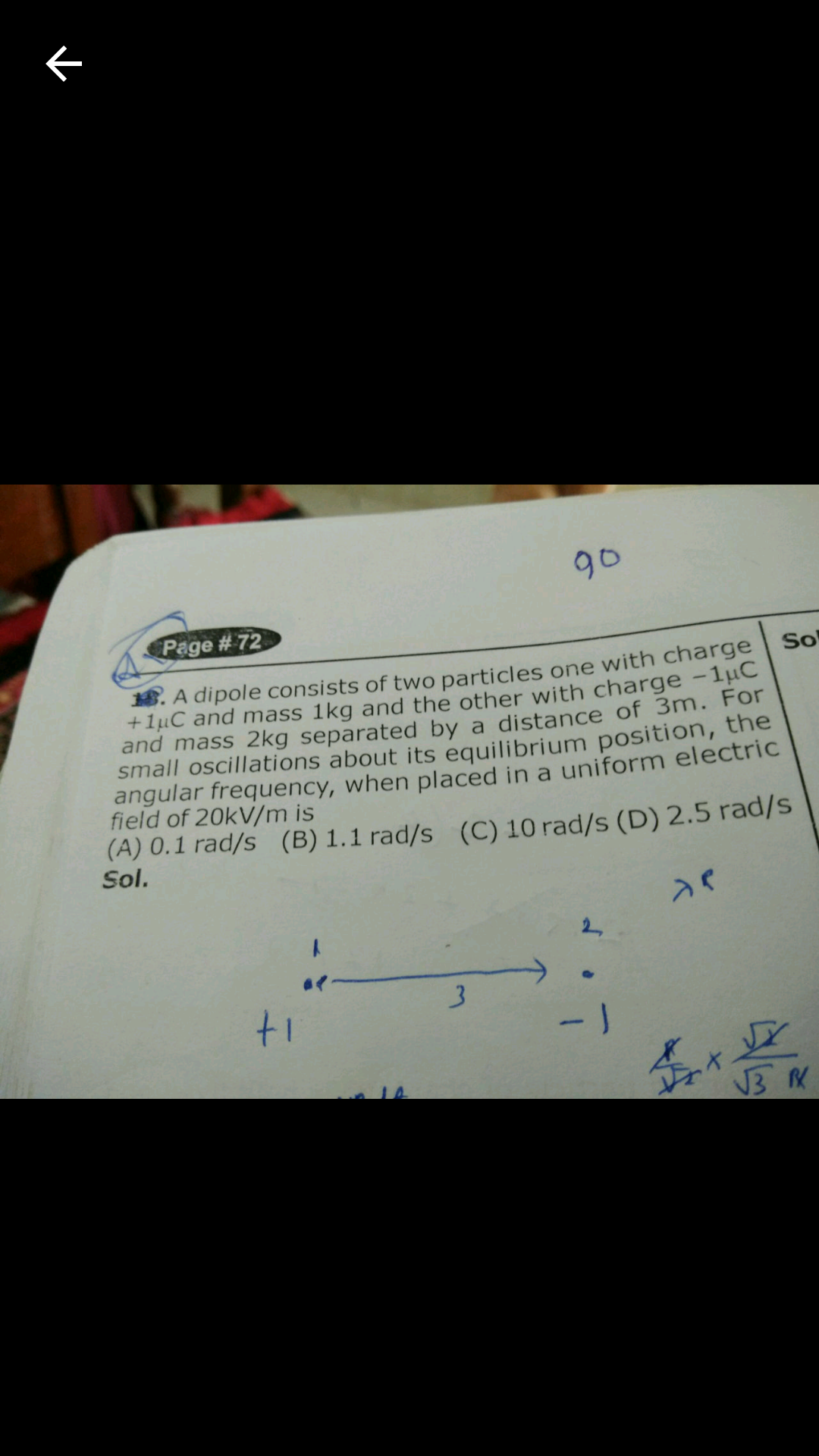
To determine the angular frequency of small oscillations of a dipole in a uniform electric field, we can use some fundamental principles of physics. A dipole consists of two equal and opposite charges separated by a distance, and when placed in an electric field, it experiences a torque that tends to align it with the field. Let's break down the problem step by step.
Understanding the Dipole Moment
The dipole moment (p) is defined as the product of the charge (q) and the distance (d) between the charges. In this case, we have:
- Charge, q = 1 microcoulomb = 1 x 10⁻⁶ C
- Distance, d = 3 m
Thus, the dipole moment can be calculated as:
p = q × d = (1 x 10⁻⁶ C) × (3 m) = 3 x 10⁻⁶ C·m
Torque on the Dipole
When the dipole is placed in a uniform electric field (E), it experiences a torque (τ) given by the equation:
τ = p × E
Here, the electric field strength is given as 20 kV/m, which is equivalent to:
E = 20,000 V/m
Substituting the values we have:
τ = (3 x 10⁻⁶ C·m) × (20,000 V/m) = 0.06 N·m
Moment of Inertia
For small oscillations, we also need to consider the moment of inertia (I) of the dipole. The moment of inertia for a system of point masses is given by:
I = Σ mi ri2
In our case, we have two charges:
- Charge +1 microcoulomb (mass = 1 kg) at a distance of 1.5 m from the center
- Charge -1 microcoulomb (mass = 2 kg) at a distance of 1.5 m from the center
Calculating the moment of inertia:
I = (1 kg)(1.5 m)2 + (2 kg)(1.5 m)2 = 1.5 + 6 = 7.5 kg·m2
Angular Frequency of Oscillation
The angular frequency (ω) for small oscillations can be derived from the relationship between torque and angular displacement:
τ = -Iα
Where α is the angular acceleration. For small oscillations, we can relate torque to angular displacement (θ) as:
τ = -pE sin(θ) ≈ -pE θ
Thus, we can write:
pE θ = Iα
Since α = d²θ/dt², we can express this as:
pE θ = I (d²θ/dt²)
This leads us to the equation of motion for simple harmonic motion:
d²θ/dt² + (pE/I) θ = 0
From this, we can identify the angular frequency:
ω = √(pE/I)
Final Calculation
Substituting the values we have:
ω = √((3 x 10⁻⁶ C·m)(20,000 V/m) / (7.5 kg·m2))
ω = √((0.06 N·m) / (7.5 kg·m2))
ω = √(0.008) = 0.0894 rad/s
Therefore, the angular frequency of small oscillations of the dipole in the given electric field is approximately 0.0894 rad/s. This frequency indicates how quickly the dipole will oscillate about its equilibrium position when subjected to the electric field.