

Grade 12th passElectrostatics
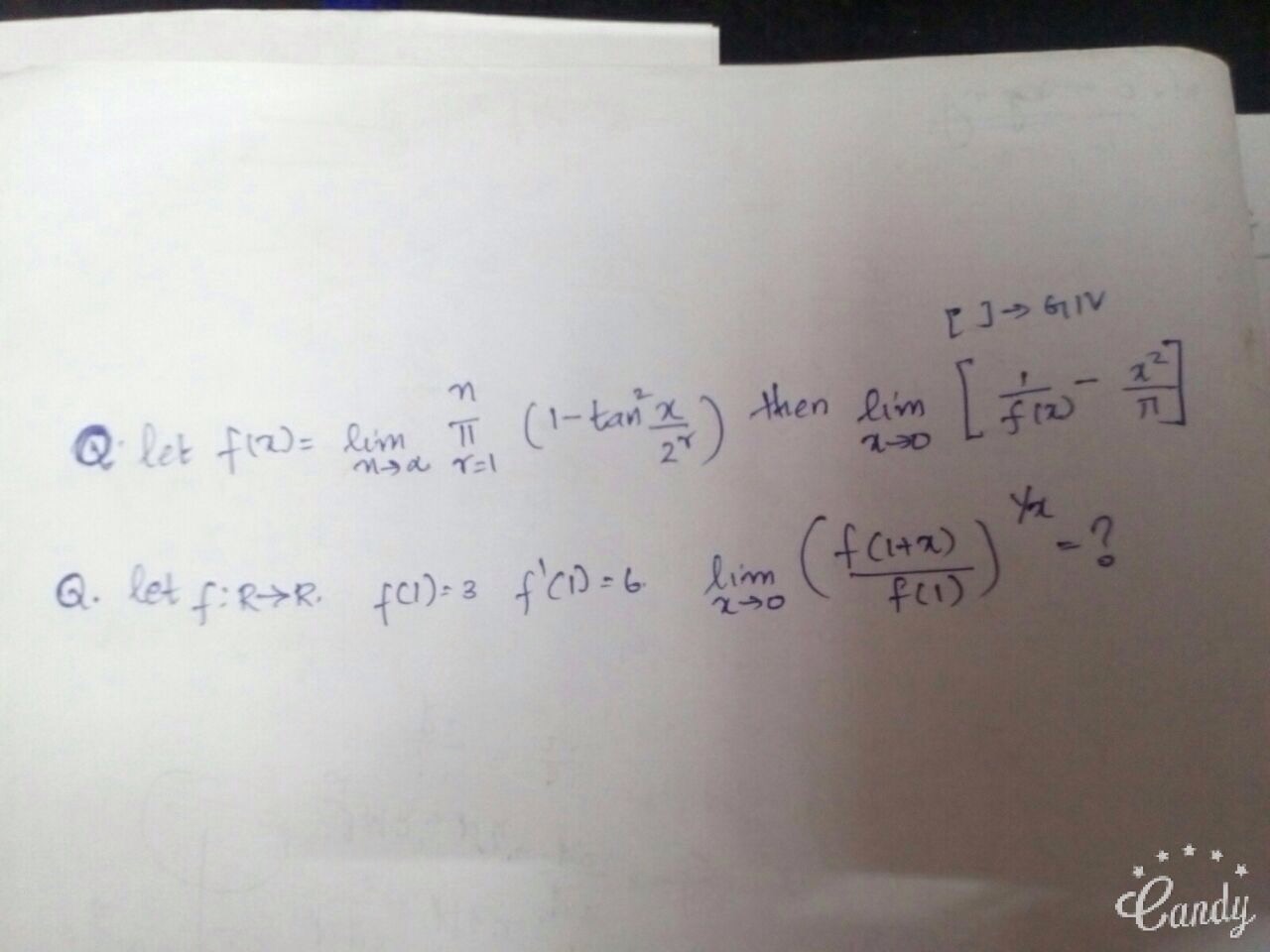
Can some one help me solve yhese limits? I am not able to solve it
Can some one help me solve yhese limits? I am not able to solve it



 Approved Tutor Answer11 Months ago
Absolutely, I’d be happy to help you with limits! Limits are a fundamental concept in calculus that help us understand the behavior of functions as they approach a certain point. Let’s break down how to solve limits step by step, using some examples to clarify the process.
In essence, a limit examines what happens to a function as it gets close to a specific value. For instance, if we have a function f(x), the limit as x approaches a number c is denoted as:
lim (x → c) f(x)
This notation asks, "What value does f(x) get closer to as x gets closer to c?"
Let’s consider a simple example:
lim (x → 2) (3x + 1)
To solve this, we can directly substitute x with 2:
3(2) + 1 = 6 + 1 = 7
So, the limit is 7. This is straightforward because the function is continuous at x = 2.
Now, let’s look at a slightly more complex example:
lim (x → 1) (x² - 1) / (x - 1)
If we substitute x = 1 directly, we get:
(1² - 1) / (1 - 1) = 0 / 0
This is an indeterminate form, which means we need to simplify the expression. We can factor the numerator:
(x - 1)(x + 1) / (x - 1)
Now, we can cancel out (x - 1) from the numerator and denominator (as long as x ≠ 1):
lim (x → 1) (x + 1)
Now substituting x = 1 gives us:
1 + 1 = 2
Thus, the limit is 2.
In cases where you encounter limits that result in indeterminate forms like 0/0 or ∞/∞, L'Hôpital's Rule can be very useful. This rule states that:
If lim (x → c) f(x)/g(x) = 0/0 or ∞/∞, then:
lim (x → c) f(x)/g(x) = lim (x → c) f'(x)/g'(x)
Let’s apply this to our previous example:
We have f(x) = x² - 1 and g(x) = x - 1. The derivatives are:
Now applying L'Hôpital's Rule:
lim (x → 1) (2x / 1) = 2(1) = 2
This confirms our previous result.
To become proficient in solving limits, practice is key. Try working on different types of limits, including those involving trigonometric functions, exponential functions, and logarithmic functions. Each type may require a different approach, but the underlying principles remain the same.
If you have specific limits you’re struggling with, feel free to share them, and we can work through them together!

Last Activity: 3 Years ago
Last Activity: 4 Years ago
Last Activity: 4 Years ago
Last Activity: 4 Years ago