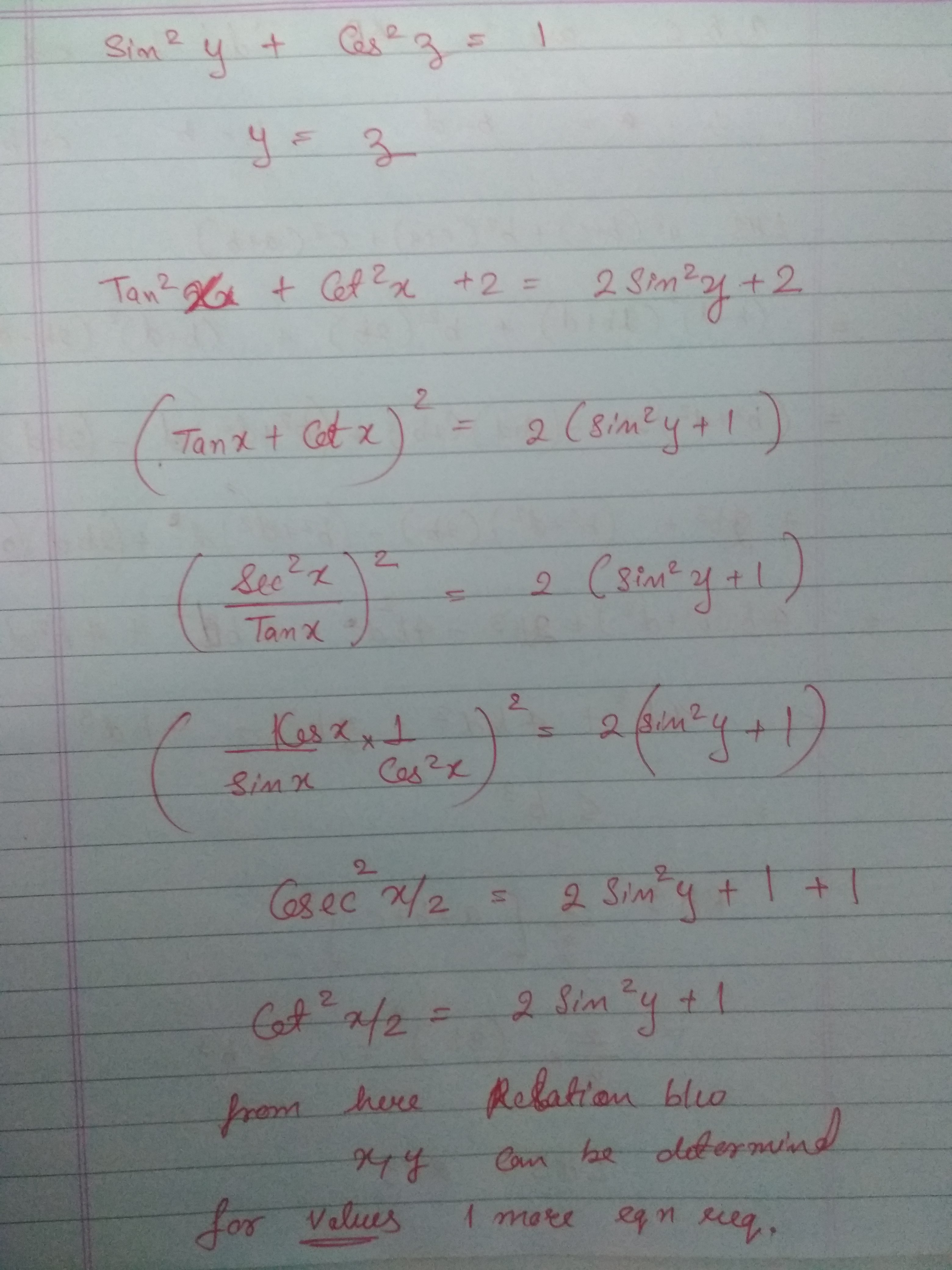
To solve the equations tan²x + cot²x = 2sin²y and sin²y + cos²z = 1, we can break it down step by step. Let's analyze each equation and find relationships between the variables.
Breaking Down the First Equation
The first equation is tan²x + cot²x = 2sin²y. To simplify this, we can use the identities for tangent and cotangent:
- tan²x = sin²x / cos²x
- cot²x = cos²x / sin²x
By substituting these identities into the equation, we have:
tan²x + cot²x = (sin²x / cos²x) + (cos²x / sin²x).
This can be combined into a single fraction:
tan²x + cot²x = (sin^4x + cos^4x) / (sin²x cos²x).
Next, we can use the identity sin²x + cos²x = 1 to express sin⁴x + cos⁴x in a useful way:
sin⁴x + cos⁴x = (sin²x + cos²x)² - 2sin²x cos²x = 1 - 2sin²x cos²x.
Substituting this back, we find:
tan²x + cot²x = (1 - 2sin²x cos²x) / (sin²x cos²x).
Now, simplifying the left-hand side gives us:
tan²x + cot²x = 2sin²y.
Thus, we can set:
(1 - 2sin²x cos²x) / (sin²x cos²x) = 2sin²y.
Solving for sin²y
From our equation, we can now express sin²y:
2sin²y = (1 - 2sin²x cos²x) / (sin²x cos²x).
This means:
sin²y = (1 - 2sin²x cos²x) / (2sin²x cos²x).
Examining the Second Equation
The second equation is sin²y + cos²z = 1. We can express cos²z in terms of sin²y:
cos²z = 1 - sin²y.
Now, substituting our expression for sin²y into this equation:
cos²z = 1 - (1 - 2sin²x cos²x) / (2sin²x cos²x).
To simplify further, we can find a common denominator:
cos²z = (2sin²x cos²x - (1 - 2sin²x cos²x)) / (2sin²x cos²x).
This simplifies to:
cos²z = (2sin²x cos²x - 1 + 2sin²x cos²x) / (2sin²x cos²x).
Thus:
cos²z = (4sin²x cos²x - 1) / (2sin²x cos²x).
Finding Solutions
At this point, we have expressions for both sin²y and cos²z in terms of sin²x and cos²x. The next step would involve finding specific values for x, y, and z that satisfy both equations. This may involve substituting known angles or using numerical methods if no simple angles yield satisfactory results.
For instance, if we assume x = 45 degrees (where tan²x and cot²x yield equal values), we can calculate sin²y and cos²z accordingly:
- tan²(45°) = 1, cot²(45°) = 1, so tan²x + cot²x = 2.
- Plugging into our first equation: 2 = 2sin²y, hence sin²y = 1 implies y = 90°.
- Next, substituting sin²y into the second equation: 1 + cos²z = 1 leads to cos²z = 0, hence z = 90°.
Therefore, a possible solution set could be x = 45°, y = 90°, and z = 90°. However, other solutions may exist, depending on the values chosen for x.
Summary of Results
The variables can be solved by breaking down the equations using trigonometric identities and substitutions, leading us to potential values for x, y, and z. Further exploration may yield additional solutions depending on the constraints and angles considered.