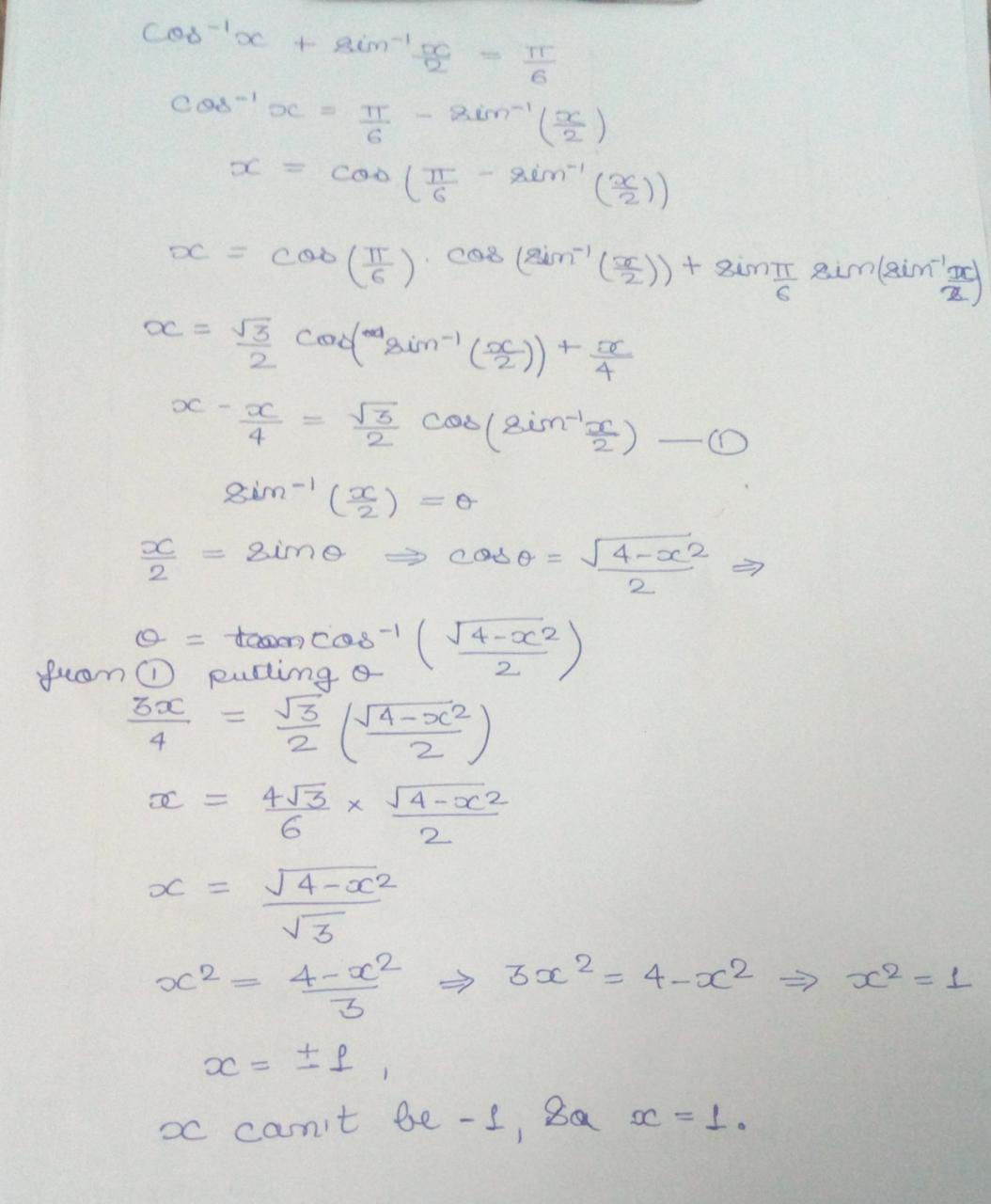
Sher Mohammad12 Years agotake sin for both sides,sin(cos^-1(x) + sin^-1(x/2) )= sin(pi/6)sin(cos^-1(x))cos(sin^-1(x/2))+sin(sin^-1(x/2) ))cos(cos^-1(x))=.5sqrt(1-cos(cos^-1(x)))^2)sqrt(1-sin(sin^-1(x/2)))^2)+x^2/2=.5sqrt(1-x^2)sqrt(1-(x/2)^2)+x^2/2=.5now , solve for xsher mohammadb.tech, iit delhi
moon7 Years ago We have cos–1x + sin–1 2x=6cos–1x =6– sin–1x x = cos 2x– sin6–1= cos6cos 2xsin–1+ sin6sin 2xsin–1 x =23cos 2x·214xcos 1–2–1 x =4x4x1–23 2 x –4x=4x1–23 24x1–2343x 2 4x1–43169x2 243x2= 1 –4x24x43x2 2 = 144x2= 1 x2 = 1 x = ±1 But x = 1
Rishi Sharma5 Years agoDear Student,Please find below the solution to your problem.Thanks and Regards