Flag Trigonometry> Let α and β be non–zero real numbers such...
question mark

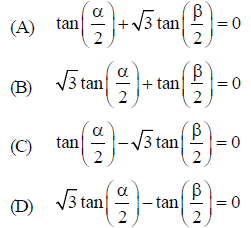
Let α and β be non–zero real numbers such that 2(cosβ – cosα) + cosα cosβ = 1. Then which of the following is/are true?
Umang Kumar , 7 Years ago
Grade 12
anser 1 Answers
Umang Kumar
2(cosb-cosa)+cosa.cosb=1
2cosb-2cosa+cosa.cosb=1
cosb(2+cosa)-(2cosa+1)=0
cos\beta =\frac{2cos\alpha +1}{2+cos\alpha }
Now converting cos\beta =\frac{1-tan^{2}\frac{\beta }{2}}{1+tan^{2}\frac{\beta }{2}}
cos\alpha =\frac{1-tan^{2}\frac{\alpha }{2}}{1+tan^{2}\frac{\alpha }{2}}
now equating cosa and cosb in
cos\beta =\frac{2cos\alpha +1}{2+cos\alpha }
we get
\frac{1-tan^{2}\frac{\beta }{2}}{1+tan^{2}\frac{\beta }{2}}=\frac{3-tan^{2}\frac{\alpha }{2}}{3+tan^{2}\frac{\alpha }{2}}
After applying Componendo and dividendo method each side we get:
\frac{2}{-2tan^{2}\frac{\beta }{2}}=\frac{6}{-2tan^{2}\frac{\alpha }{2}}
After solving this we get:
\frac{1}{tan^{2}\frac{\beta }{2}}=\frac{3}{tan^{2}\frac{\alpha }{2}}
After cross multiplying we get:
tan^{2\frac{\alpha }{2}}=3tan^{2\frac{\beta }{2}}
Square root both side:
tan\frac{\alpha }{2}=\pm \sqrt{3}tan\frac{\beta }{2}
hence the answers are:-
1.tan\frac{\alpha }{2}+\sqrt{3}tan\frac{\beta }{2}=0
2.tan\frac{\alpha }{2}-\sqrt{3}tan\frac{\beta }{2}=0
 
Last Activity: 7 Years ago
star
LIVE ONLINE CLASSES

Prepraring for the competition made easy just by live online class.

tv

Full Live Access

material

Study Material

removal

Live Doubts Solving

assignment

Daily Class Assignments