

Grade 12th passPhysical Chemistry
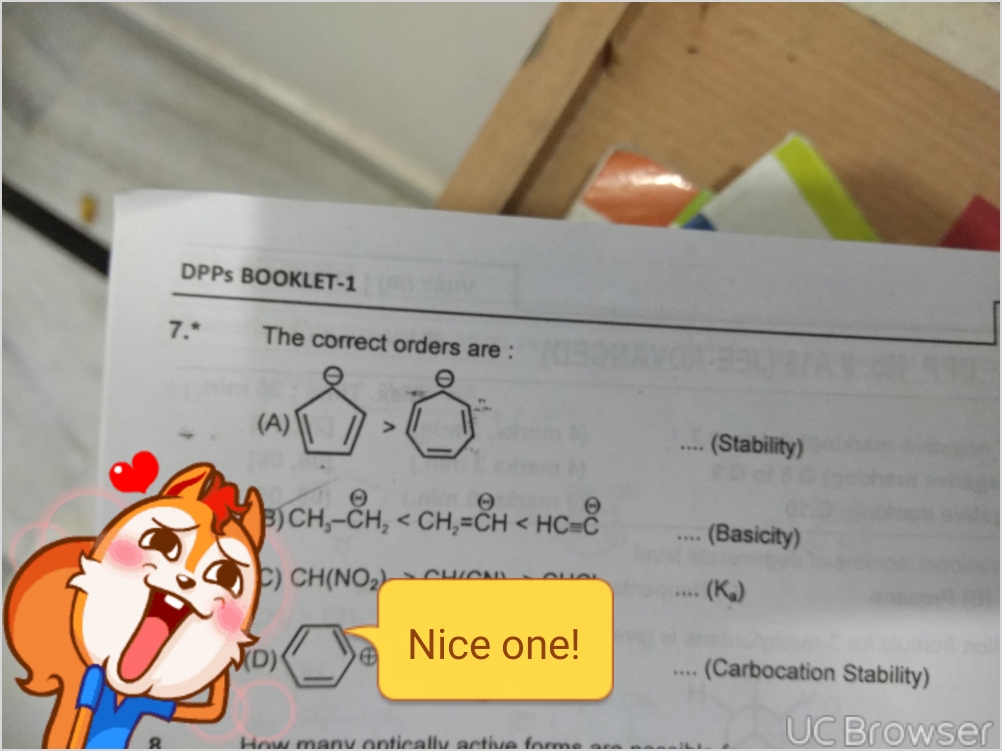
Why is option B wrong. post it as fast as you can. I think basicity order is white in that case.


 Approved Tutor Answer0 Years ago
To address why option B might be incorrect in the context of basicity order, we first need to clarify what we mean by basicity and how it is determined. Basicity refers to the ability of a compound to accept protons (H⁺ ions) or donate electron pairs. The basicity of a substance can be influenced by several factors, including the structure of the molecule, the presence of electronegative atoms, and resonance effects.
When assessing the basicity of different compounds, consider the following key factors:
Now, let’s consider why option B might be deemed incorrect in this context. If option B suggests that a particular compound is more basic than another without considering the factors mentioned above, it could lead to an inaccurate conclusion. For instance, if option B claims that a compound with a highly electronegative atom is more basic than one without, this would be misleading. The electronegative atom would likely pull electron density away from the basic site, making it less basic.
Take ammonia (NH₃) and methylamine (CH₃NH₂) as an example. Methylamine is generally more basic than ammonia due to the electron-donating effect of the methyl group, which increases the electron density on the nitrogen atom, making it more willing to accept a proton. If option B incorrectly states that ammonia is more basic than methylamine, it fails to account for the inductive effect of the methyl group.
In summary, the basicity order is influenced by various structural and electronic factors. If option B overlooks these critical aspects, it can lead to a misunderstanding of the basicity of the compounds in question. Always consider the molecular structure and the electronic environment when evaluating basicity to arrive at an accurate conclusion.

Last Activity: 3 Years ago
Last Activity: 3 Years ago
Last Activity: 3 Years ago
Last Activity: 4 Years ago