

Grade 12Physical Chemistry
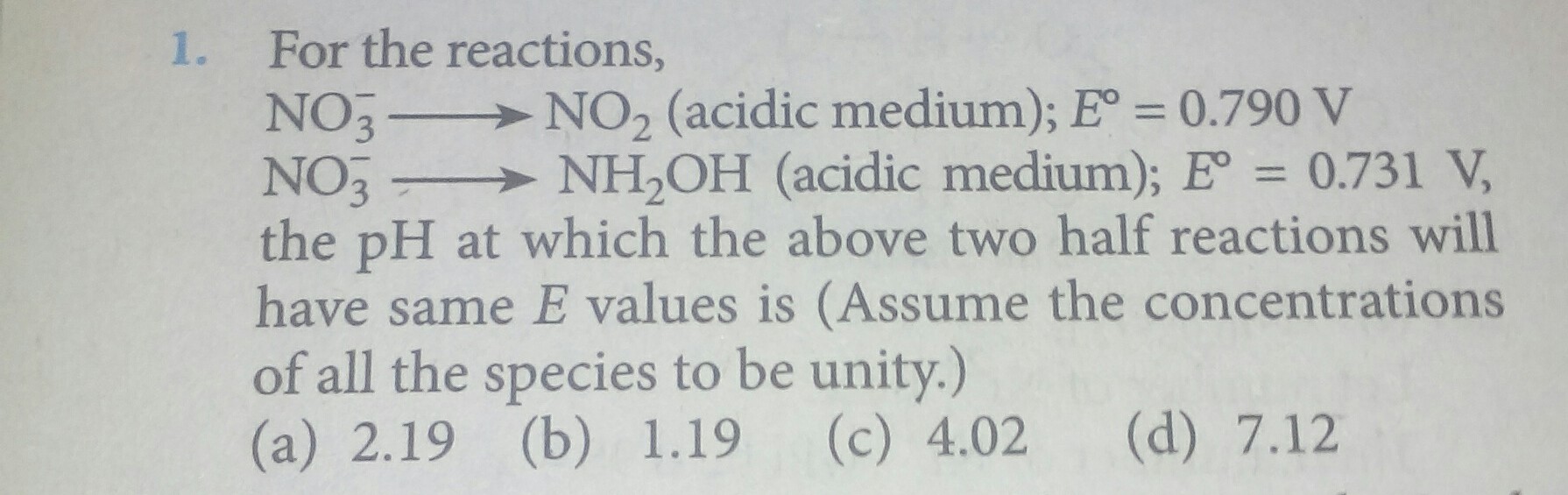
What will be the ph at which the two half equations will have the same E value.??


 Approved Tutor Answer1 Year ago
To determine the pH at which two half-equations have the same standard electrode potential (E), we need to consider the Nernst equation, which relates the concentration of reactants and products to the electrode potential. This is particularly relevant in redox reactions where the pH can influence the potential of half-reactions involving protons (H+).
The Nernst equation is given by:
E = E° - (RT/nF) * ln(Q)
Where:
When dealing with two half-reactions, we can express their potentials as:
E1 = E1° - (RT/n1F) * ln(Q1)
E2 = E2° - (RT/n2F) * ln(Q2)
To find the pH where E1 = E2, we set the two equations equal to each other:
E1° - (RT/n1F) * ln(Q1) = E2° - (RT/n2F) * ln(Q2)
If one or both half-reactions involve protons, the reaction quotient Q will include [H+], which is directly related to pH:
[H+] = 10-pH
Substituting this into the Nernst equation allows us to express the potentials in terms of pH. For example, if we have a half-reaction like:
Ox + 2H+ + 2e- ⇌ Red
The reaction quotient Q would be expressed as:
Q = [Red]/([Ox] * [H+]2)
Thus, as pH changes, the concentration of H+ changes, affecting the potential E.
To find the specific pH where E1 = E2, you would typically rearrange the equation to isolate pH. This might involve logarithmic manipulation and solving for pH based on the known values of E1°, E2°, and the stoichiometry of the half-reactions.
Suppose we have two half-reactions:
Setting the potentials equal and substituting the Nernst equation for both half-reactions, we can solve for pH. This will involve plugging in the values and manipulating the equation until we isolate pH.
In summary, the pH at which two half-equations have the same E value can be found by applying the Nernst equation, considering the influence of H+ concentration on the electrode potentials. By setting the equations equal and solving for pH, you can determine the specific conditions under which the two half-reactions yield the same potential. This approach is essential in electrochemistry and helps in understanding the behavior of redox reactions in various environments.

Last Activity: 3 Years ago
Last Activity: 3 Years ago
Last Activity: 3 Years ago
Last Activity: 4 Years ago