

Grade 9Physical Chemistry
What is spectrochemical series? Explain the difference between a weak field ligand and a strong field ligand.


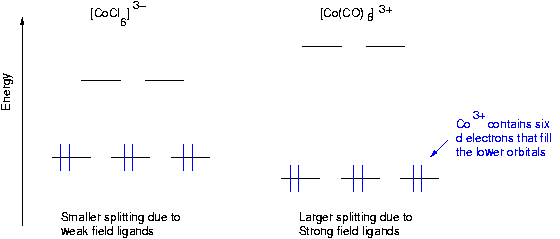
Ligands are ranked according to the extent that they split the d electrons. Strong field ligands cause the d orbitals to be split by a large amount. Weak field ligands, on the other hand, cause the d orbitals to be split by only a small amount. The order for some common ligands is as follows:
| I-< Br-< S2-<SCN-< Cl-< NO3-< Cl-< F-< OH-< H2O < < O2-< NH3<NO2-< CN-< CO |
| <-- weaker field ligands stronger field ligands --> |
| <-- Larger wavelength absorption smaller wavelength absorption --> |
This is known as the spectrochemical series. A ligand like CO is called a strong field ligand, whereas as ligand like Cl-is considered a weak field ligand. Consider what this looks like for two octahedral complexes formed by Co3+: [CoCl6]3-( Co3+w/ six Cl-ligands) and [Co(CO)6]3+( Co3+w/ six neutral CO ligands):

Last Activity: 3 Years ago
Last Activity: 3 Years ago
Last Activity: 3 Years ago
Last Activity: 4 Years ago