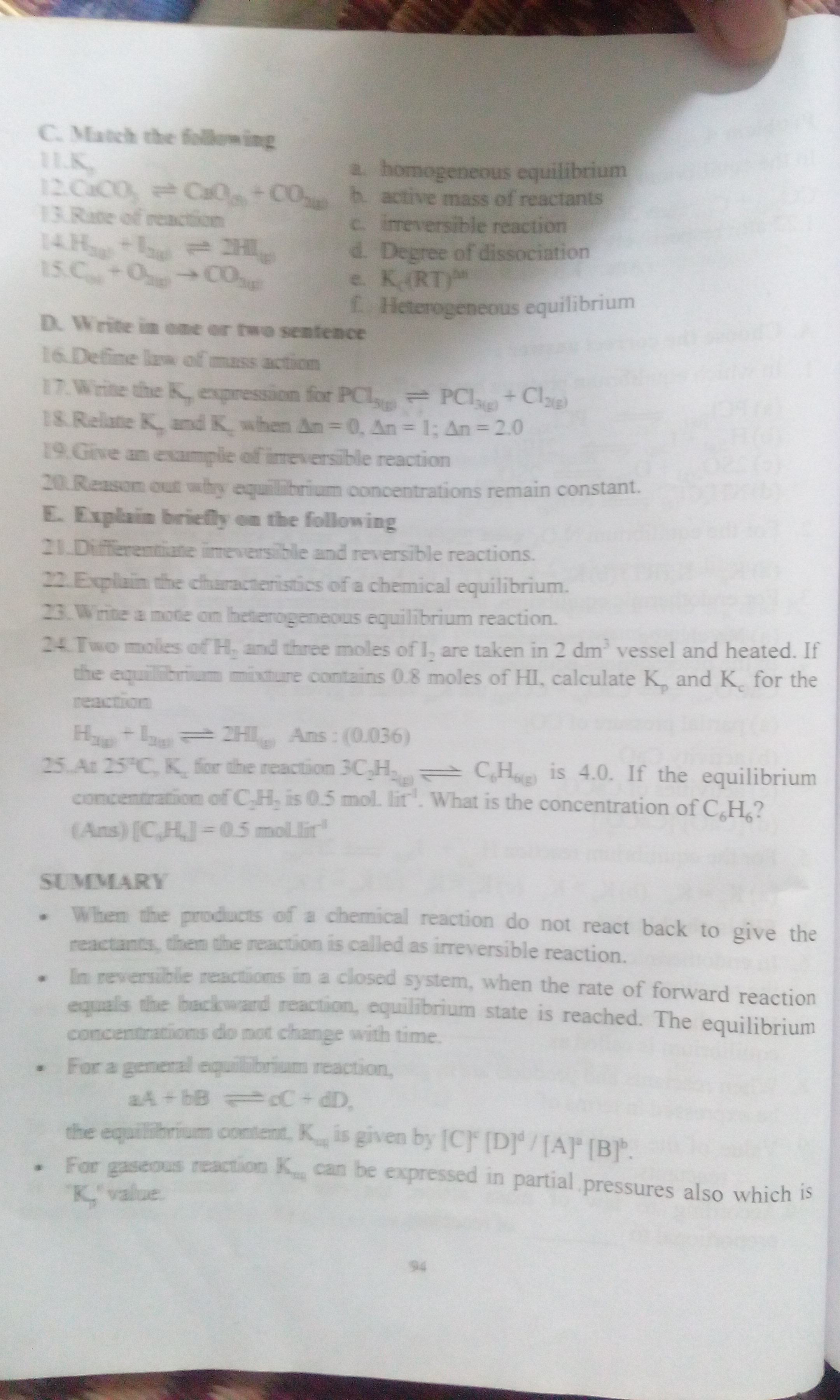
To tackle the problem of calculating the equilibrium constants \( K_p \) and \( K_c \) for the reaction \( H_2(g) + I_2(g) \rightleftharpoons 2 HI(g) \), we need to start by analyzing the initial conditions and the changes that occur as the reaction reaches equilibrium. Let's break this down step by step.
Initial Conditions
We have:
- Initial moles of \( H_2 \) = 2 moles
- Initial moles of \( I_2 \) = 3 moles
- Volume of the vessel = 2 dm³
Equilibrium Information
At equilibrium, we are given that there are 0.8 moles of \( HI \). Since the reaction produces 2 moles of \( HI \) for every mole of \( H_2 \) and \( I_2 \) that reacts, we can determine how many moles of \( H_2 \) and \( I_2 \) have reacted.
Change in Moles
From the stoichiometry of the reaction, if \( x \) moles of \( H_2 \) and \( I_2 \) react, then:
- Moles of \( HI \) produced = \( 2x \)
Since we know that at equilibrium there are 0.8 moles of \( HI \), we can set up the equation:
\( 2x = 0.8 \)
From this, we find:
\( x = 0.4 \) moles
Calculating Equilibrium Moles
Now we can find the equilibrium moles of \( H_2 \) and \( I_2 \):
- Equilibrium moles of \( H_2 \) = \( 2 - x = 2 - 0.4 = 1.6 \) moles
- Equilibrium moles of \( I_2 \) = \( 3 - x = 3 - 0.4 = 2.6 \) moles
Calculating Concentrations
Next, we need to calculate the concentrations of each species at equilibrium. Concentration is given by the formula:
\( \text{Concentration} = \frac{\text{Moles}}{\text{Volume}} \)
Given that the volume is 2 dm³, we can find:
- Concentration of \( H_2 \) = \( \frac{1.6 \text{ moles}}{2 \text{ dm}^3} = 0.8 \text{ mol/dm}^3 \)
- Concentration of \( I_2 \) = \( \frac{2.6 \text{ moles}}{2 \text{ dm}^3} = 1.3 \text{ mol/dm}^3 \)
- Concentration of \( HI \) = \( \frac{0.8 \text{ moles}}{2 \text{ dm}^3} = 0.4 \text{ mol/dm}^3 \)
Equilibrium Constants
Now we can calculate \( K_c \) and \( K_p \). The expressions for these constants are as follows:
- For \( K_c \):
\( K_c = \frac{[HI]^2}{[H_2][I_2]} \)
- For \( K_p \):
\( K_p = K_c(RT)^{\Delta n} \)
Where \( \Delta n \) is the change in moles of gas, which is \( 2 - (1 + 1) = 0 \) for this reaction.
Calculating Kc
Substituting the equilibrium concentrations into the \( K_c \) expression:
\( K_c = \frac{(0.4)^2}{(0.8)(1.3)} \)
Calculating this gives:
\( K_c = \frac{0.16}{1.04} \approx 0.1538 \, \text{mol/dm}^3 \)
Calculating Kp
Since \( \Delta n = 0 \), we have:
\( K_p = K_c(RT)^0 = K_c \)
Thus, \( K_p = 0.1538 \, \text{atm} \) (assuming ideal gas behavior and standard conditions).
Final Results
In summary, the equilibrium constants for the reaction are:
- \( K_c \approx 0.1538 \, \text{mol/dm}^3 \)
- \( K_p \approx 0.1538 \, \text{atm} \)
This process illustrates how to approach equilibrium problems systematically, using stoichiometry and the definitions of equilibrium constants. If you have any further questions or need clarification on any step, feel free to ask!