

Grade 12Physical Chemistry
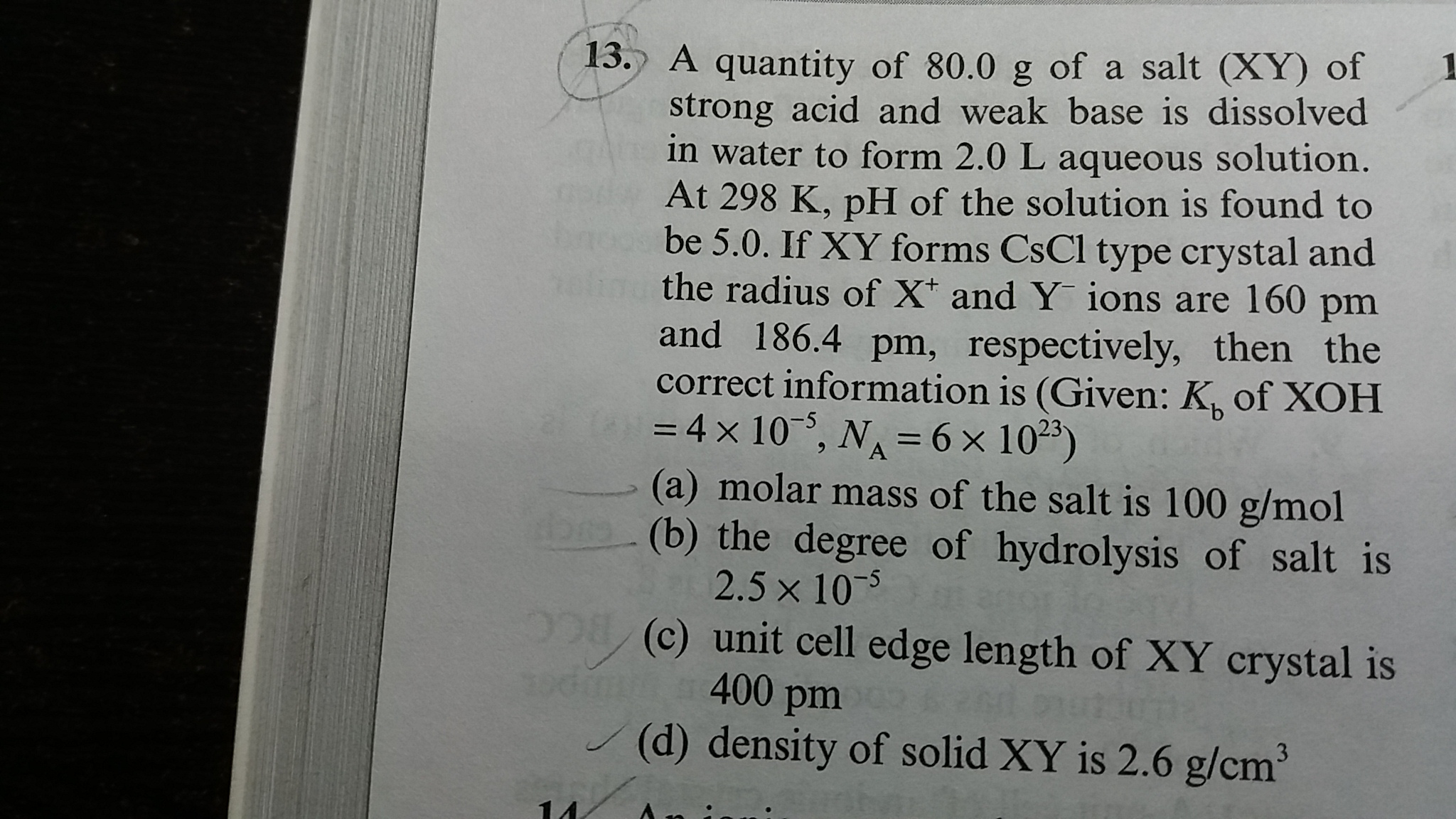
This question is a mixture of ionic equilibrium and solid state
This question is a mixture of ionic equilibrium and solid state


 Approved Tutor Answer11 Months ago
When discussing a topic that intertwines ionic equilibrium and solid-state chemistry, it's essential to break down both concepts to understand how they interact. Ionic equilibrium primarily deals with the balance of ions in a solution, while solid-state chemistry focuses on the arrangement of atoms in solid materials. Let's dive into how these two areas can overlap, particularly in the context of solubility and the behavior of ionic compounds in solid forms.
Ionic equilibrium refers to the state in which the concentrations of ions in a solution remain constant over time. This can occur in various scenarios, such as when a salt dissolves in water. For instance, when sodium chloride (NaCl) is added to water, it dissociates into sodium ions (Na+) and chloride ions (Cl-). The equilibrium can be represented by the following equation:
At equilibrium, the rate of dissolution of NaCl equals the rate of precipitation, meaning the concentration of Na+ and Cl- ions remains constant.
In solid-state chemistry, we examine how ions are arranged in a solid lattice structure. Ionic compounds like NaCl form a crystalline structure where each Na+ ion is surrounded by six Cl- ions and vice versa. This arrangement is crucial because it influences the compound's properties, such as melting point, solubility, and conductivity.
The connection between ionic equilibrium and solid-state chemistry becomes particularly evident when considering solubility equilibria. The solubility product constant (Ksp) is a key concept here. It quantifies the extent to which a solid ionic compound can dissolve in a solvent. For a generic ionic compound represented as AxBy, the Ksp expression can be written as:
For example, consider calcium fluoride (CaF2). Its dissolution can be represented as:
The Ksp for this reaction would be:
Several factors influence the solubility of ionic compounds, including:
Understanding the relationship between ionic equilibrium and solid-state chemistry is crucial in various fields, including environmental science, materials science, and pharmaceuticals. For instance, in wastewater treatment, knowing how ionic compounds behave in solid and aqueous states can help in designing effective removal processes.
In summary, the interplay between ionic equilibrium and solid-state chemistry is fundamental to grasping how ionic compounds behave in different environments. By examining solubility and the factors that influence it, we can better understand the properties and applications of these materials in real-world scenarios.

Last Activity: 3 Years ago
Last Activity: 3 Years ago
Last Activity: 3 Years ago
Last Activity: 4 Years ago