Question icon
Grade 11Physical Chemistry

The vapour pressure of pure benzene at a certain temperature is 0.850 bar. A non-volatile, non-electrolyte solid weighing 0.5 g when added to 39.0 g of benzene (molar mass 78 g mol-1). Vapour pressure of the solution, then, is 0.845 bar. What is the molar mass of the solid substance?

Profile image of Jayant Kumar
12 Years agoGrade 11
Answers icon

3 Answers

Profile image of Pankaj
11 Years ago
pi° =0.850 bar:
p=0.845 bar:
M1 = 78 g mol-1
w2 = 0.5 g
w1=39g
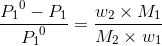
Substituting these values In equation .
\frac{{P_1}^0-P_1}{{P_1}^0} = \frac{w_2\times M_1}{M_2\times w_1}
and calculating,

M2= 170 g mol-1
Profile image of Neeti
8 Years ago
P°=0.850
P'=0.845
No of moles of benzene=39/78=0.5
No of moles of solute=x
(P°-P')/p°=mole fraction of solute
P°-p'=0.005
Mole fraction of solute=0.005/0.850----*1
Mole fraction of solute=x/(x+0.5)-----*2
Sub eq 1 and 2
X=169g
 
Profile image of Kushagra Madhukar
6 Years ago
Hello Student
Given
Psolution = Ps =  0.845
Psolvent = Po = 0.850 (Benzene)
Moles of solvent = 39/78 = 0.5
Let the moles of solute = a
 
Now, according to Raoult’s law
Relative lowering of vapour pressure = mole fraction of solute
(Po – Ps)/Po = a/(a + 0.5)
a/(a + 5) = (0.850- 0.845)/0.850 = 0.005882
 
On solving for a, we get, 
a = 0.00296
Given mass of solute = 0.5 g
Hence, molar mass of solute = mass of solute / number of moles = 0.5/0.00296 = 169 g/mol
 
Hope it helps