

Grade 12Physical Chemistry
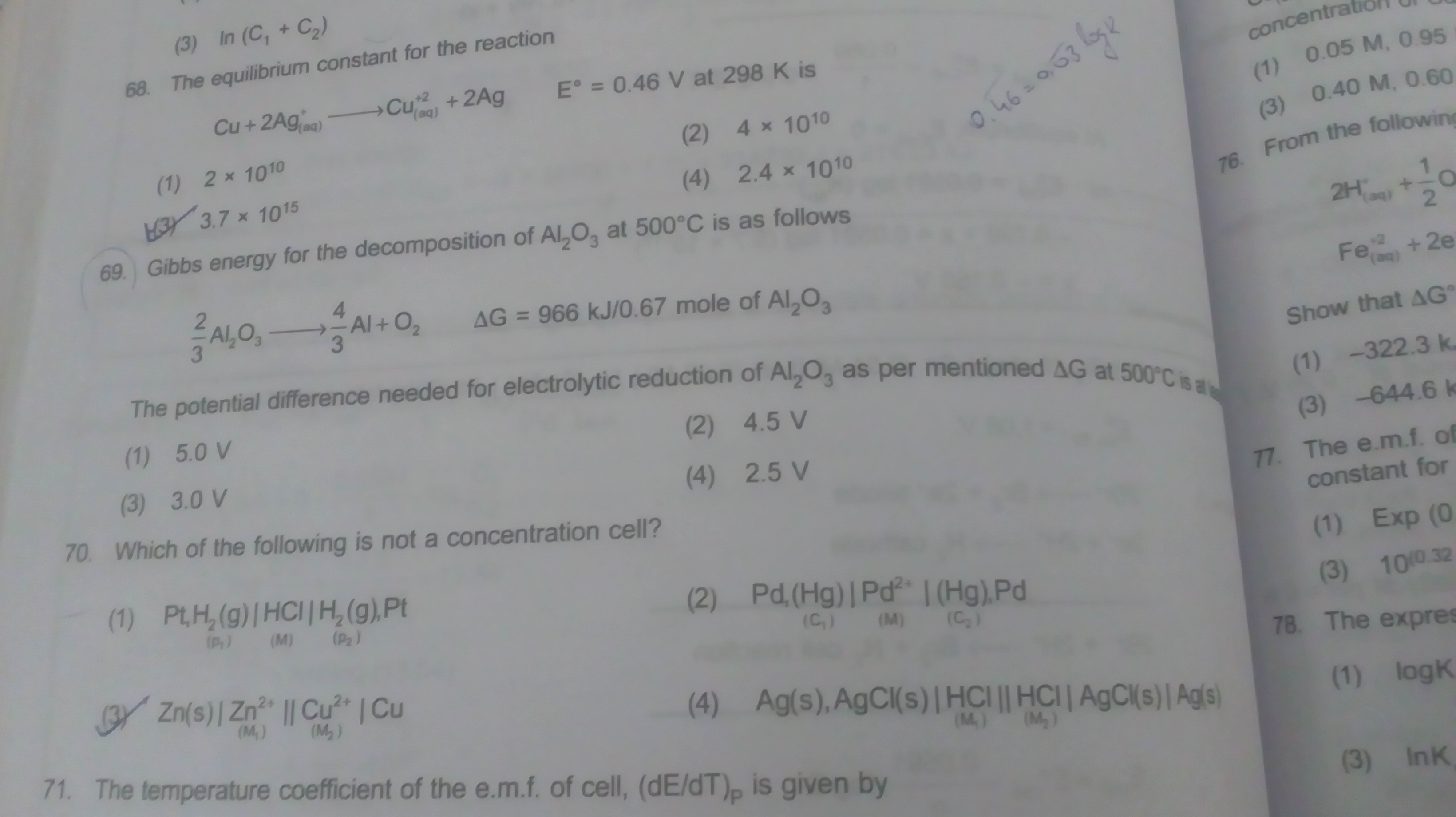
Question 69 in the attatched photo.i.e.Gibbs energy for the decomposition of ........is at least.


 Approved Tutor Answer1 Year ago
To determine the Gibbs energy for the decomposition of a substance, we need to understand the relationship between Gibbs free energy (G) and the spontaneity of a reaction. The Gibbs free energy change (ΔG) is a crucial factor in predicting whether a reaction will occur spontaneously at constant temperature and pressure. If ΔG is negative, the reaction is spontaneous; if it is positive, the reaction is non-spontaneous.
The Gibbs free energy is defined by the equation:
ΔG = ΔH - TΔS
To assess the Gibbs energy for the decomposition reaction, consider the following:
Let’s consider a hypothetical decomposition reaction:
A(s) → B(g) + C(g)
Assume the following values:
To find ΔG at a specific temperature, say 298 K (25°C), we first convert ΔS to kJ:
ΔS = 200 J/(mol·K) = 0.2 kJ/(mol·K)
Now, we can substitute the values into the Gibbs free energy equation:
ΔG = ΔH - TΔS
ΔG = 100 kJ/mol - (298 K × 0.2 kJ/(mol·K))
ΔG = 100 kJ/mol - 59.6 kJ/mol = 40.4 kJ/mol
Since ΔG is positive, the decomposition reaction is non-spontaneous at 298 K.
In summary, to determine the Gibbs energy for the decomposition of a substance, you need to analyze the changes in enthalpy and entropy, along with the temperature. By applying the Gibbs free energy equation, you can predict the spontaneity of the reaction. If you have specific values for ΔH and ΔS for the decomposition in question, you can plug them into the equation to find the Gibbs energy change.

Last Activity: 3 Years ago
Last Activity: 3 Years ago
Last Activity: 3 Years ago
Last Activity: 4 Years ago