Thermodynamics is a fascinating branch of physical chemistry that deals with the relationships between heat, work, temperature, and energy. It provides a framework for understanding how energy is transferred and transformed in chemical processes. Let’s delve into some key concepts and principles that are fundamental to thermodynamics.
Key Concepts of Thermodynamics
At its core, thermodynamics revolves around several important laws and concepts:
- System and Surroundings: A system is the part of the universe we are focusing on, while the surroundings encompass everything else. Systems can be open, closed, or isolated based on how they exchange energy and matter with their surroundings.
- Internal Energy: This is the total energy contained within a system, including kinetic and potential energies of the molecules. Changes in internal energy are crucial for understanding how systems respond to heat and work.
- Enthalpy (H): This is a measure of the total heat content of a system. It is particularly useful in processes occurring at constant pressure, as it combines internal energy with the product of pressure and volume.
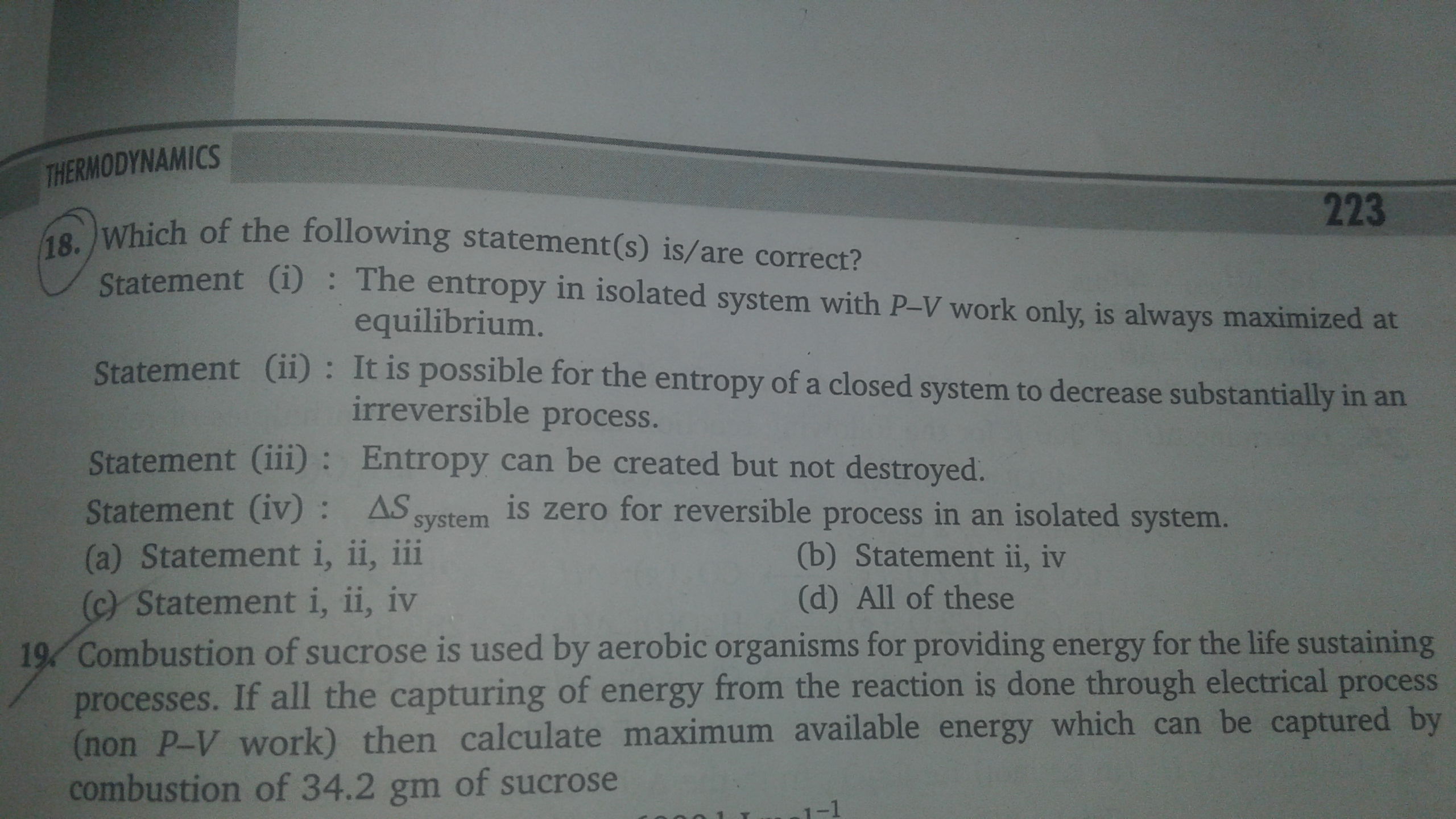
- Entropy (S): Entropy is a measure of disorder or randomness in a system. It helps predict the direction of spontaneous processes and is a central concept in the second law of thermodynamics.
- Gibbs Free Energy (G): This is a thermodynamic potential that can be used to predict whether a process will occur spontaneously at constant temperature and pressure. A negative change in Gibbs free energy indicates a spontaneous process.
Understanding the Laws of Thermodynamics
Thermodynamics is governed by four fundamental laws:
- First Law: This law states that energy cannot be created or destroyed, only transformed. Mathematically, it can be expressed as ΔU = Q - W, where ΔU is the change in internal energy, Q is the heat added to the system, and W is the work done by the system.
- Second Law: This law introduces the concept of entropy, stating that in any energy transfer, the total entropy of a closed system can never decrease. This explains why certain processes are irreversible and why energy tends to disperse.
- Third Law: As a system approaches absolute zero, the entropy of a perfect crystal approaches zero. This law helps establish a reference point for measuring entropy.
- Zeroth Law: This law establishes thermal equilibrium, stating that if two systems are each in thermal equilibrium with a third system, they are in thermal equilibrium with each other.
Applications in Chemistry
Thermodynamics plays a crucial role in various chemical processes. For instance:
- Reaction Spontaneity: By calculating the Gibbs free energy change for a reaction, chemists can predict whether the reaction will occur under specific conditions.
- Phase Changes: Thermodynamic principles help explain phenomena like melting, boiling, and sublimation, as they involve energy changes and entropy considerations.
- Equilibrium: The concept of chemical equilibrium is deeply rooted in thermodynamics, where the rates of the forward and reverse reactions are equal, leading to a stable concentration of reactants and products.
Example: Calculating Gibbs Free Energy
Let’s say we have a reaction at standard conditions, and we know the standard enthalpy change (ΔH°) and the standard entropy change (ΔS°). We can calculate the Gibbs free energy change using the formula:
ΔG° = ΔH° - TΔS°
Where T is the temperature in Kelvin. If ΔG° is negative, the reaction is spontaneous; if positive, it is non-spontaneous.
Final Thoughts
Thermodynamics is essential for understanding the energy dynamics of chemical reactions and processes. By grasping these principles, you can better predict how substances will behave under various conditions, which is invaluable in both academic and practical applications in chemistry.