
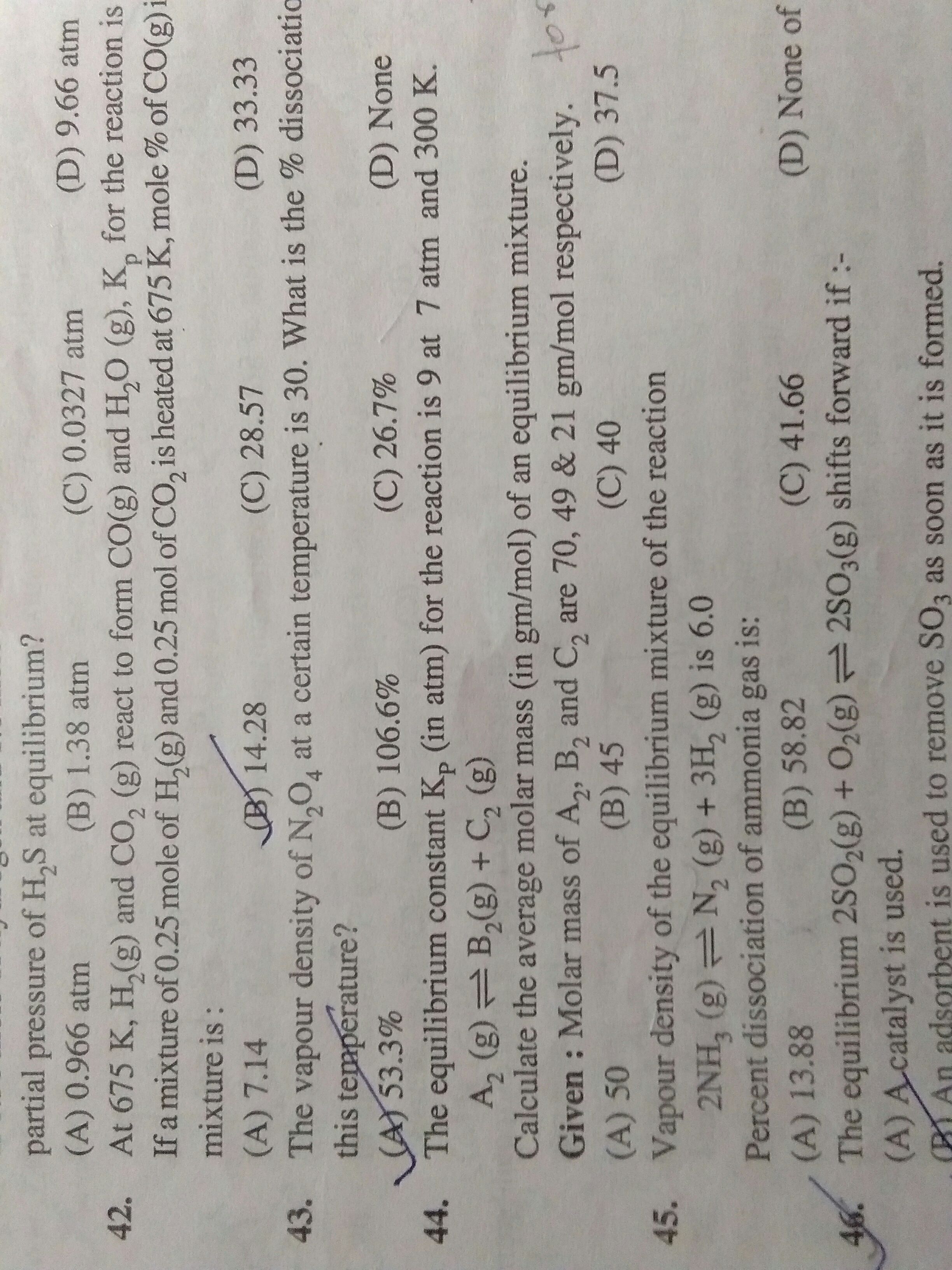
Please solve question 44 how to calculate average molar mass in this reaction

Dinesh , 8 Years ago
Grade 12th pass
 Physical Chemistry> Please solve question 44 how to calculate...
 1 Answers
To calculate the average molar mass in a chemical reaction, you first need to understand the components involved in the reaction and their respective molar masses. Let’s break this down step by step.
Molar mass is the mass of one mole of a substance, typically expressed in grams per mole (g/mol). Each element has a specific molar mass, which can be found on the periodic table. For compounds, the molar mass is the sum of the molar masses of all the atoms in the molecule.
Here’s how you can calculate the average molar mass for a reaction:
For H2O:
Once you have the molar masses of all reactants and products, you can find the average molar mass of the reaction. This is done by taking the total mass of the reactants and dividing it by the total number of moles of the reactants.
By following these steps, you can effectively calculate the average molar mass for any reaction. Remember, the key is to ensure that your chemical equation is balanced and that you accurately find the molar masses of all substances involved. This method not only helps in understanding the reaction better but also in applying this knowledge to various chemical calculations.
 Approved
Prepraring for the competition made easy just by live online class.

Full Live Access

Study Material

Live Doubts Solving

Daily Class Assignments

Last Activity: 3 Years ago
Last Activity: 3 Years ago
Last Activity: 4 Years ago