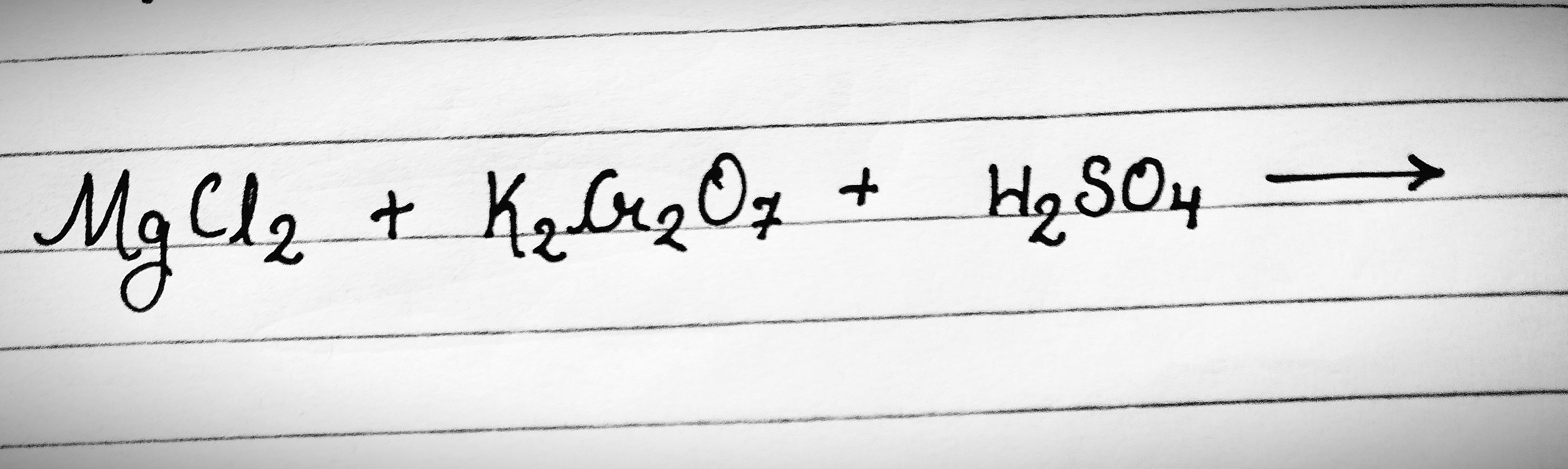
To determine the products of the chemical reaction and rewrite the balanced equation, we first need to understand the reactants involved. Since I can't see the attached image, I'll guide you through a typical reaction that produces chromyl chloride (CrO2Cl2) as one of the products. This often occurs when chromium compounds react with chlorine or hydrochloric acid.
Typical Reaction Involving Chromyl Chloride
One common reaction that produces chromyl chloride is the reaction of chromium trioxide (CrO3) with hydrochloric acid (HCl). The balanced equation for this reaction can be represented as follows:
Balanced Chemical Equation
The unbalanced equation looks like this:
- CrO3 + HCl → CrO2Cl2 + H2O
Now, let's balance it. The balanced equation is:
- CrO3 + 2 HCl → CrO2Cl2 + H2O
Breaking Down the Reaction
In this reaction:
- Chromium Trioxide (CrO3): This is a powerful oxidizing agent and is often used in various chemical syntheses.
- Hydrochloric Acid (HCl): This strong acid provides the chloride ions necessary for forming chromyl chloride.
- Chromyl Chloride (CrO2Cl2): This is the product of interest, which is a dark red liquid and has applications in organic synthesis.
- Water (H2O): This is a byproduct of the reaction.
Understanding the Formation of Products
When CrO3 reacts with HCl, the chromium in CrO3 is reduced, while the chloride ions from HCl combine with chromium to form chromyl chloride. The reaction also produces water as a byproduct. This type of reaction is a classic example of an acid-base reaction where the acid (HCl) reacts with a base (CrO3) to form a salt (CrO2Cl2) and water.
Conclusion
In summary, the balanced equation for the reaction producing chromyl chloride from chromium trioxide and hydrochloric acid is:
- CrO3 + 2 HCl → CrO2Cl2 + H2O
Understanding these types of reactions is crucial in chemistry, especially when dealing with transition metals and their compounds. If you have any specific details from the image or further questions about this reaction or others, feel free to ask!