Question icon
Grade 12th passPhysical Chemistry

Please answers these questions......
Base on the attachment model, answers the following questions.
  1. What is the relationship between Atom 1 and Atom 3? (One word is sufficient.)
  2. Write each of the atoms above in the shorthand notation that describes the most common isotope of hydrogen as H-1.
  3. Briefly comment on the proportions of these atoms as they are depicted here
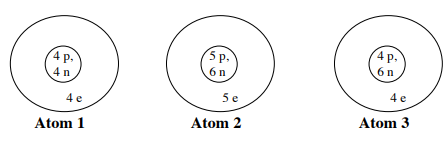
How many valence electrons does Atom -2 have

Question image for Please answers these questions...... Base on the
Profile image of Mateen ul Hasan
8 Years agoGrade 12th pass
Answers icon

1 Answer

Profile image of Askiitians Tutor Team
ApprovedApproved Tutor Answer0 Years ago

To address your questions based on the attachment model, let's break it down step by step.

Relationship Between Atom 1 and Atom 3

The relationship between Atom 1 and Atom 3 can be described in one word: bonded.

Shorthand Notation for Atoms

In shorthand notation, the most common isotopes of hydrogen are represented as follows:

  • Atom 1: H-1
  • Atom 2: H-2
  • Atom 3: H-3

Here, H-1 refers to protium, which is the most abundant isotope of hydrogen, containing one proton and no neutrons. H-2, known as deuterium, has one proton and one neutron, while H-3, or tritium, contains one proton and two neutrons.

Proportions of Atoms

When considering the proportions of these isotopes in nature, H-1 is by far the most prevalent, making up about 99.98% of all hydrogen found. H-2 is much rarer, occurring at about 0.0156%, and H-3 is even less common, primarily produced in trace amounts through cosmic ray interactions and certain nuclear reactions.

Valence Electrons in Atom 2

Atom 2, which is H-2 (deuterium), has one valence electron. This is because hydrogen, regardless of its isotope, has only one electron in its outer shell, which is also its only electron overall. Valence electrons are crucial as they determine how an atom interacts and bonds with others.

In summary, Atom 1 and Atom 3 are bonded, the shorthand notations for the isotopes of hydrogen are H-1, H-2, and H-3, and Atom 2 has one valence electron. This understanding of atomic structure and relationships is fundamental in chemistry, especially when exploring molecular interactions.