

Grade 12Physical Chemistry
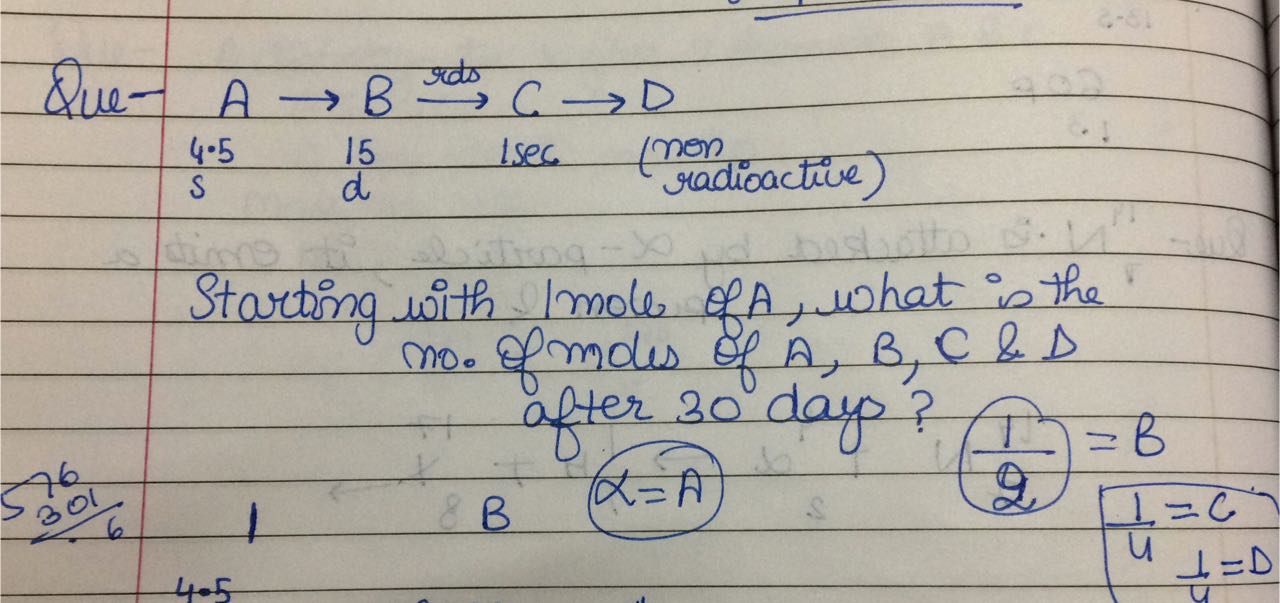
Please answer this question Ans:1/2B, 1/4C &1/4D and no moles of A
Please answer this question
Ans:1/2B, 1/4C &1/4D and no moles of A


 Approved Tutor Answer11 Months ago
To tackle the expression you've provided, let's break it down step by step. It seems like you're dealing with a chemical reaction or a stoichiometric problem involving substances A, B, C, and D. The notation suggests that you have specific ratios or fractions of B, C, and D, while noting that there are no moles of A present. This could imply that A is either a reactant that hasn't been introduced or is not involved in the current state of the reaction.
The fractions you've mentioned—1/2B, 1/4C, and 1/4D—indicate the proportions of each substance in relation to some total amount. Let's assume these fractions represent the amounts of each substance in a mixture or a reaction.
The absence of moles of A could have several implications depending on the context. If A is a reactant, it might mean that the reaction cannot proceed as expected since one of the necessary components is missing. Alternatively, if A is a product or a catalyst, its absence might indicate a different phase of the reaction or a need for additional input to reach completion.
Let’s consider a hypothetical reaction where A reacts with B, C, and D to form products. If we start with no moles of A, we cannot produce any products that depend on A. Thus, the presence of B, C, and D alone does not lead to any reaction unless A is introduced. This situation can be visualized like a recipe missing a key ingredient; without it, you cannot complete the dish.
In summary, the fractions of B, C, and D represent their respective contributions to a total mixture or reaction, while the absence of A suggests that either the reaction is incomplete or that A is not necessary for the current state of the system. Understanding these relationships is crucial in chemistry, especially in stoichiometry and reaction dynamics.

Last Activity: 3 Years ago
Last Activity: 3 Years ago
Last Activity: 3 Years ago
Last Activity: 4 Years ago