

Grade 11Physical Chemistry
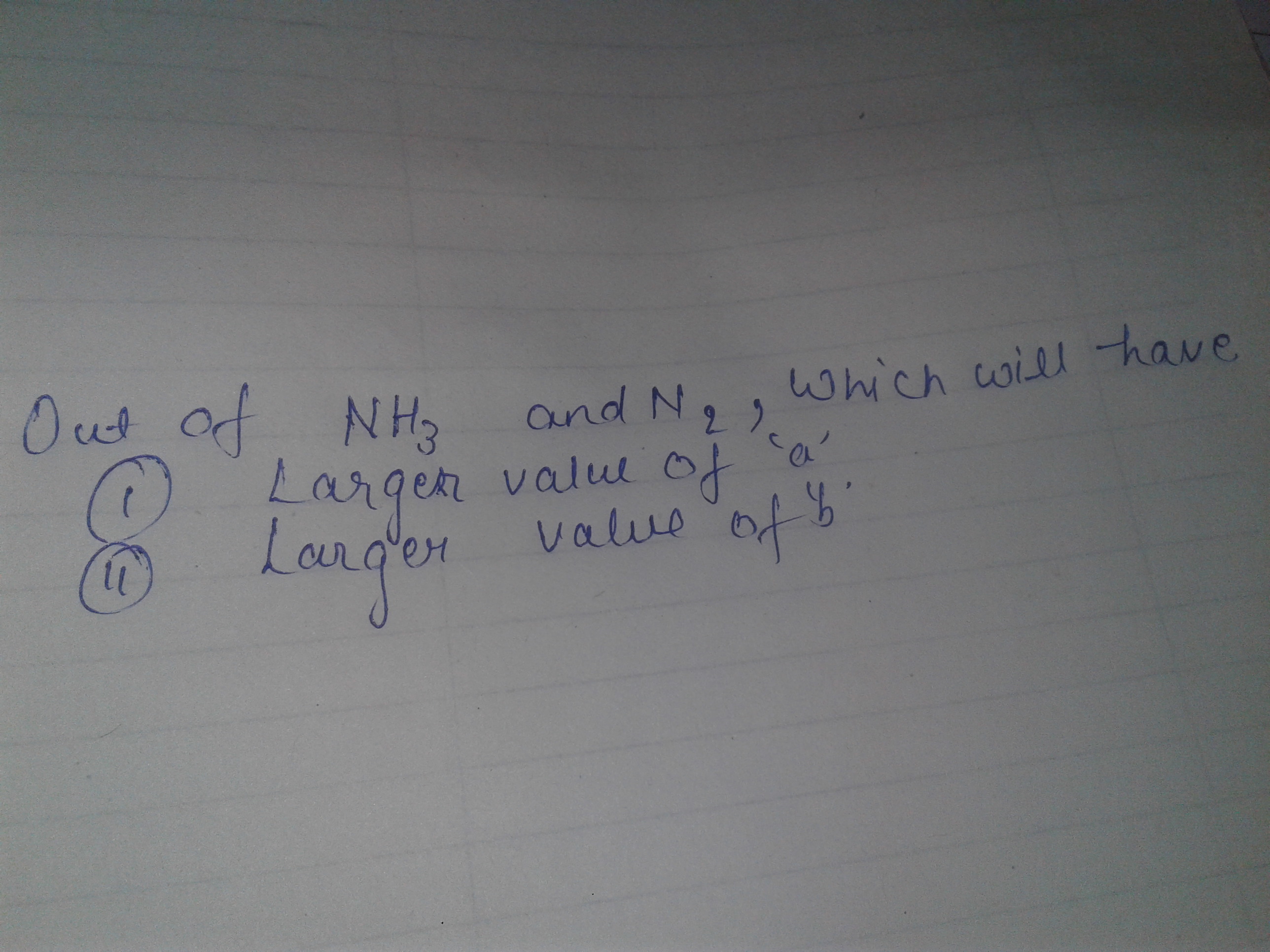
Out of NH3 and N2 which will have (1)larger value of a (2)lager value of b


 Approved Tutor Answer1 Year ago
To determine which substance, ammonia (NH3) or nitrogen (N2), has larger values of the van der Waals constants \(a\) and \(b\), we need to understand what these constants represent in the context of real gases. The van der Waals equation is an adjustment of the ideal gas law that accounts for the volume occupied by gas molecules and the attractive forces between them.
The constants \(a\) and \(b\) in the van der Waals equation have specific meanings:
Now, let's compare ammonia (NH3) and nitrogen (N2) based on these constants:
Ammonia (NH3) has a larger value of \(a\) compared to nitrogen (N2). This is primarily because NH3 molecules exhibit stronger intermolecular forces due to hydrogen bonding, which is absent in N2. The presence of these hydrogen bonds in NH3 leads to greater attractions between molecules, resulting in a higher \(a\) value.
When it comes to constant \(b\), ammonia also has a larger value than nitrogen. This is because NH3 molecules are larger and more complex than the diatomic nitrogen molecules. The molecular structure of NH3, which includes one nitrogen atom bonded to three hydrogen atoms, occupies more volume than the simpler N2 molecule, which consists of just two nitrogen atoms bonded together.
In summary:
Understanding these differences helps us appreciate how molecular structure and interactions influence the behavior of gases in real-world conditions. If you have any more questions about gas laws or related topics, feel free to ask!

Last Activity: 3 Years ago
Last Activity: 3 Years ago
Last Activity: 3 Years ago
Last Activity: 4 Years ago