The
Bayer process is the principal industrial means of refining bauxite to produce alumina (aluminium oxide). Bauxite, the most important ore of aluminium, contains only 30–54% aluminium oxide, (alumina), Al2O3, the rest being a mixture of silica, various iron oxides, and titanium dioxide. The aluminium oxide must be purified before it can be refined to aluminium metal.
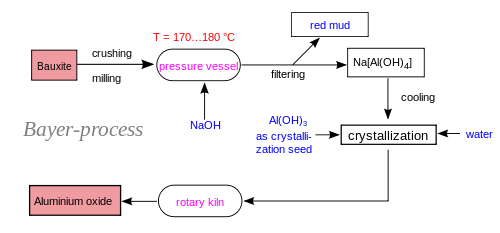
ProcessIn the Bayer process, bauxite is digested by washing with a hot solution of sodium hydroxide, NaOH, at 175 °C, under pressure. This converts the aluminium oxide in the ore to soluble sodium aluminate, 2NaAlO2, according to the chemical equation:
Al2O3 + 2 NaOH + 3 H2O → 2 NaAlO2
This treatment also dissolves silica, but the other components of bauxite do not dissolve. Sometimes lime is added here, to precipitate the silica as calcium silicate. The solution is clarified by filtering off the solid impurities, commonly with a rotary sand trap, and a flocculant such as starch, to get rid of the fine particles. The mixture of solid impurities is called red mud. Originally, the alkaline solution was cooled and treated by bubbling carbon dioxide into it, through which aluminium hydroxide precipitates:
2 NaAlO2 + CO2 → 2 Al(OH)3 + Na2CO3 + H2O
But later, this gave way to seeding the supersaturated solution with high-purity aluminum hydroxide (Al(OH)3) crystal, which eliminated the need for cooling the liquid and was more economically feasible:
2 H2O + NaAlO2 → Al(OH)3 + NaOH
Then, when heated to 980°C (calcined), the aluminium hydroxide decomposes to aluminium oxide, giving off water vapor in the process:
2 Al(OH)3 → Al2O3 + 3 H2O
The left-over NaOH solution is then recycled. This, however, allows gallium and vanadium impurities to build up in the liquors, so these are extracted.
For bauxites having more than 10% silica, Bayer process becomes infeasible due to insoluble sodium aluminum silicate being formed, which reduces yield, and another process must be chosen.
A large amount of the aluminium oxide so produced is then subsequently smelted in the Hall–Héroult process in order to produce aluminium.


 Physical Chemistry> Name the method by which AL is extracted ...
 1 Answers


