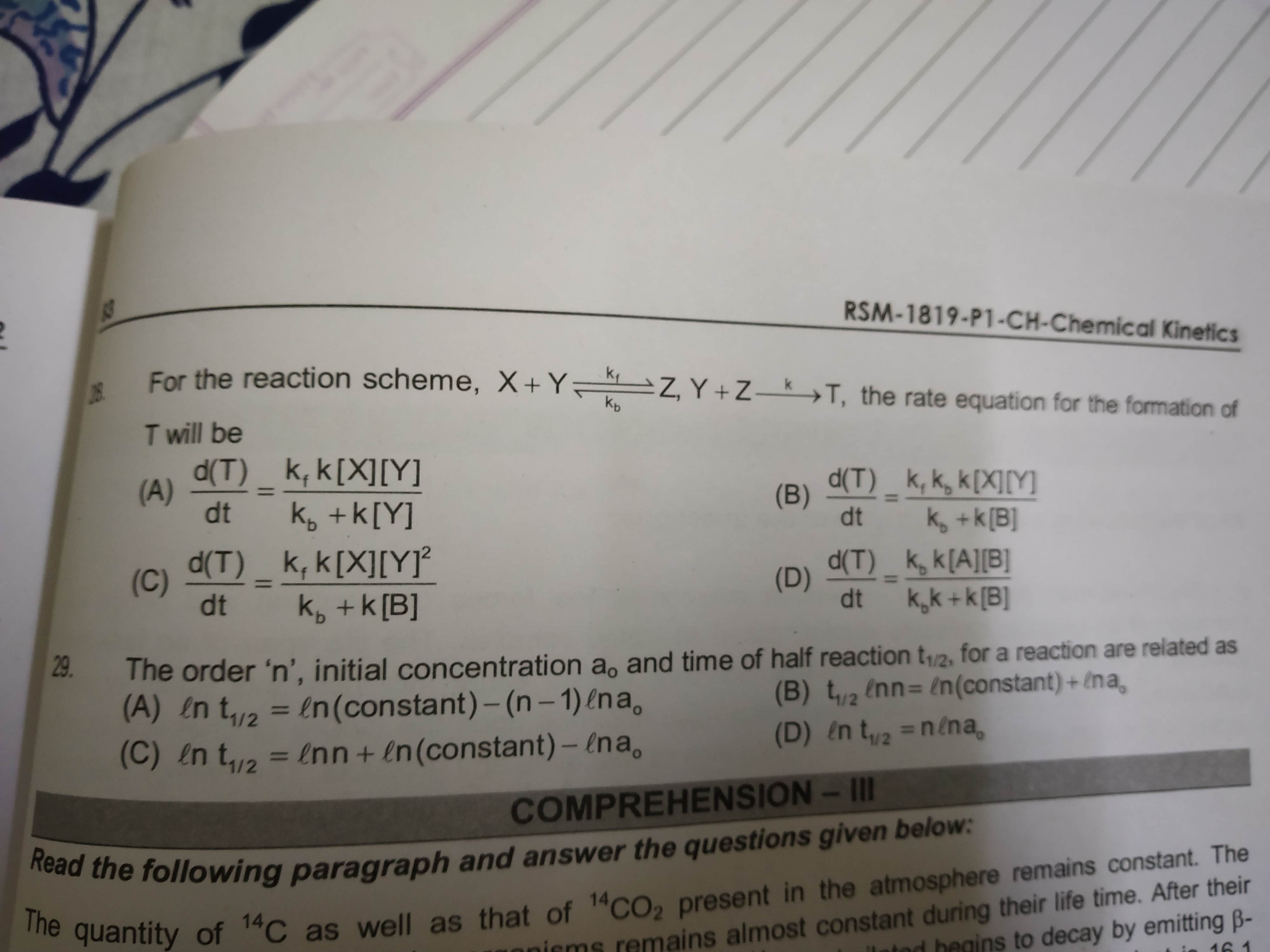
When tackling a kinetics rate law question, especially when you're given an answer for part B without any context, it’s essential to approach the problem methodically. Here’s how you can proceed to analyze the situation and derive the correct answer.
Understanding Rate Laws
Rate laws express the relationship between the rate of a chemical reaction and the concentration of its reactants. The general form of a rate law can be expressed as:
Rate = k [A]^m [B]^n
In this equation, k is the rate constant, [A] and [B] are the concentrations of the reactants, and m and n are the reaction orders with respect to each reactant.
Steps to Analyze the Given Answer
- Identify the Reaction: Start by determining the chemical equation for the reaction in question. This will help you understand the reactants involved.
- Gather Experimental Data: If available, look at any experimental data provided in the question. This data often includes concentrations and corresponding reaction rates.
- Determine Reaction Orders: Use the method of initial rates or integrated rate laws to find the orders of the reaction with respect to each reactant. This involves comparing how changes in concentration affect the rate.
- Calculate the Rate Constant: Once you have the orders, you can substitute the known concentrations and rates into the rate law to solve for the rate constant k.
Example Scenario
Let’s say you have a reaction where the rate law is suspected to be:
Rate = k [A]^2 [B]^1
If you were given a rate of reaction at different concentrations of A and B, you could set up a table to analyze how the rate changes with varying concentrations. For instance:
| [A] |
[B] |
Rate |
| 1 M |
1 M |
0.1 M/s |
| 2 M |
1 M |
0.4 M/s |
By comparing the rates, you can deduce the order with respect to A and B. For example, doubling [A] while keeping [B] constant quadruples the rate, indicating that the reaction is second order with respect to A.
Verifying the Given Answer
If the answer provided for part B seems incorrect, you can verify it by recalculating based on your derived rate law. If your calculations yield a different result, you can confidently assert that the given answer is incorrect. Document your findings clearly, showing each step of your reasoning and calculations.
Communicating Your Findings
When presenting your conclusion, be sure to explain your reasoning clearly. You might say something like:
“Based on my calculations, the rate law for this reaction is determined to be Rate = k [A]^2 [B]^1. Therefore, the answer provided for part B does not align with the data and analysis I conducted.”
By following these steps, you can systematically approach the problem, verify the accuracy of the provided answer, and confidently arrive at the correct conclusion. This method not only helps in understanding kinetics but also enhances your problem-solving skills in chemistry.