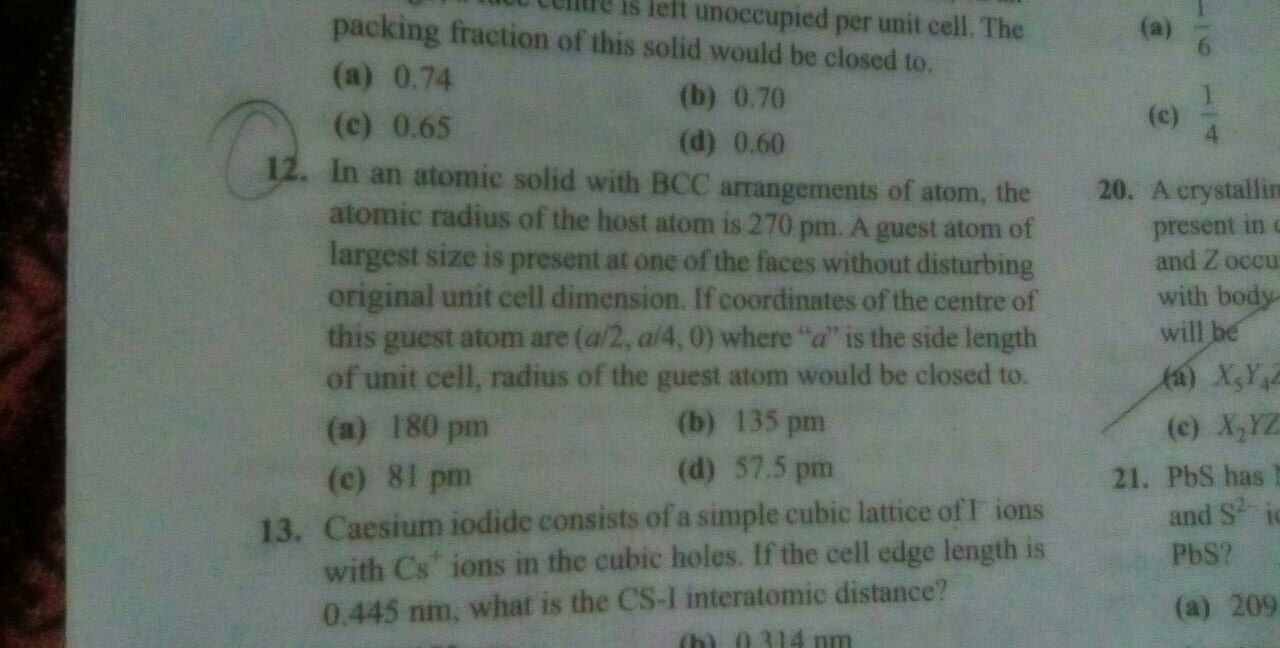
To determine the radius of the guest atom in a body-centered cubic (bcc) arrangement, we first need to understand the geometry of the unit cell and how the guest atom fits within it. In a bcc structure, the atoms are located at the corners and one atom is at the center of the cube. The side length of the unit cell is denoted as "a," and the atomic radius of the host atom is given as 270 pm.
Understanding the BCC Structure
In a bcc unit cell, the relationship between the atomic radius (r) and the side length (a) can be expressed as:
- The body diagonal of the cube contains four atomic radii: one from each corner atom and one from the center atom.
- The length of the body diagonal can be calculated using the Pythagorean theorem: Diagonal = a√3.
Thus, we have the equation:
a√3 = 4r
From this, we can derive the side length of the unit cell in terms of the atomic radius:
a = (4r) / √3
Calculating the Side Length
Substituting the given radius of the host atom (270 pm) into the equation:
a = (4 × 270 pm) / √3 ≈ 622.5 pm
Positioning the Guest Atom
The guest atom is positioned at the coordinates (a/2, a/4, 0). This means it is located on one of the faces of the unit cell. To find the maximum radius of the guest atom that can fit at this position without disturbing the original unit cell dimensions, we need to consider its proximity to the host atoms.
Distance from Host Atoms
At the coordinates (a/2, a/4, 0), the guest atom is closest to the corner atoms located at (0, 0, 0) and (0, 0, a). The distance from the guest atom to one of these corner atoms can be calculated as follows:
Distance = √[(a/2 - 0)² + (a/4 - 0)² + (0 - 0)²]
Substituting the value of "a":
Distance = √[(622.5 pm/2)² + (622.5 pm/4)²]
Distance = √[(311.25 pm)² + (155.625 pm)²]
Distance = √[96789.0625 pm² + 24266.640625 pm²] ≈ √121055.703125 pm² ≈ 348.7 pm
Determining the Radius of the Guest Atom
For the guest atom to fit without overlapping with the host atoms, the sum of the radii of the guest and host atoms must be less than or equal to the distance calculated:
r_guest + r_host ≤ Distance
Substituting the known values:
r_guest + 270 pm ≤ 348.7 pm
Solving for the radius of the guest atom:
r_guest ≤ 348.7 pm - 270 pm ≈ 78.7 pm
Thus, the radius of the guest atom is approximately 79 pm. This value indicates that the guest atom can fit snugly at the specified coordinates without disturbing the arrangement of the host atoms in the bcc structure.