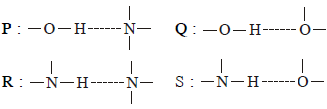
To compare the strength of hydrogen bonding between the two options, P (which likely involves O-H bonds) and S (which involves N-H bonds), we need to delve into the nature of hydrogen bonds and the factors that influence their strength. You’re correct in noting that electronegativity plays a crucial role in this comparison.
Understanding Hydrogen Bonding
Hydrogen bonds occur when a hydrogen atom covalently bonded to a highly electronegative atom (like oxygen or nitrogen) experiences an attraction to another electronegative atom. The strength of these bonds is influenced by several factors, including the electronegativity of the atoms involved, the distance between them, and the molecular environment.
Electronegativity and Bond Strength
Electronegativity is a measure of an atom's ability to attract electrons. In the context of hydrogen bonding:
- Oxygen (O) has a higher electronegativity (around 3.5 on the Pauling scale) compared to Nitrogen (N) (about 3.0).
- This difference means that when hydrogen is bonded to oxygen, the O-H bond is more polar than the N-H bond.
The increased polarity in O-H bonds results in a stronger partial positive charge on the hydrogen atom, which enhances its ability to attract nearby electronegative atoms, leading to stronger hydrogen bonds.
Comparing P and S
In your comparison, if P represents a molecule with O-H bonds and S represents one with N-H bonds, we can summarize the differences as follows:
- **P (O-H)**: The hydrogen bonding is stronger due to the higher electronegativity of oxygen, which creates a more significant dipole moment.
- **S (N-H)**: The hydrogen bonding is weaker because nitrogen's lower electronegativity results in a less polar bond.
Thus, the strength of hydrogen bonding in P is greater than in S, leading to the conclusion that P > S in terms of hydrogen bond strength.
Real-World Implications
This difference in hydrogen bond strength has practical implications. For instance, water (H2O), which has strong O-H hydrogen bonds, exhibits high boiling and melting points compared to ammonia (NH3), which has weaker N-H hydrogen bonds. This is why water remains liquid at room temperature while ammonia is a gas under similar conditions.
Conclusion
In summary, when comparing P and S, the stronger hydrogen bonding in P is primarily due to the higher electronegativity of oxygen compared to nitrogen. This results in a more polar bond and a stronger attraction between molecules, making P > S in terms of hydrogen bond strength. Understanding these principles can help you predict the behavior of different substances in various chemical contexts.