Dear Rohan
Please ask only one question in one thread.
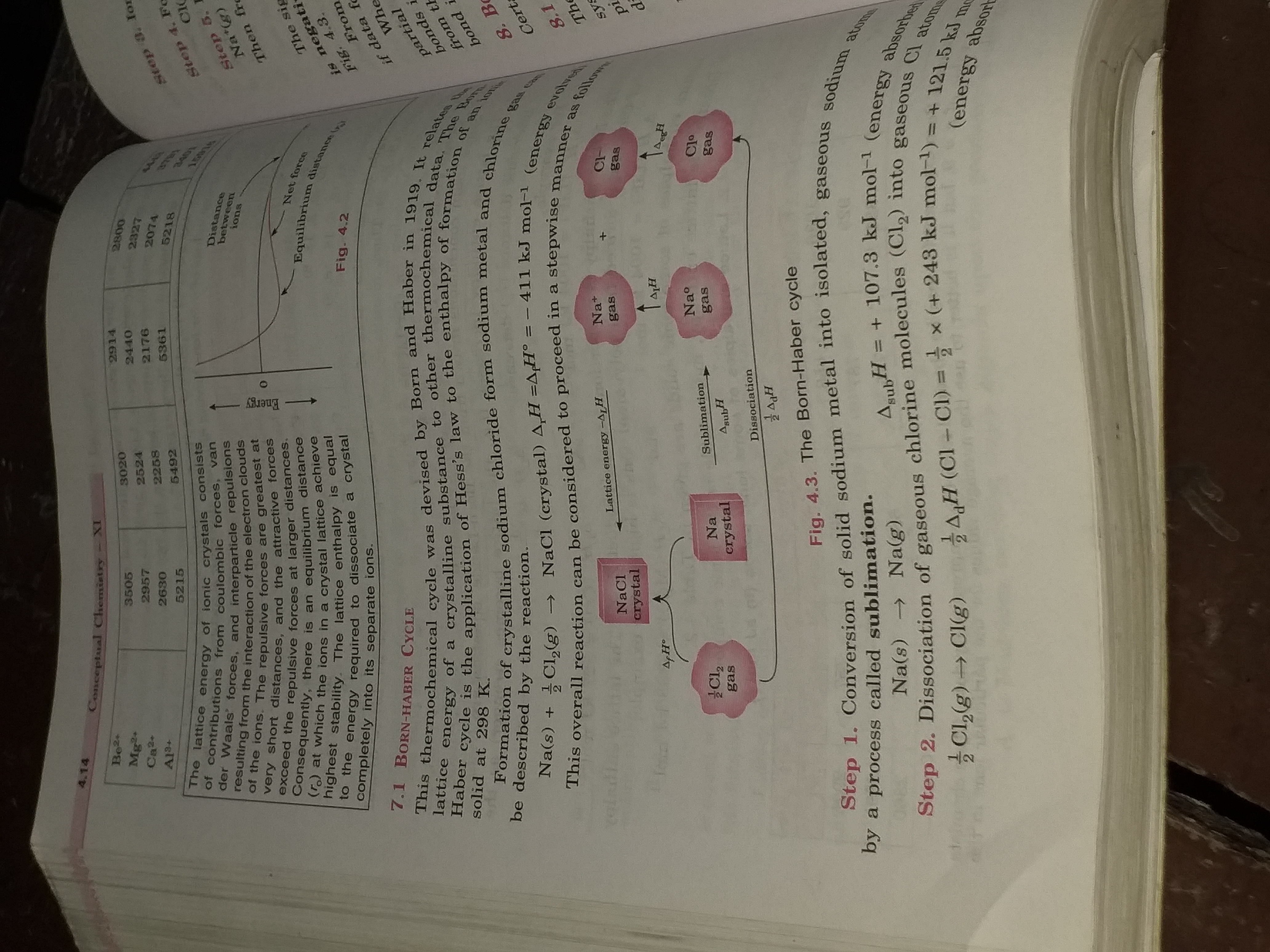
The Born Haber cycle for the formation of calcium chloride from its constituent elements involves following steps.
- Atomization enthalpy of calcium: This step involves the conversion of solid calcium to gaseous state.
Ca(s) → Ca(g) ΔHa°(Ca) =178 kj/mol
- Ionization enthalpy of calcium: Calcium forms di-positive ion (Ca2+), therefore the energy involve in the removal of first electron is called as first ionization energy and valued 590 kj/mol. The removal of second electron requires more energy as it’sdifficult to remove electron from a cation. Hence the second ionization energy for calcium ion is 1145 kj/mol.
Ca(g) → Ca+(g) + e-Δ HIE°= 590 kj/mol
Ca+(g) → Ca2+(g) + e- Δ4HIE°= 1145 kj/mol
- Atomization enthalpy of Chlorine: This step involves dissociation of Cl2(g) into Cl(g) atoms. The reaction enthalpy is half of the bond dissociation enthalpy of chlorine.
½ Cl2(g) → Cl(g) ;Δ Ha°= ½Δ HCl-Cl°=121 kj/mol
- For the formation of calcium chloride, two Cl(g) requires, therefore total atomization enthalpy will be double that is 242 kj/mol.
- Electron affinity of chlorine: This is the amount of energy released during the addition of electron in an isolated neutral gaseous chlorine atom.
Cl(g) + e- → Cl-(g) ;Δ Hea°= -364 kj/mol
- Lattice enthalpy: The combination of one Ca2+ ion and two chloride ions (Cl-)to form one mole of calcium chloride release lattice energy (ΔHLE).
Ca2+ (g) + 2Cl-(g) → CaCl2(s)