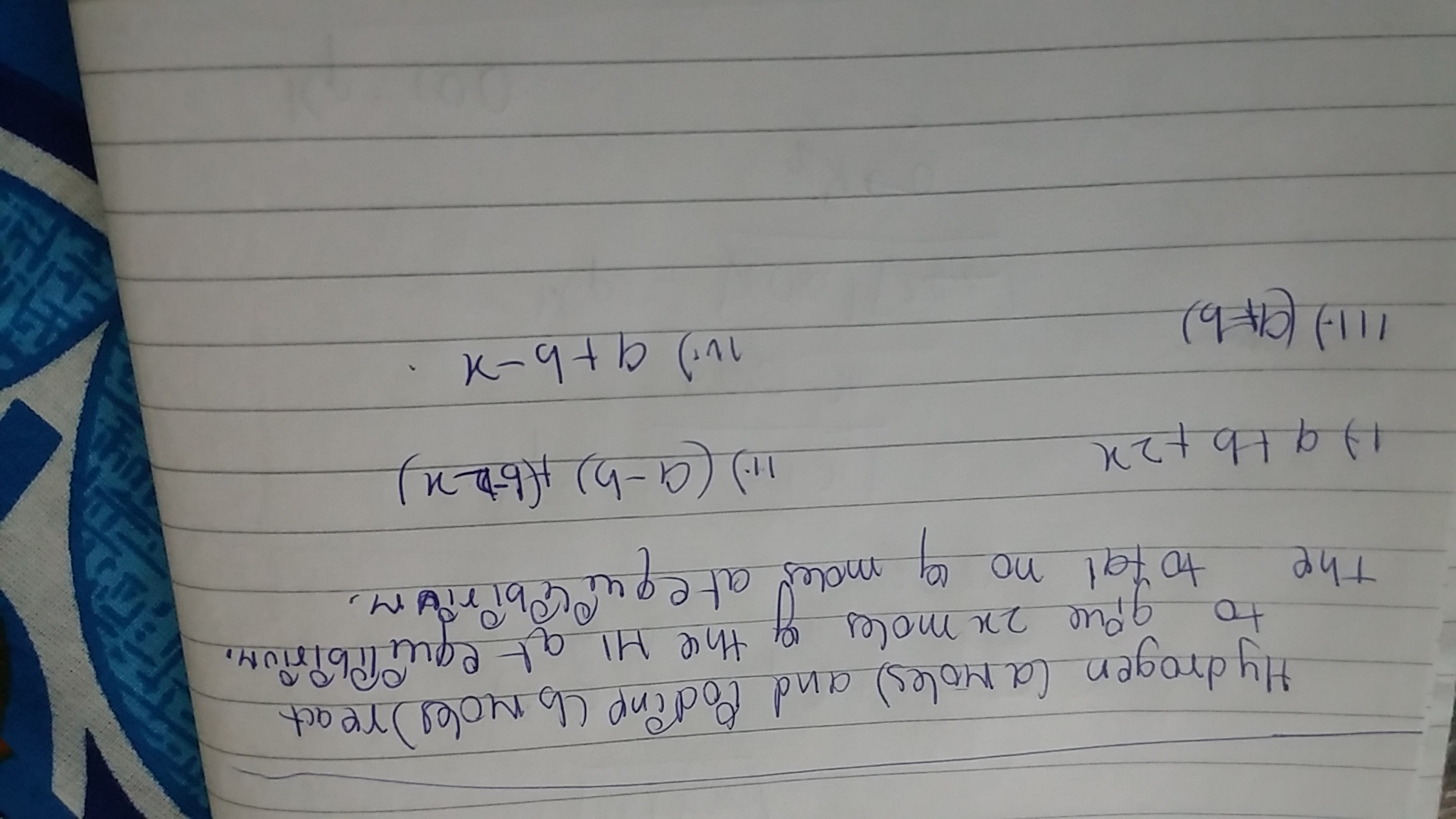
To determine the total number of moles at equilibrium for the reaction between hydrogen (H₂) and iodine (I₂) to form hydrogen iodide (HI), we need to analyze the stoichiometry of the reaction. The balanced chemical equation for this reaction can be represented as:
Balanced Reaction
H₂(g) + I₂(g) ⇌ 2 HI(g)
Initial Moles
Let's denote the initial moles of hydrogen as 'a' and the initial moles of iodine as 'b'. At the start of the reaction, we have:
- Moles of H₂ = a
- Moles of I₂ = b
- Moles of HI = 0
Change in Moles
As the reaction proceeds towards equilibrium, hydrogen and iodine will react to form hydrogen iodide. If we assume that 'x' moles of H₂ and I₂ react, the changes in moles can be expressed as:
- Moles of H₂ at equilibrium = a - x
- Moles of I₂ at equilibrium = b - x
- Moles of HI at equilibrium = 2x
Equilibrium Expression
At equilibrium, the total number of moles can be calculated by adding the moles of each substance present:
- Total moles at equilibrium = (a - x) + (b - x) + 2x
Simplifying the Equation
Now, let's simplify this expression:
- Total moles at equilibrium = a + b - x + 2x
- Total moles at equilibrium = a + b + x
Final Consideration
To find the exact total number of moles at equilibrium, we need to know the value of 'x', which represents the moles of H₂ and I₂ that reacted. However, if we are only interested in the relationship, we can conclude that the total number of moles at equilibrium is:
Total moles at equilibrium = a + b + x
This means that the total moles at equilibrium will depend on the extent of the reaction, represented by 'x'. If you have specific values for 'a' and 'b', or if you know the equilibrium constant, you could calculate 'x' and thus find the exact total moles at equilibrium.