
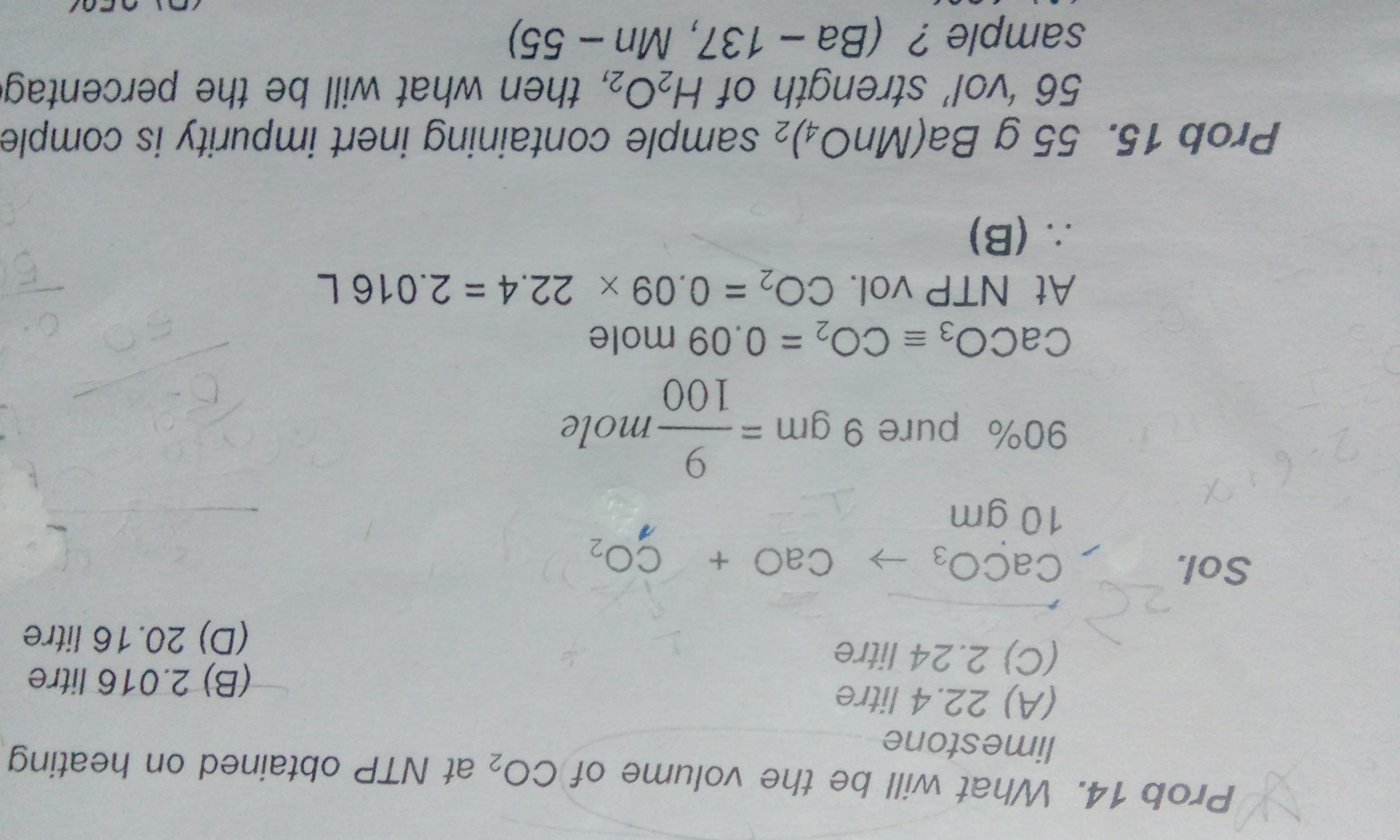
How to solve this question using equivalence concept (not using mole concept)

Riya Shah , 8 Years ago
Grade 11
 Physical Chemistry> How to solve this question using equivale...
 1 Answers
To tackle a problem using the equivalence concept rather than the mole concept, it's essential to first grasp what equivalence means in a chemical context. Equivalence refers to the amount of a substance that reacts with or is equivalent to another substance in a chemical reaction. This approach is particularly useful in titrations and redox reactions, where we often deal with the stoichiometry of reactions without explicitly calculating moles.
In chemistry, equivalence can be defined in terms of reactive capacity. For example, in acid-base reactions, one equivalent of an acid can neutralize one equivalent of a base. The key is to identify the reactive species and their stoichiometric relationships.
HCl + NaOH → NaCl + H₂O
Equivalents of HCl = Equivalents of NaOH
Equivalents of HCl = Molarity × Volume = 0.1 mol/L × 0.050 L = 0.005 equivalents
Volume of NaOH = Equivalents of NaOH / Molarity = 0.005 equivalents / 0.1 mol/L = 0.050 L or 50 mL
Consider a scenario where you are titrating a solution of sulfuric acid (H₂SO₄) with sodium hydroxide (NaOH). Sulfuric acid is a diprotic acid, meaning it can donate two protons. Therefore, 1 mole of H₂SO₄ is equivalent to 2 equivalents. If you have 0.1 M H₂SO₄ and you use 25 mL of it:
Equivalents of H₂SO₄ = 0.1 mol/L × 0.025 L = 0.0025 equivalents (but since it's diprotic, you have 0.005 equivalents).
To neutralize this, you would need 0.005 equivalents of NaOH. If your NaOH solution is also 0.1 M:
Volume of NaOH = 0.005 equivalents / 0.1 mol/L = 0.050 L or 50 mL.
This equivalence concept is particularly useful in laboratory settings, such as titrations, where precise measurements are critical. By focusing on equivalents, you can simplify calculations and ensure that you are accurately determining the concentrations of reactants and products in a reaction.
In summary, using the equivalence concept allows you to approach chemical reactions from a practical standpoint, focusing on the reactive capacities of substances rather than getting bogged down in mole calculations. This method is especially effective in scenarios involving acid-base neutralizations and redox reactions, where understanding the relationship between reactants is key to solving problems efficiently.
 Approved
Prepraring for the competition made easy just by live online class.

Full Live Access

Study Material

Live Doubts Solving

Daily Class Assignments

Last Activity: 3 Years ago
Last Activity: 3 Years ago
Last Activity: 3 Years ago