

Grade 11Physical Chemistry
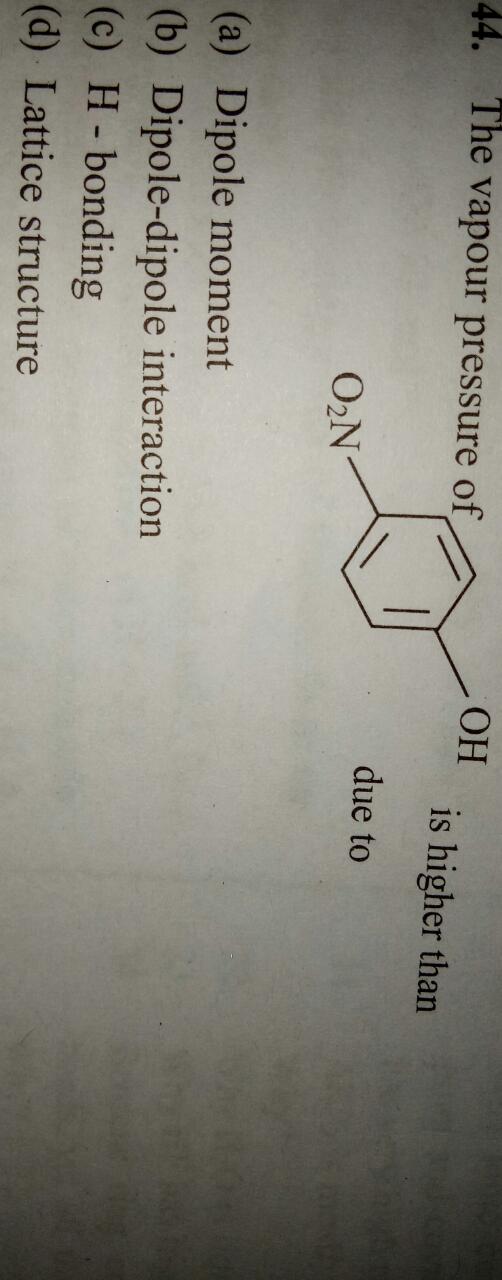
FIND WHY THE VAPOUR PRESSURE IS HIGHER?SEE THE ATTACHED IMAGE FOR THE QUESTION DESCRICPTION.
FIND WHY THE VAPOUR PRESSURE IS HIGHER?
SEE THE ATTACHED IMAGE FOR THE QUESTION DESCRICPTION.


 Approved Tutor Answer1 Year ago
To understand why vapor pressure is higher in certain conditions, we need to dive into the concepts of vapor pressure itself and the factors that influence it. Vapor pressure is the pressure exerted by a vapor in equilibrium with its liquid or solid form at a given temperature. Essentially, it reflects how readily molecules escape from the liquid phase into the vapor phase.
Several key factors affect vapor pressure, including temperature, intermolecular forces, and the nature of the liquid. Let’s break these down:
One of the most significant factors is temperature. As temperature increases, the kinetic energy of the molecules in a liquid also increases. This means that more molecules have enough energy to overcome the intermolecular forces holding them in the liquid state. Consequently, a higher number of molecules escape into the vapor phase, leading to an increase in vapor pressure.
The strength of intermolecular forces plays a crucial role in determining vapor pressure. Liquids with strong intermolecular forces, such as hydrogen bonding in water, will have lower vapor pressures because more energy is required for molecules to escape into the vapor phase. Conversely, liquids with weaker forces, like those found in nonpolar substances, will exhibit higher vapor pressures since their molecules can escape more easily.
The chemical composition and structure of the liquid also influence its vapor pressure. For example, volatile substances like acetone have higher vapor pressures compared to less volatile substances like glycerol. This is due to the differences in molecular structure and the strength of the intermolecular forces present.
Understanding vapor pressure is essential in various fields, such as meteorology, cooking, and chemical engineering. For instance, in cooking, knowing the vapor pressure of water helps in understanding boiling points at different altitudes, where lower atmospheric pressure can lead to lower boiling points.
In summary, the vapor pressure of a liquid is influenced by temperature, the strength of intermolecular forces, and the specific characteristics of the liquid itself. By considering these factors, we can better understand why certain liquids exhibit higher vapor pressures than others. If you have any more questions or need clarification on any point, feel free to ask!

Last Activity: 3 Years ago
Last Activity: 3 Years ago
Last Activity: 3 Years ago
Last Activity: 4 Years ago