
Explain the ideal solution and non ideal solution .with some examples

Salman khan , 8 Years ago
Grade 12th pass
 Physical Chemistry> Explain the ideal solution and non ideal ...
 1 Answers
The solutions which obey Raoult’s Law at every range of concentration and at all temperatures are called Ideal Solutions. We can obtain ideal solutions by mixing two ideal components that is, solute and a solvent having similar molecular size and structure. For Example, consider two liquids A and B, and mix them. The formed solution will experience several intermolecular forces of attractions inside it, which will be:
A – A intermolecular forces of attraction
B – B intermolecular forces of attraction
A – B intermolecular forces of attraction
The solution is said to be an ideal solution, only when the intermolecular forces of attraction between A – A, B – B and A – B are nearly equal.
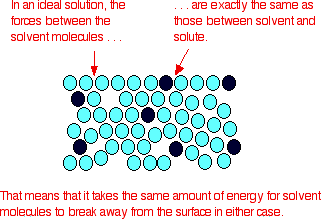
Image 2: Molecular structure is same in case of ideal solutions
Ideal Solutions generally have characteristics as follows:
They follow Raoult’s Law, which means partial pressure of components A and B in a solution will be PA = PA0 xA and PB = PB0xB where PA0 and PB0 are respective vapour pressure in pure form and xA and xB are respective mole fractions of components A and B
The enthalpy of mixing of two components should be zero, that is, Δmix H = 0. This signifies that no heat is released or absorbed during mixing of two pure components to form ideal solution
The volume of mixing of two components should be zero that is, Δmix V = 0. This means that total volume of solution is equal to the sum of the volume of solute and solution. Adding further, it also signifies that there is no occurrence of contraction or expansion of volume while mixing of two components
The solute-solute interaction and solvent-solvent interaction is nearly equal to solute-solvent interaction
Note: Perfectly ideal solutions are rare in nature, only some solutions show some ideal behavior.
Examples of Ideal Solutions
n-hexane and n-heptane
Benzene and Toluene
CCl4 and SiCl4
Chlorobenzene and Bromobenzene
Ethyl Bromide and Ethyl Iodide
n-Butyl Chloride and n-Butyl Bromide
The solutions which don’t obey Raoult’s law at every range of concentration and at all temperatures are called Non-Ideal Solutions. Non-ideal solutions deviate from ideal solutions and are also known as Non-Ideal Solutions.
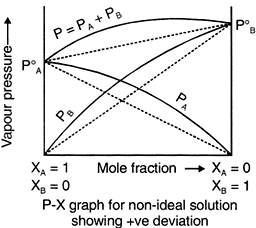
Image 3: Graph between vapour pressuring and mole fraction
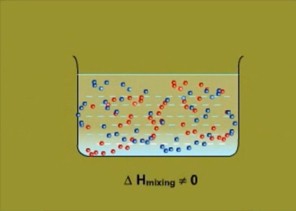
Image 4: The enthalpy of mixing is non-zero in non-ideal solution as some heat is released or absorbed in the process.
Non-ideal solutions depict characteristics as follows:
The solute-solute and solvent-solvent interaction is different from that of solute-solvent interaction
The enthalpy of mixing that is, Δmix H ≠ 0, which means that heat might have released if enthalpy of mixing is negative (ΔmixH mix H > 0)
The volume of mixing that is, Δmix V ≠ 0, which depicts that there will be some expansion or contraction in dissolution of liquids
Non-ideal solutions are of two types:
Non-ideal solutions showing positive deviation from Raoult’s Law
Non-ideal solutions showing negative deviation from Raoult’s Law

Prepraring for the competition made easy just by live online class.

Full Live Access

Study Material

Live Doubts Solving

Daily Class Assignments

Last Activity: 3 Years ago
Last Activity: 3 Years ago
Last Activity: 4 Years ago