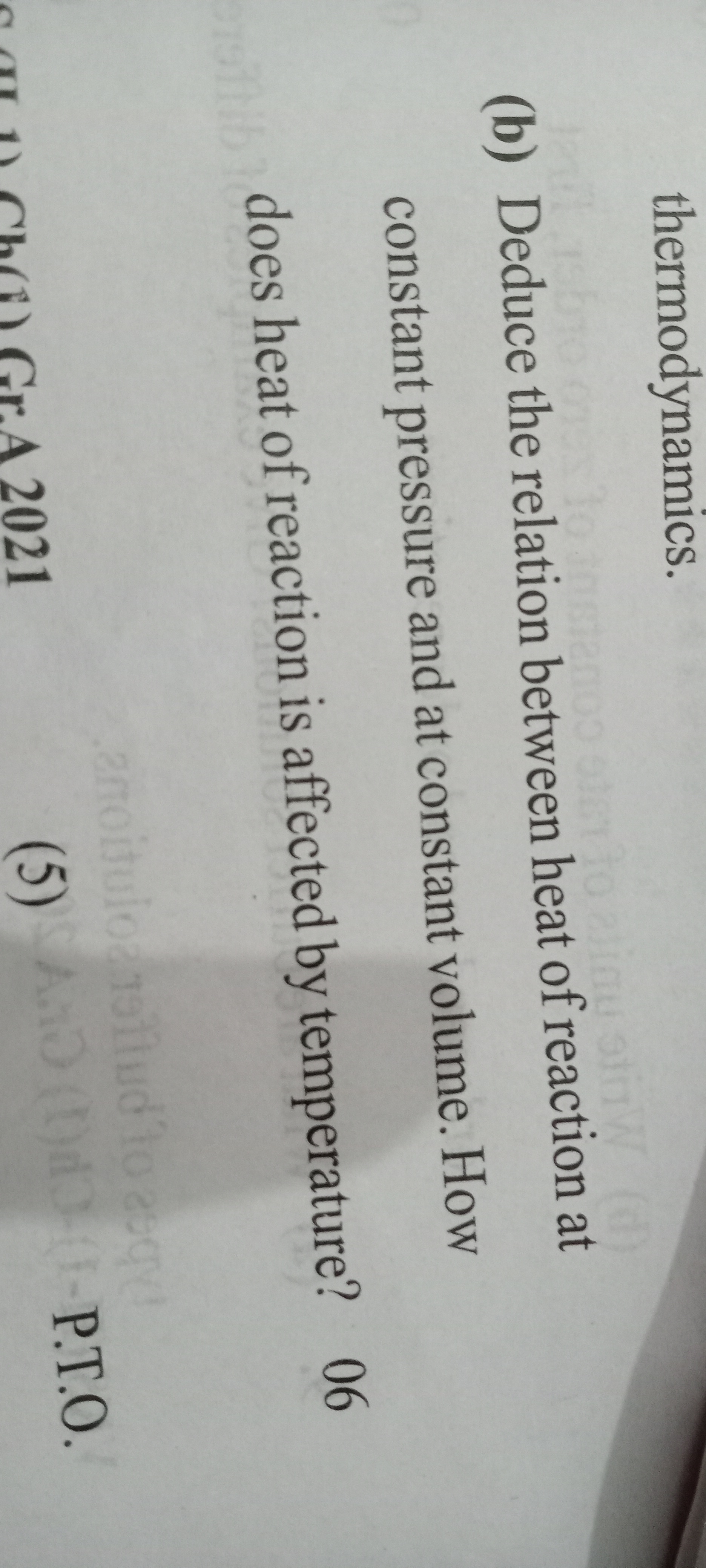
To understand the relationship between the heat of reaction at constant pressure and at constant volume, we need to delve into some fundamental concepts of thermodynamics. The heat of reaction, often referred to as enthalpy change (ΔH) at constant pressure and internal energy change (ΔU) at constant volume, plays a crucial role in chemical reactions. Let's break this down step by step.
Understanding Heat of Reaction
The heat of reaction is the amount of energy released or absorbed during a chemical reaction. This energy change can be measured under different conditions, primarily at constant pressure or constant volume. The key difference between these two scenarios lies in how the system interacts with its surroundings.
Constant Pressure vs. Constant Volume
At constant pressure, the heat of reaction is defined as the change in enthalpy (ΔH). Enthalpy is a thermodynamic quantity that reflects the total heat content of a system, which includes internal energy and the product of pressure and volume. The relationship can be expressed as:
Here, ΔU represents the change in internal energy, P is the pressure, and ΔV is the change in volume. This equation shows that at constant pressure, the heat of reaction accounts for both the internal energy change and the work done by the system due to volume change.
In contrast, at constant volume, the heat of reaction corresponds to the change in internal energy (ΔU) alone, since there is no volume change (ΔV = 0). Therefore, we can express this as:
- ΔU = Q (heat at constant volume)
Connecting the Two
To relate the two, we can rearrange the first equation:
From this, we can see that if a reaction occurs at constant volume, the heat of reaction (ΔH) will differ from ΔU by the term PΔV. This means that if the reaction involves a change in the number of moles of gas, the volume change will influence the heat of reaction at constant pressure. For example, if a gas is produced in a reaction, the volume increases, leading to a positive PΔV term, which makes ΔH greater than ΔU.
Impact of Temperature on Heat of Reaction
Temperature also plays a significant role in the heat of reaction. As temperature increases, the kinetic energy of the molecules involved in the reaction rises, which can affect the reaction rate and the amount of heat absorbed or released. The relationship between temperature and heat of reaction can be understood through the concept of reaction equilibrium and the principles of thermodynamics.
Le Chatelier's Principle
According to Le Chatelier's Principle, if a system at equilibrium is subjected to a change in temperature, the system will adjust to counteract that change. For exothermic reactions (which release heat), increasing the temperature shifts the equilibrium position to favor the reactants, thereby decreasing the heat of reaction. Conversely, for endothermic reactions (which absorb heat), increasing the temperature shifts the equilibrium towards the products, increasing the heat of reaction.
Practical Implications
In practical terms, this means that the heat of reaction is not a fixed value; it can vary with temperature. This is often quantified using the Van 't Hoff equation, which relates the change in equilibrium constant with temperature to the heat of reaction:
- ln(K2/K1) = -ΔH/R (1/T2 - 1/T1)
Here, K is the equilibrium constant, R is the gas constant, and T is the temperature in Kelvin. This equation illustrates how the heat of reaction influences the position of equilibrium as temperature changes.
In summary, the heat of reaction at constant pressure and constant volume is interconnected through the changes in enthalpy and internal energy, with temperature acting as a crucial factor that influences these values. Understanding these relationships is essential for predicting how reactions will behave under different conditions.