

Grade 12th passPhysical Chemistry
Chemical equilibrium.
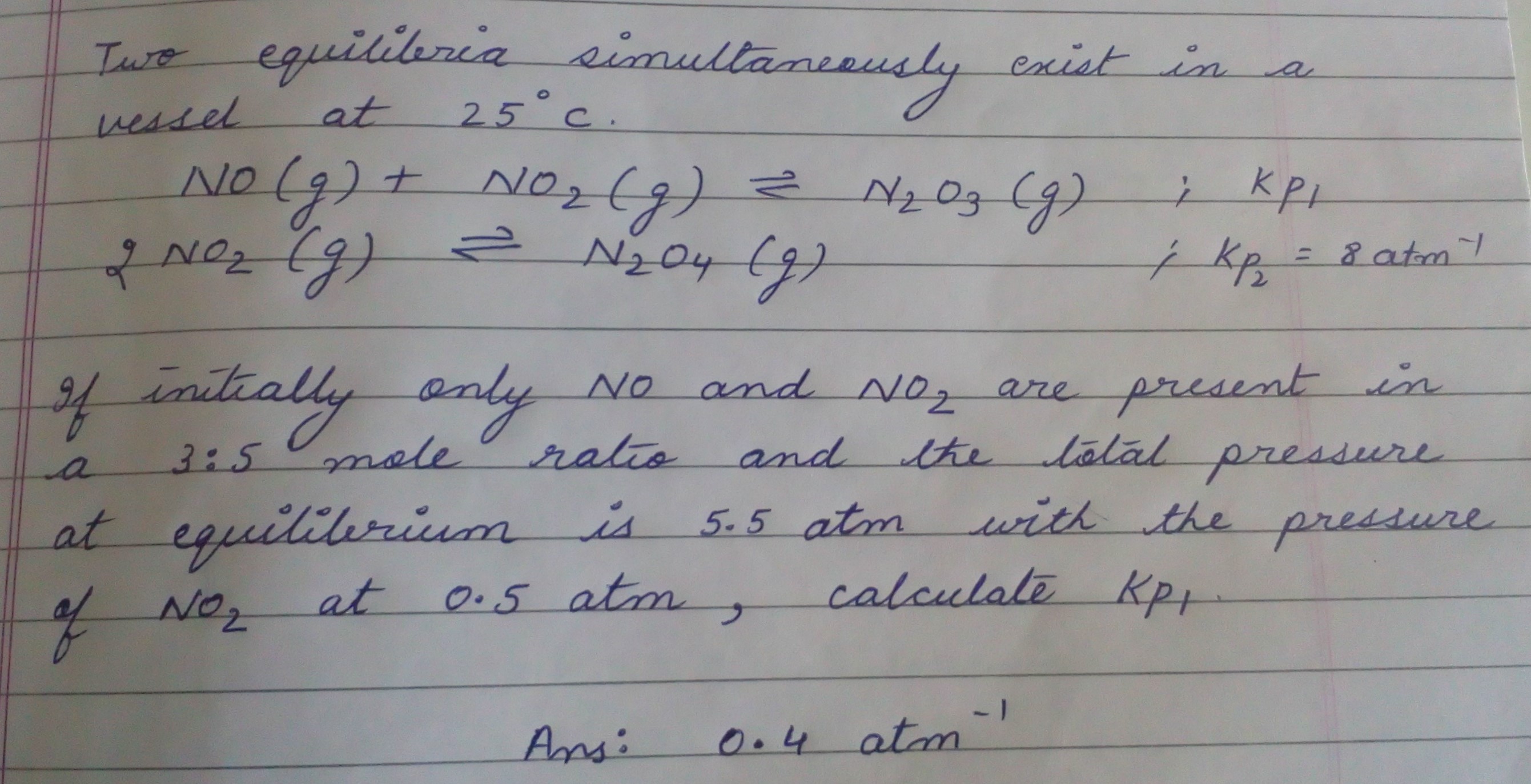
Qs is in the imageSimultaneous Equilibrium
Chemical equilibrium.
Qs is in the image
Qs is in the image
Simultaneous Equilibrium


 Approved Tutor Answer0 Years ago
Chemical equilibrium is a fascinating concept in chemistry that describes a state where the concentrations of reactants and products remain constant over time. This occurs when the forward and reverse reactions happen at the same rate, resulting in no net change in the system. Let's delve deeper into this idea, especially in the context of simultaneous equilibria, which can be a bit more complex.
At equilibrium, the rate of the forward reaction equals the rate of the reverse reaction. This doesn't mean that the reactions have stopped; rather, they continue to occur, but the overall concentrations of reactants and products do not change. A classic example is the synthesis of ammonia from nitrogen and hydrogen gases:
In this reaction, as ammonia is produced, some of it will decompose back into nitrogen and hydrogen. At equilibrium, the amount of ammonia formed will be constant, even though both reactions are still occurring.
When we talk about simultaneous equilibria, we refer to situations where multiple reactions are occurring at the same time, each reaching its own equilibrium state. This can happen in complex systems where different reactions are interlinked. For instance, consider a system where two different reactions are happening:
In this scenario, both reactions can reach equilibrium independently. However, the presence of one reaction can influence the other. For example, if the concentration of B increases, it might shift the equilibrium of the first reaction to the left, affecting the concentrations of A and B. Similarly, changes in the concentration of D could influence the equilibrium of the second reaction.
To understand how simultaneous equilibria interact, we can apply Le Chatelier's Principle. This principle states that if a system at equilibrium is disturbed, the system will adjust to counteract the disturbance and restore a new equilibrium. For example:
These adjustments can lead to changes in the concentrations of all species involved, demonstrating the interconnectedness of simultaneous equilibria.
Simultaneous equilibria are not just theoretical; they have practical implications in various fields. For instance, in industrial processes like the Haber process for ammonia synthesis, understanding how different reactions interact can optimize yield and efficiency. Similarly, in biological systems, enzyme reactions often involve multiple substrates and products, where equilibrium dynamics play a crucial role in metabolic pathways.
In summary, chemical equilibrium is a dynamic state where reactants and products coexist in stable concentrations. When dealing with simultaneous equilibria, it's essential to consider how different reactions influence one another, often using principles like Le Chatelier's to predict the system's response to changes. This understanding is vital for both theoretical chemistry and practical applications in various scientific fields.

Last Activity: 3 Years ago
Last Activity: 3 Years ago
Last Activity: 3 Years ago
Last Activity: 4 Years ago