Grade 12Physical Chemistry
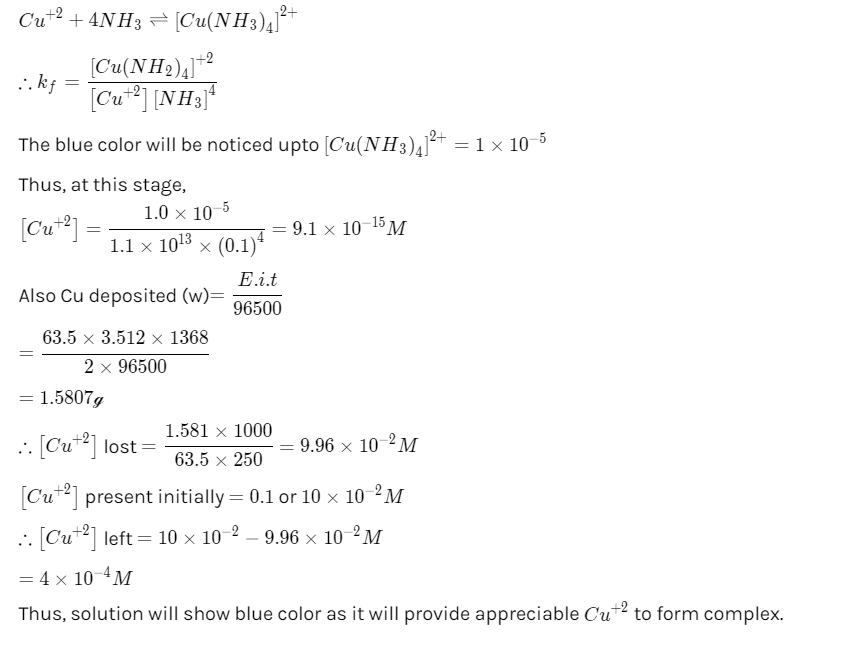
A test for complete removal of Cu ions from a solution of Cu (aq.) is to add NH3(aq.). A blue colour signifies the formation of complex
>• Problem 7. >- Problem 8.
[CU(NH3)4]2+ having K{= 1.1 x 10¹³ and thus confirms the presence of Cu2+ in solution. 250 mLof 0.1 A/CuS04(aq.) is electrolysed by passing a current of 3.512 ampere for 1368 second. After passage of this charge sufficient quantity of NH3(aq.) is added to electrolysed solution maintaining [NH3] =0.10M. If [Cu(NH3)4]2+ is detectable upto its concentration as low as 1 x 10~5, would a blue colour be shown by the electrolysed solution on addition of NH3
A test for complete removal of Cu ions from a solution of Cu (aq.) is to add NH3(aq.). A blue colour signifies the formation of complex
>• Problem 7. >- Problem 8.
[CU(NH3)4]2+ having K{= 1.1 x 10¹³ and thus confirms the presence of Cu2+ in solution. 250 mLof 0.1 A/CuS04(aq.) is electrolysed by passing a current of 3.512 ampere for 1368 second. After passage of this charge sufficient quantity of NH3(aq.) is added to electrolysed solution maintaining [NH3] =0.10M. If [Cu(NH3)4]2+ is detectable upto its concentration as low as 1 x 10~5, would a blue colour be shown by the electrolysed solution on addition of NH3
>• Problem 7. >- Problem 8.
[CU(NH3)4]2+ having K{= 1.1 x 10¹³ and thus confirms the presence of Cu2+ in solution. 250 mLof 0.1 A/CuS04(aq.) is electrolysed by passing a current of 3.512 ampere for 1368 second. After passage of this charge sufficient quantity of NH3(aq.) is added to electrolysed solution maintaining [NH3] =0.10M. If [Cu(NH3)4]2+ is detectable upto its concentration as low as 1 x 10~5, would a blue colour be shown by the electrolysed solution on addition of NH3