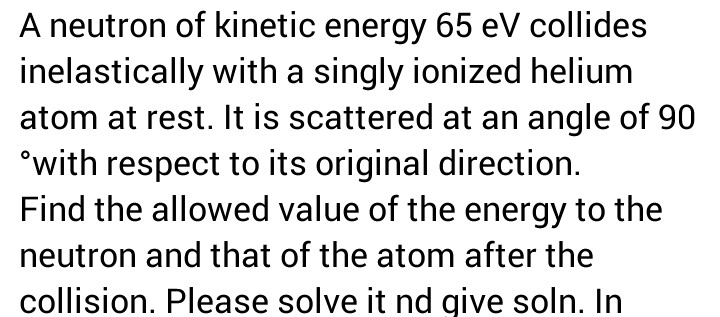
To tackle this problem, we need to analyze the collision between a neutron and a singly ionized helium atom (He+). The neutron has an initial kinetic energy of 65 eV and is colliding inelastically with the helium atom, which is initially at rest. After the collision, the neutron is scattered at a 90-degree angle relative to its original direction. Our goal is to find the allowed values of energy for both the neutron and the helium atom after the collision.
Understanding the Collision Dynamics
In an inelastic collision, kinetic energy is not conserved, but momentum is conserved. The neutron transfers some of its kinetic energy to the helium atom, which results in the helium atom gaining kinetic energy and possibly moving after the collision.
Conservation of Momentum
Let's denote:
- En: Initial kinetic energy of the neutron = 65 eV
- En': Final kinetic energy of the neutron after the collision
- EHe': Final kinetic energy of the helium atom after the collision
Since the neutron is scattered at a 90-degree angle, we can use the conservation of momentum in two dimensions. The initial momentum of the system is solely due to the neutron, as the helium atom is at rest:
Initial momentum of the neutron:
After the collision, the momentum of the neutron and helium atom can be expressed as:
- pn' = mn * vn' (at 90 degrees)
- pHe' = mHe * vHe'
Using the conservation of momentum in the x and y directions:
- In the x-direction: mn * vn = mn * vn' * cos(90) + mHe * vHe' * cos(θ)
- In the y-direction: 0 = mn * vn' * sin(90) - mHe * vHe' * sin(θ)
Energy Considerations
The total initial kinetic energy is:
After the collision, the total kinetic energy is:
Since this is an inelastic collision, we can express the energy lost as:
Calculating Allowed Energy Values
To find the allowed values of energy for the neutron and the helium atom after the collision, we need to consider the conservation equations we derived. The neutron's final energy will depend on the angle at which the helium atom is scattered. However, since we are not given specific angles for the helium atom's motion, we can assume it moves in the direction that conserves momentum.
From the conservation of momentum in the y-direction, we can derive:
Using the relationship between kinetic energy and momentum, we can express the final energies in terms of the initial energy:
Given that the maximum energy transfer occurs when the neutron transfers a significant portion of its energy to the helium atom, we can estimate the maximum energy of the helium atom after the collision. The neutron's energy will decrease accordingly.
Final Values
Assuming a significant energy transfer, we can estimate:
- EHe' can be a maximum of approximately 65 eV
- En' will be less than 65 eV, depending on the exact angle of scattering and energy lost
In summary, the final energies of the neutron and helium atom depend on the specifics of the collision, but the conservation principles guide us in estimating their values. The neutron will have less energy than its initial 65 eV, while the helium atom will gain some energy, potentially up to 65 eV, depending on the energy transfer during the inelastic collision.