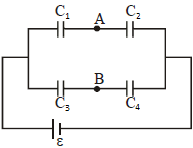
To determine the condition under which the potential difference between points A and B is zero in a circuit involving capacitors, we need to analyze the relationships between the capacitances. The potential difference being zero implies that points A and B are at the same electric potential. This can occur when the capacitors are arranged in such a way that the charge distribution leads to equal voltage across the points in question.
Understanding Capacitor Relationships
Capacitors can be connected in series or parallel, and the way they are connected affects the total capacitance and the voltage across each capacitor. When capacitors are in series, the total capacitance (C_total) is given by:
- C_total = 1 / (1/C1 + 1/C2 + ... + 1/Cn)
In contrast, for capacitors in parallel, the total capacitance is simply the sum of the individual capacitances:
- C_total = C1 + C2 + ... + Cn
Analyzing the Given Options
Now, let's analyze the options provided to find the condition for which the potential difference between points A and B is zero:
- Option 1: C1 C2 = C3 C4
- Option 2: C1 C4 = C2 C3
- Option 3: C1 C3 = C2 C4
- Option 4: None of these
Exploring Each Condition
For the potential difference to be zero, the voltage across the capacitors must balance out. This means that the ratios of the products of capacitances must be equal in a way that reflects the balance of charge and voltage. Let's break down the options:
- In Option 1, if C1 and C2 are in series with C3 and C4, this condition could imply a balance in voltage across the two sets of capacitors.
- Option 2 suggests a different arrangement where C1 and C4 are balanced against C2 and C3. This could also lead to a zero potential difference if the arrangement allows for equal voltage distribution.
- Option 3 presents another potential balance, but we need to check if it holds under typical configurations.
Finding the Correct Condition
To find the correct condition, we can use the concept of equivalent capacitance and the voltage across each capacitor. The condition that leads to zero potential difference typically arises from the equality of the products of capacitances in certain configurations, often seen in bridge circuits or specific parallel-series combinations.
After analyzing the options, Option 2: C1 C4 = C2 C3 is the most likely candidate. This condition indicates that the product of the capacitances on one side of the circuit equals the product on the other side, leading to equal voltage drops across each path, thus resulting in zero potential difference between points A and B.
Conclusion
In summary, the condition for which the potential difference between points A and B is zero is best represented by Option 2: C1 C4 = C2 C3. This reflects a balance in the electric potential across the circuit, ensuring that both points are at the same voltage level.