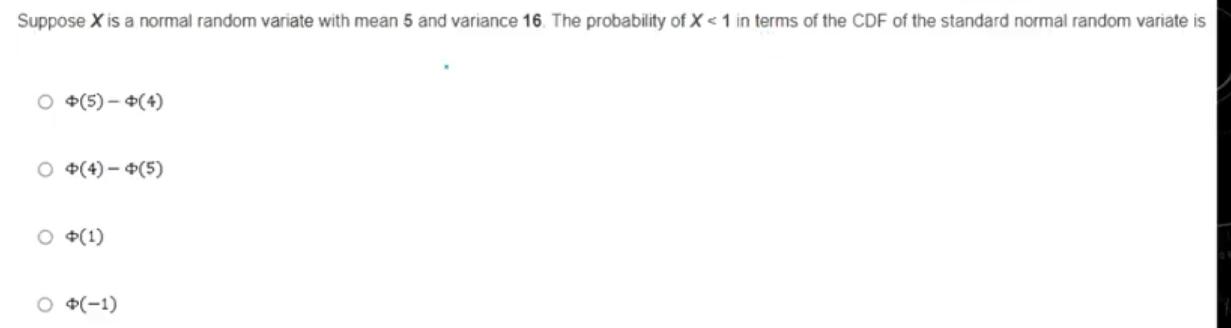
To find the probability in terms of the cumulative distribution function (CDF) of the standard normal variate, we first need to understand the properties of the normal distribution. In this case, you have a normal random variable \( x \) with a mean (\( \mu \)) of 5 and a variance (\( \sigma^2 \)) of 16. The standard deviation (\( \sigma \)) is the square root of the variance, which gives us \( \sigma = 4 \).
Transforming to Standard Normal
The standard normal distribution is a normal distribution with a mean of 0 and a standard deviation of 1. To convert our normal random variable \( x \) into a standard normal variable \( z \), we use the following transformation:
z = (x - μ) / σ
Substituting the values we have:
z = (x - 5) / 4
Finding the Probability
Now, if you want to find the probability of \( x \) being less than a certain value \( a \), you can express this in terms of the standard normal variable \( z \). The probability can be written as:
P(X < a) = P(Z < (a - 5) / 4)
Here, \( P(Z < (a - 5) / 4) \) represents the cumulative distribution function of the standard normal distribution evaluated at \( (a - 5) / 4 \). This is often denoted as \( \Phi(z) \), where \( \Phi \) is the CDF of the standard normal distribution.
Example Calculation
Let’s say you want to find the probability that \( x \) is less than 10. You would calculate it as follows:
- First, find \( z \):
- z = (10 - 5) / 4 = 5 / 4 = 1.25
- Next, look up \( \Phi(1.25) \) in the standard normal distribution table or use a calculator:
- Assuming \( \Phi(1.25) \approx 0.8944\), this means:
- P(X < 10) = 0.8944
Summary
In summary, to express the probability in terms of the CDF of the standard normal variate, you first convert your normal random variable to the standard normal form using the transformation \( z = (x - 5) / 4 \). Then, you can find the probability \( P(X < a) \) by evaluating the CDF \( \Phi(z) \) at the transformed value. This method allows you to leverage the properties of the standard normal distribution to find probabilities for any normal random variable.