

Grade 12th passAnalytical Geometry
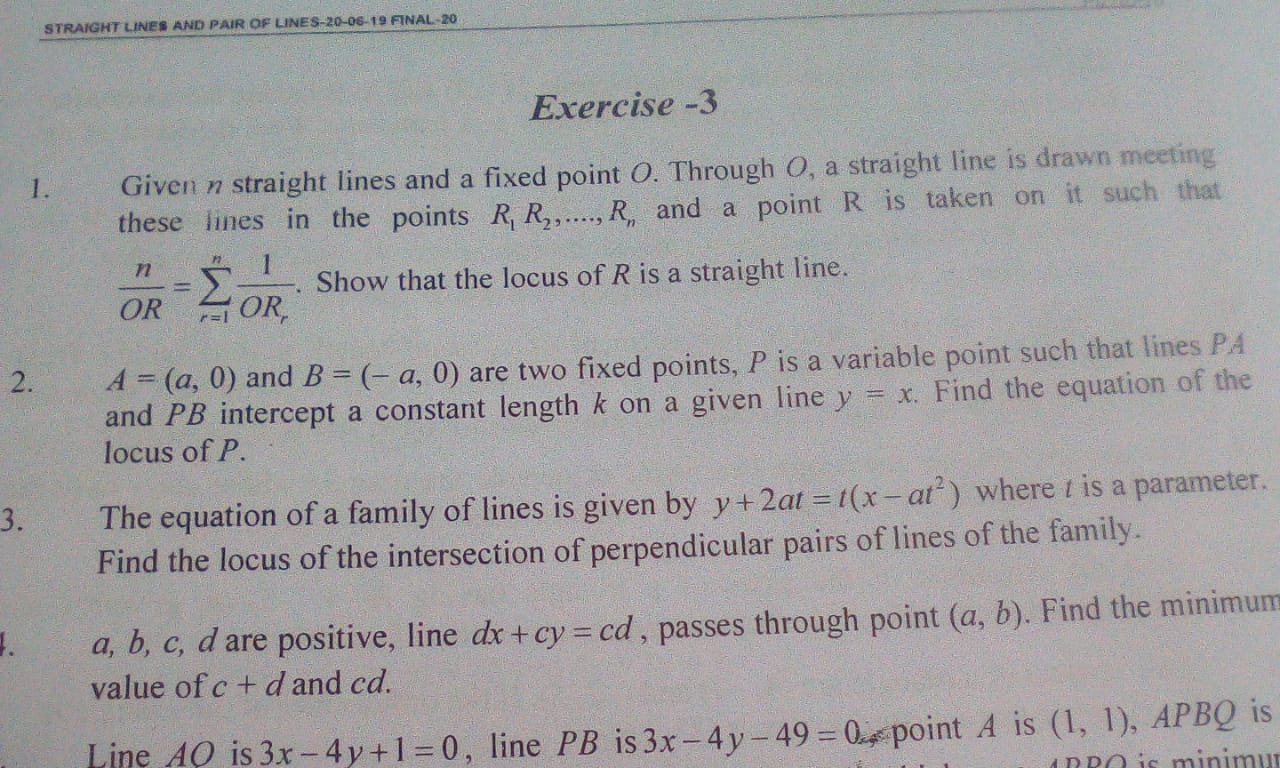
Please sir i dont understand question 2I unable to find ans2root2a(x-y)y =k[a² -(x-y)²]
Please sir i dont understand question 2
I unable to find ans
2root2a(x-y)y =k[a² -(x-y)²]


 Approved Tutor Answer1 Year ago
Let's break down the equation you've provided: \(2\sqrt{2a}(x-y)y = k[a^2 - (x-y)^2]\). It looks like you're dealing with a relationship that involves variables \(x\), \(y\), \(a\), and a constant \(k\). To find the answer to question 2, we need to isolate one of the variables or simplify the equation. Let's go through the steps together.
The equation can be seen as a balance between two expressions. On the left side, we have \(2\sqrt{2a}(x-y)y\), which involves the product of \(y\) and the difference \(x-y\). On the right side, we have \(k[a^2 - (x-y)^2]\), which is a constant multiplied by a difference of squares. This structure suggests that we can manipulate the equation to isolate one of the variables.
Step 1: Divide both sides by \(a^2 - (x-y)^2\) (assuming this is not zero):
\(k = \frac{2\sqrt{2a}(x-y)y}{a^2 - (x-y)^2}\)
This expression gives us \(k\) in terms of \(x\), \(y\), and \(a\). Each variable plays a crucial role in determining the value of \(k\). If you have specific values for \(x\), \(y\), and \(a\), you can substitute them into this equation to find \(k\).
Let’s say \(a = 1\), \(x = 3\), and \(y = 2\). We can substitute these values into our rearranged equation:
\(k = \frac{2\sqrt{2 \cdot 1}(3-2) \cdot 2}{1^2 - (3-2)^2}\)
Simplifying this gives:
\(k = \frac{2\sqrt{2} \cdot 1 \cdot 2}{1 - 1} = \text{undefined}\)
In this case, the denominator becomes zero, which indicates that the values chosen lead to a situation where \(k\) cannot be determined. This is an important aspect of working with equations: sometimes, the values you choose can lead to undefined results, so it's essential to consider the implications of your substitutions.
By rearranging the equation and understanding the relationships between the variables, you can find \(k\) or analyze how changes in \(x\), \(y\), or \(a\) affect it. If you have any specific values or further questions about this equation, feel free to ask!

Last Activity: 4 Years ago
Last Activity: 4 Years ago
Last Activity: 4 Years ago
Last Activity: 4 Years ago
Last Activity: 4 Years ago